Someone on the internet told you French takes three months. Someone else said ten years. Both of them are lying, and neither of them has ever met you.
Here is the honest version: how long to learn French depends on three numbers — your starting point, your weekly hours, and what you mean by "learn". Change any one of them and the timeline moves.
What you will get from this guide
- Realistic hour bands for each CEFR level, from A1 to B2
- A week-by-week map of what progress actually looks like
- The five things that slow French learners down most
- How to pick a target that fits your actual calendar
The Two Things People Mean by "Learning French"
Ask a stranger and they picture ordering coffee in Paris. Ask a DELF examiner and they picture a two-hour written paper. These are not the same goal — and they do not cost the same time.
Roughly, the French-learning world splits into three missions:
If you do not pick one, you will drift for years and finish none of them.
Hours, Not Months: The Real Currency
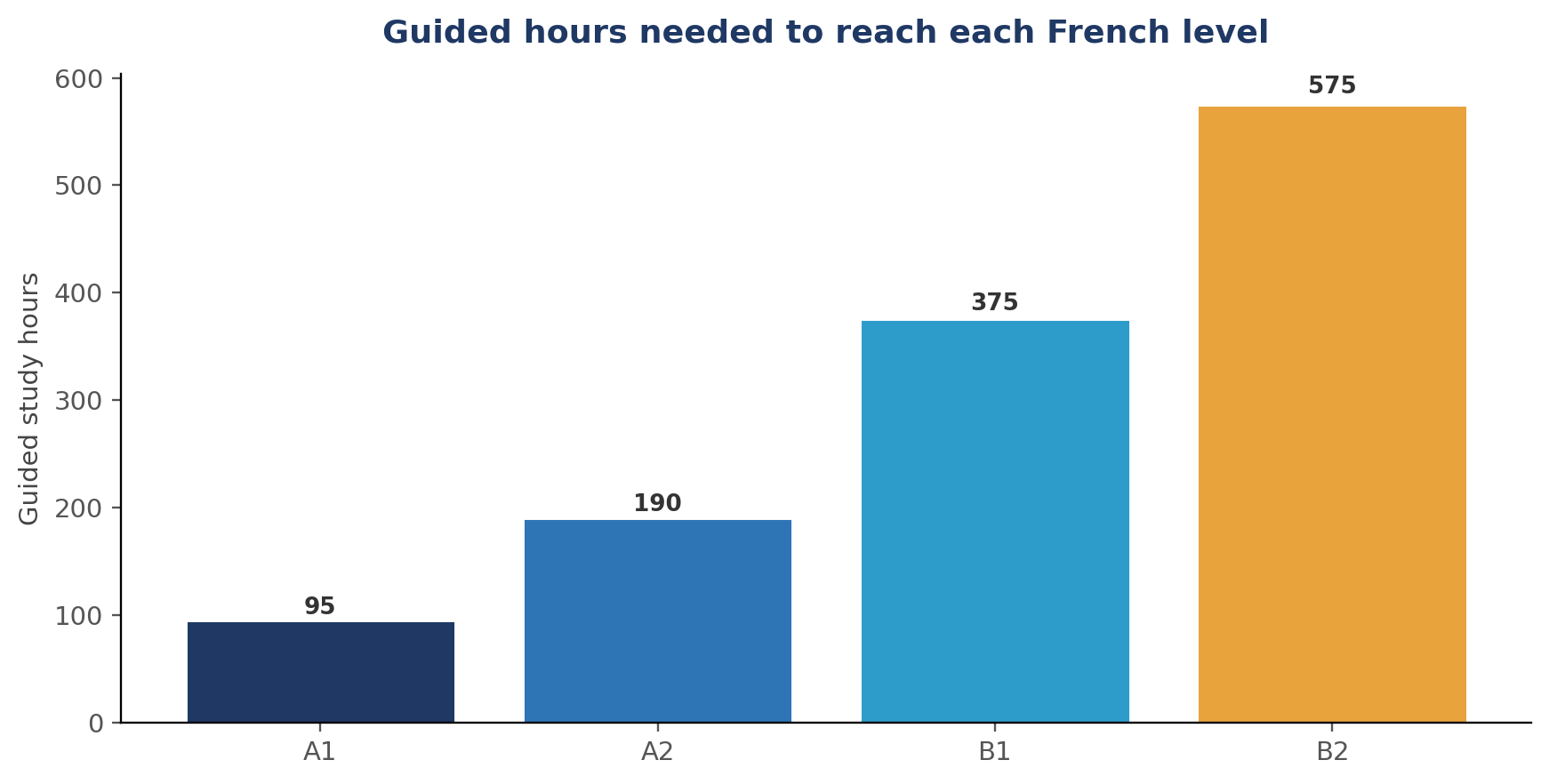
Months are a marketing unit. Hours are a fact. The CEFR hour bands below are planning estimates used across European language schools, and French sits in the moderate band — harder than Spanish for English speakers, easier than German or Russian.
Those numbers assume guided instruction plus homework. Self-study without feedback tends to run 40–60% longer, mostly because errors calcify quietly.
The Timeline Table You Actually Came For
Now the same hours, expressed at real weekly pace. This is where most people discover their plan is fantasy.
Notice what that table says. Doubling your hours does not halve the calendar — but it changes it more than any app, any method, any magic deck of flashcards.
Your timeline needs a coach, not another app
An AI voice tutor hears the errors you cannot hear yet and fixes them in week two instead of year two. Self-paced lessons, real feedback, and a plan sized to your calendar.
See French courses →Create a free accountWhat Progress Actually Feels Like, Week by Week
The first month feels like flying. The third month feels like drowning. That is not failure — that is the plateau, and it is scheduled.
The Wall is where 70% of learners quit, and it is entirely predictable. Plan for it and it stops being scary.
Five Things That Steal Your Years
French is not slow. These are:
- Switching methods every three weeks. Each restart costs you the last one.
- Never speaking until "ready". Ready never arrives. Speak in week one, badly.
- Reading about grammar instead of using it. Grammar is a tool, not a hobby.
- Learning vocabulary in isolation. Words without a scene die fast.
- Zero listening practice. French elides words; ears learn what eyes cannot.
Fix even two of these and your timeline compresses by months.
Does Age or Talent Change the Number?
Less than the internet claims. Adults usually outpace children at grammar and vocabulary early on because they study deliberately. Children win at pronunciation over years, not months.
The real variable is not your brain. It is whether you show up on a Tuesday when nothing is fun.
A Timeline You Can Actually Keep
Pick your level. Pick your weekly hours from the table above. Multiply. Then subtract ten percent, because life happens, and add a coach, because feedback is the accelerator.
For most working adults, ten guided hours a week for nine months is the realistic route to B1 — the level where French stops being a subject and becomes a tool.
Nine months. One level. Real French.
Stop guessing how long it takes and start counting the weeks instead. Start a self-paced course at your level and let an AI voice tutor keep you honest.
Start your French plan →Create a free accountFrequently Asked Questions
Can I learn French in three months? To A2-level travel French, yes — with intensive hours and an AI voice tutor. To B2 or workplace fluency, no. Anyone promising full fluency in three months is selling you a feeling, not a skill.
Is French harder than Spanish? A little. French spelling is less phonetic and its pronunciation packs sounds English does not have. Expect roughly ten to fifteen percent more hours than Spanish, not double.
Do I need to live in France to learn? No. Immersion helps most at B1 and above, when you can already hold a conversation and absorb corrections. Before that, structured self-paced lessons do more per hour.
How many hours a day should I study? Twenty to forty minutes daily beats three hours on Sunday. Spacing wins because memory consolidates between sessions, not during them.
References & Further Reading
- Council of Europe — Common European Framework of Reference for Languages (CEFR), level descriptors
- France Éducation international — DELF and DALF official exam level guides
- Alliance Française — standard French course hour allocations per level
- Institut national de la statistique et des études économiques (INSEE) — French language use data
- Cambridge University Press — research on foreign language learning hours for English speakers
Ready to stop researching and start speaking? Compare levels, pick a weekly rhythm, and let an AI voice tutor turn your timeline into a finish line at languageskills.net/french.