Thirty days will not make you fluent in French. Anyone who promises otherwise is selling you a feeling, not a language. But thirty days will take you from silent to speaking — ordering, greeting, asking, apologising, surviving — and that transformation is real, fast and genuinely worth chasing.
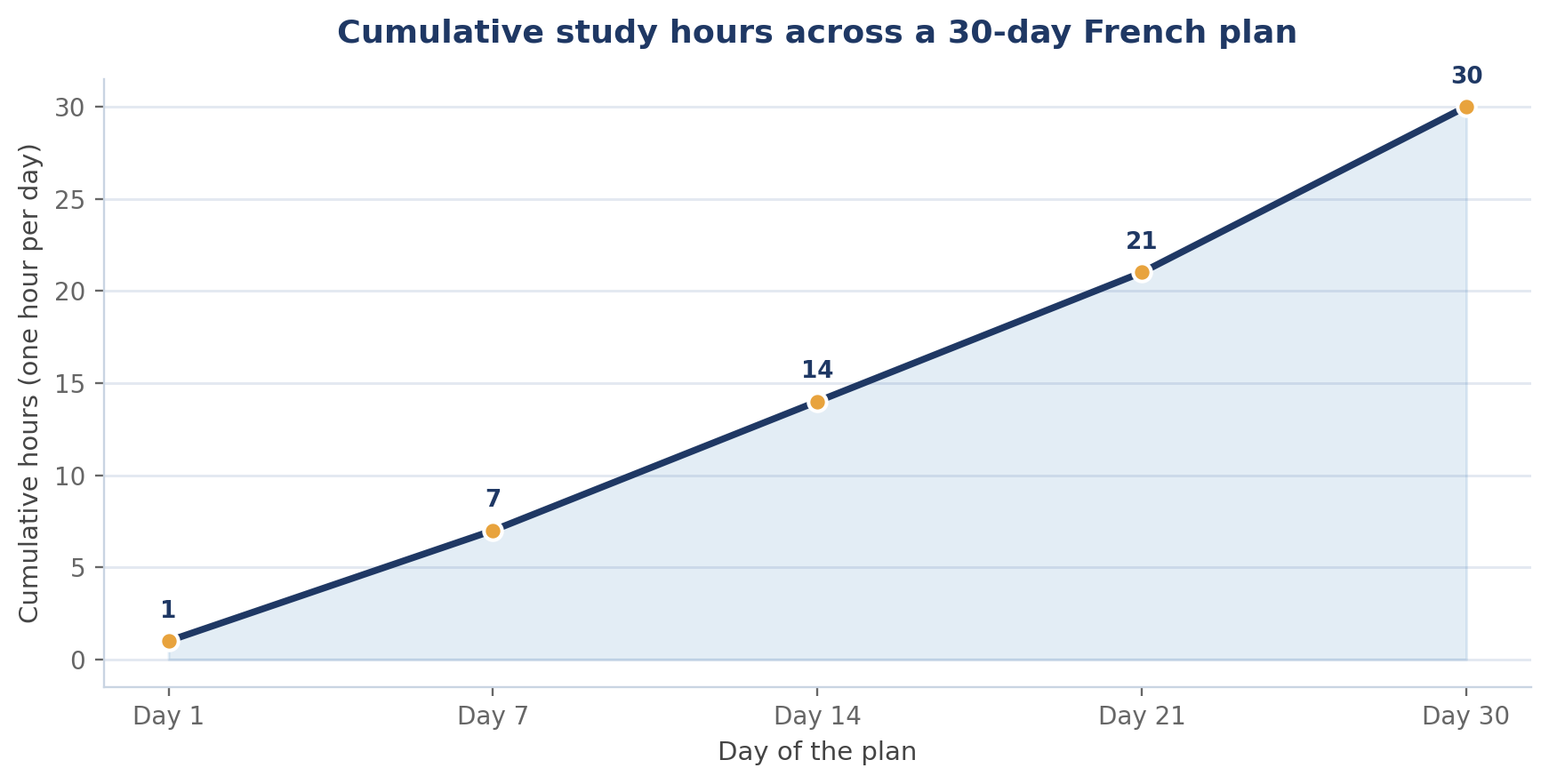
Here is the honest version: a month of focused work buys you about 30 to 40 hours of study and lands you somewhere around A1, with a vocabulary of 300 to 500 words. Small on paper. Enormous in a Paris bakery.
What you will get from this plan
- A week-by-week structure with a daily sixty-minute split
- The exact phrases you should own by day 30
- What thirty days can and cannot deliver
- The four habits that decide whether the month works
What 30 days of French actually buys you
The daily sixty minutes
Consistency beats intensity. Sixty minutes a day, every day, outperforms three hours twice a week — because language memory is built by frequency of return, not by volume.
If you only have thirty minutes some days, cut the writing and the listening. Never cut the speaking. Speaking is the one part you cannot fake later.
Week 1: sound and survival
Your first week is not about grammar. It is about the mouth. French pronunciation has rules, and learning them early saves months of repair later.
Skip the year of guessing — start speaking French in week one
Thirty days work best with a personal AI voice tutor. A Course Pass gives you structured lessons, speaking practice with AI feedback and corrections that land while the habit is still forming.
Start your 30-day French plan →Create a free accountWeek 2: food, numbers, real-world French
Week two is where French stops being theory. Cafés, bakeries and shops are the perfect classroom because the vocabulary repeats and the stakes are low.
Learn numbers out loud, in pairs, walking around your home. French numbers in the seventies and nineties are famously strange — soixante-dix, quatre-vingt-dix — and only repetition makes them automatic.
Week 3: questions and directions
Ask a question and you own a conversation.
Practise the question, then practise understanding the answer. Learners often prepare the question perfectly and freeze at the reply. That is why speaking practice matters: you have to respond to unpredictable prompts.
Week 4: putting it together
The final week is consolidation and courage. Record yourself speaking for one minute on day 22, then again on day 30. The difference will be larger than you expect, and it is more motivating than any badge.
Finish the month able to speak, not just able to study
The last week is where learners either break through or quietly stop. Structured AI-tutor sessions keep you accountable and turn your thirty days of input into thirty days of actual French.
Start your French course →Create a free accountThe four habits that decide the outcome
Do it daily, even badly. A ten-minute session on a bad day protects the habit.
Speak from the first hour. Silent study builds recognition; speech builds fluency.
Correct on a schedule. Collect errors during the week, fix five of them on Sunday.
Use one resource per skill. One vocabulary app, one listening source, one tutor. Resource-hopping feels productive and achieves nothing.
Frequently Asked Questions
Can I really learn French in 30 days? You can reach confident survival French at around A1 level — greetings, ordering, directions and simple conversation. Fluency is a longer project, typically nine to fourteen months to B1.
How many hours a day do I need? One focused hour is enough for this plan. Two hours will accelerate vocabulary, but only if the speaking component scales with it.
Will I forget everything after thirty days? You will lose ground if you stop entirely. Two maintenance sessions a week — one speaking, one listening — preserves nearly everything.
Is an app enough for this plan? Apps handle vocabulary and listening well, but they cannot correct your speaking. Pair an app with at least one weekly speaking practice session.
References & Further Reading
- Council of Europe — CEFR A1 level descriptors
- Institut français — French courses and learning resources
- RFI — Journal en français facile, daily slow-news audio
- Académie française — Answers on French usage and spelling
- TV5Monde — Apprendre le français with free exercises