You do not need three free hours and a lavender-scented study. You need fifteen honest minutes, a plan that fits inside them, and the discipline to show up. That is the entire secret behind French for busy people — and it is a very good secret.
Let us be blunt: the reason most adults fail at French is not talent. It is scheduling fantasy. They promise themselves ninety minutes a night, miss it once, miss it twice, and quit by Thursday. Fifteen minutes a day does not require motivation. It requires a calendar.
Why 15 Minutes a Day Beats the Weekend Marathon
Cramming is the enemy of fluency. Your brain consolidates language during sleep and repetition, not during a heroic Sunday session you will dread by Monday. Short, frequent contact with French keeps vocabulary warm and keeps your ear tuned.
Notice the surprise in that table: the daily plan asks for less total time than the marathon — and it works better. Consistency wins. Every time.
The 15-Minute French Routine That Actually Works
Split your quarter hour into three tight blocks. No block lasts longer than six minutes, because attention is the scarce resource, not time.
That is it. Review, input, output. You have now touched French in all three directions in a single sitting — and you never once opened a textbook that made you sigh.
Making Micro Learning French Stick
Micro learning is not about doing less. It is about doing smaller pieces more often. Here is how to make tiny sessions punch above their weight.
The pattern is unmistakable. The learners who make it are not the ones with the most free time — they are the ones who refuse to let a day pass without contact. Fifteen minutes is enough to keep the chain unbroken. And an unbroken chain is what fluency is made of.
Your Fifteen Minutes, Fully Scripted
Stop wondering what to study today — the French Course Pass hands you a ready-made daily plan, audio, and drills that fit inside your quarter hour.
Start my 15-minute French plan →Create a free accountBuilding the Habit Without Willpower
Willpower is a terrible long-term strategy. Systems are better. Anchor your fifteen minutes to something you already do every day — coffee, the train, the kettle boiling — and you stop negotiating with yourself.
Pick exactly one. Stacking two new habits at once is how good intentions die. One anchor, one slot, one week. Then repeat.
And if you miss a day? Miss it gracefully. The rule among people who genuinely succeed is simple: never miss twice. A single gap is noise. Two gaps is a pattern. Guard against the pattern, not the gap.
Sample Week: What 15 Minutes Looks Like
Here is a full week so you can stop planning and start doing. Note how modest each day is — that is the point.
Seven days, under two hours total, and every core skill touched. This is what "French for busy adults" actually looks like in practice — unglamorous, repeatable, and quietly effective.
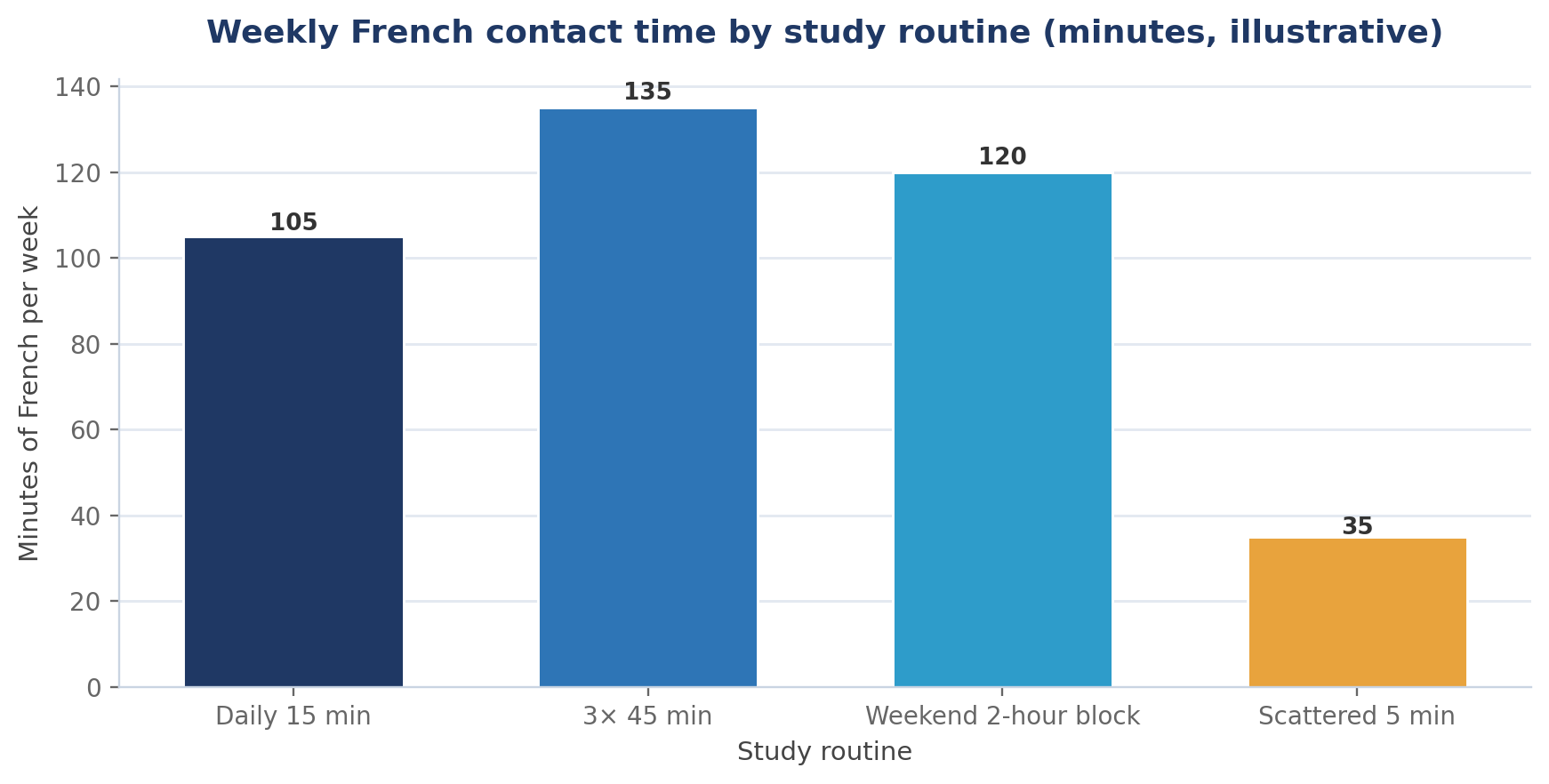
Weekly Contact Time: The Honest Picture
Before you decide fifteen minutes is "too small," look at what each routine really asks of you per week. The numbers below are illustrative weekly totals for each routine, not measured outcomes — the takeaway is the shape, not the decimal.
Common Traps That Kill the 15-Minute Habit
A few honest warnings, because knowing the potholes saves you the fall.
Every trap above is a habit problem, not a knowledge problem. Fix the habit and the French follows.
How to Know It Is Working
Progress in language learning is famously hard to feel, so measure it deliberately. Once a week, on your ten-minute Sunday test, check three things: can you recall yesterday's words unprompted, can you say two sentences without notes, and can you understand a short clip better than last month?
If you can tick two of those three, you are on track — regardless of how slow it feels. Fluency is built from hundreds of unremarkable fifteen-minute days, not from a single dramatic breakthrough.
Built for People With No Time
The French Course Pass is designed for exactly fifteen minutes a day — short lessons, instant feedback, and a streak you will want to protect.
Get the French Course Pass →Create a free accountReady to make it official? Create your free account and let the quarter hour do what the marathon never could.
Frequently Asked Questions
Is 15 minutes a day really enough to learn French? For steady progress toward conversational French, yes — provided it is daily and you include speaking. Studies of spaced practice consistently favor short, frequent sessions over long, rare ones. For exam deadlines or fast-track fluency you will likely want more, but fifteen minutes is a genuinely effective maintenance and growth floor.
What if I miss a day? Miss it once and move on. The working rule is never miss twice. A single gap has almost no effect on retention; two in a row starts a habit of quitting.
Should I use apps, courses, or a tutor for my fifteen minutes? All three can work. Apps shine for vocabulary and streaks, structured courses give you sequence and feedback, and tutors push real speaking. Most successful self-learners combine a course backbone with audio on the go. You can pair this routine with a structured plan like the French Course Pass.
Can busy adults with zero time still make progress? Yes, but you must convert existing dead time — commutes, queues, kettle-boiling — into French time rather than hunting for new free hours. Micro learning works precisely because it does not demand a new slot in your day.
References & Further Reading
- Council of Europe — Common European Framework of Reference for Languages (CEFR)
- BBC — Learning a language in short daily bursts
- Alliance Française — Learning French resources and guidance
- Cambridge University Press — Research on spaced practice and vocabulary retention
- TV5MONDE — Free French listening and learning exercises