Ask a hundred beginners if French is hard and ninety will nod. Then ask them why. Most will mumble something about silent letters, shrug, and change the subject. That is the tell. French is not a hard language. It is an unfamiliar one, and unfamiliarity is a problem you can solve with a plan, not a gift.
What you will get from this guide
- A straight verdict on French difficulty, backed by the US Foreign Service Institute hour bands
- The five features that genuinely slow learners down, and what to do about each
- A realistic CEFR timeline so you stop guessing how long it takes
- Quick pronunciation wins you can bank in your first week
The honest verdict: unfamiliar, not hard
The US Foreign Service Institute groups languages by how long its diplomats need to reach professional working proficiency. French sits in Category I — the easiest bracket, alongside Spanish, Italian and Dutch. That band is roughly 600 to 750 classroom hours. For context, German needs about 900, and Japanese or Mandarin need around 2,200.
So the raw maths says French is friendly. What trips learners is not volume. It is shape. English and French share a huge chunk of vocabulary — nearly a third of English words arrived from French after 1066 — but they disagree about how words should behave in a sentence. That gap is where the difficulty lives.
The five things that actually bite
Silent endings. French writes far more than it says. Parles, parle, parlent all sound identical. Your ear must lead your eye, not the reverse.
Grammatical gender. Every noun is masculine or feminine, and the article changes with it: le, la, un, une. There is no logic to memorise — only patterns to absorb.
Liaison and elision. Words glue together in speech. Vous avez becomes vou-zavé; le ami becomes l'ami. Native speakers do this automatically, which makes fast French sound like one long word.
Verb conjugation. Fewer tenses are used in daily speech than textbooks suggest, but the common ones change form for every subject.
Spelling versus sound. One sound, many spellings: the /o/ sound appears in beau, bateau, chaud and sot. Dictation is a genuine skill, not a formality.
How long does French actually take?
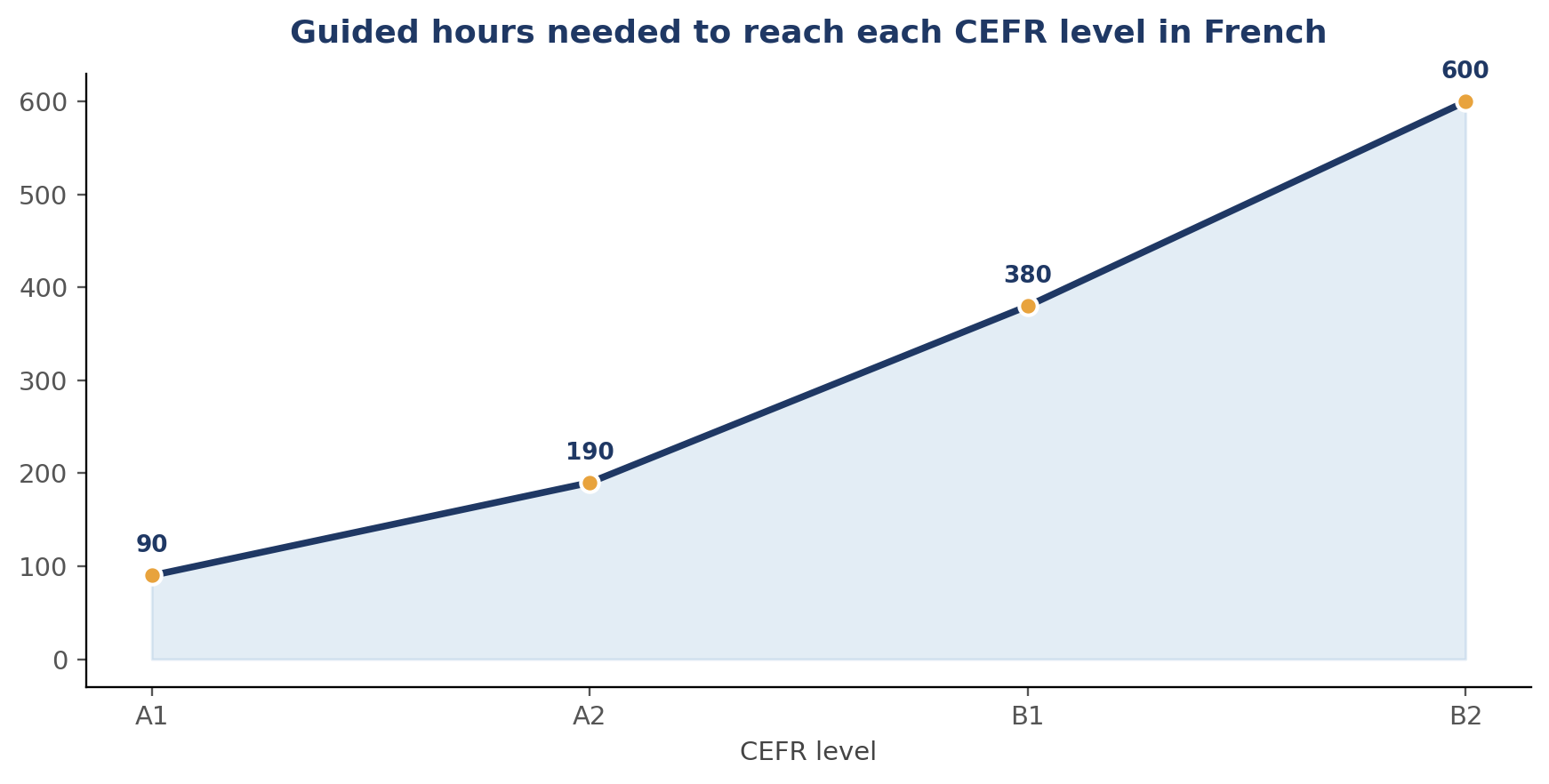
Ignore the ads promising fluency in a month. Here is what guided study usually delivers, assuming steady weekly practice and regular feedback that corrects you.
Stop guessing your French timeline — get a personal AI voice tutor who knows it
A generic app cannot hear your vowels drift or catch the gender slip you keep repeating. A personal AI voice tutor does, from your very first lesson. Your Course Pass gives you structured A1–B2 lessons, speaking practice with AI feedback, and correction on demand — at your own pace, any time.
Start your French course →Create a free accountHow to make French easier: six moves that work
Difficulty shrinks the moment you stop studying French like a museum piece and start using it like a tool.
The single biggest accelerator is feedback. Learners who practise alone plateau at A2 and stay there for years, quietly inventing their own pronunciation. Learners who get structured speaking practice with regular AI feedback progress faster, because every session starts with a correction they did not expect.
Pronunciation wins you can bank in a week
Say bateau fifty times, then château, then gâteau. You have just learned a rule that unlocks dozens of words. French rewards pattern-hunting like this far more than brute memorisation.
Turn rules into reflexes with a personal AI voice tutor
Knowing a rule and using it under pressure are two different skills. Practise the second one with a personal AI voice tutor who will not let a lazy /ɛ/ slide.
Start learning French →Create a free accountFrequently Asked Questions
Is French harder than Spanish? Slightly, for most English speakers. Spanish spells what it sounds, while French hides its sounds. But both sit in the same FSI band of roughly 600–750 hours, so the difference is small compared with choosing German or Japanese.
Can I learn French in three months? You can reach a confident A1 or low A2 in three months with daily practice. True conversation, where you handle unpredictable topics without stalling, is a B1 skill and usually takes longer.
Do I need to learn grammar to speak French? You need the six tenses people actually use and a feel for gender. That is a shorter list than most textbooks imply, and it is best absorbed through speaking, not conjugation drills.
What is the hardest part of French? Understanding natural speech at full speed. The fix is unglamorous: daily listening and weekly speaking, not more grammar exercises.
References & Further Reading
- US Department of State, Foreign Service Institute — Language proficiency categories and expected training times
- Council of Europe — Common European Framework of Reference for Languages (CEFR)
- Académie française — Questions fréquentes sur la langue française
- Institut français — Learn French resources and courses
- RFI — Journal en français facile (daily slow-news broadcast)