French can cost you nothing at all. It can also cost more than a used car. Both statements are true, and neither is useful on its own. What matters is where the money actually changes the outcome — because in language learning, spending well is far more effective than spending a lot.
This breakdown compares the real options, the honest results each delivers, and the budget that produces the best return.
What you will get from this guide
- Every realistic cost route, from free to immersion
- What each route actually delivers
- Where spending money creates the biggest jump
- Three sample budgets, from lean to serious
The routes, compared
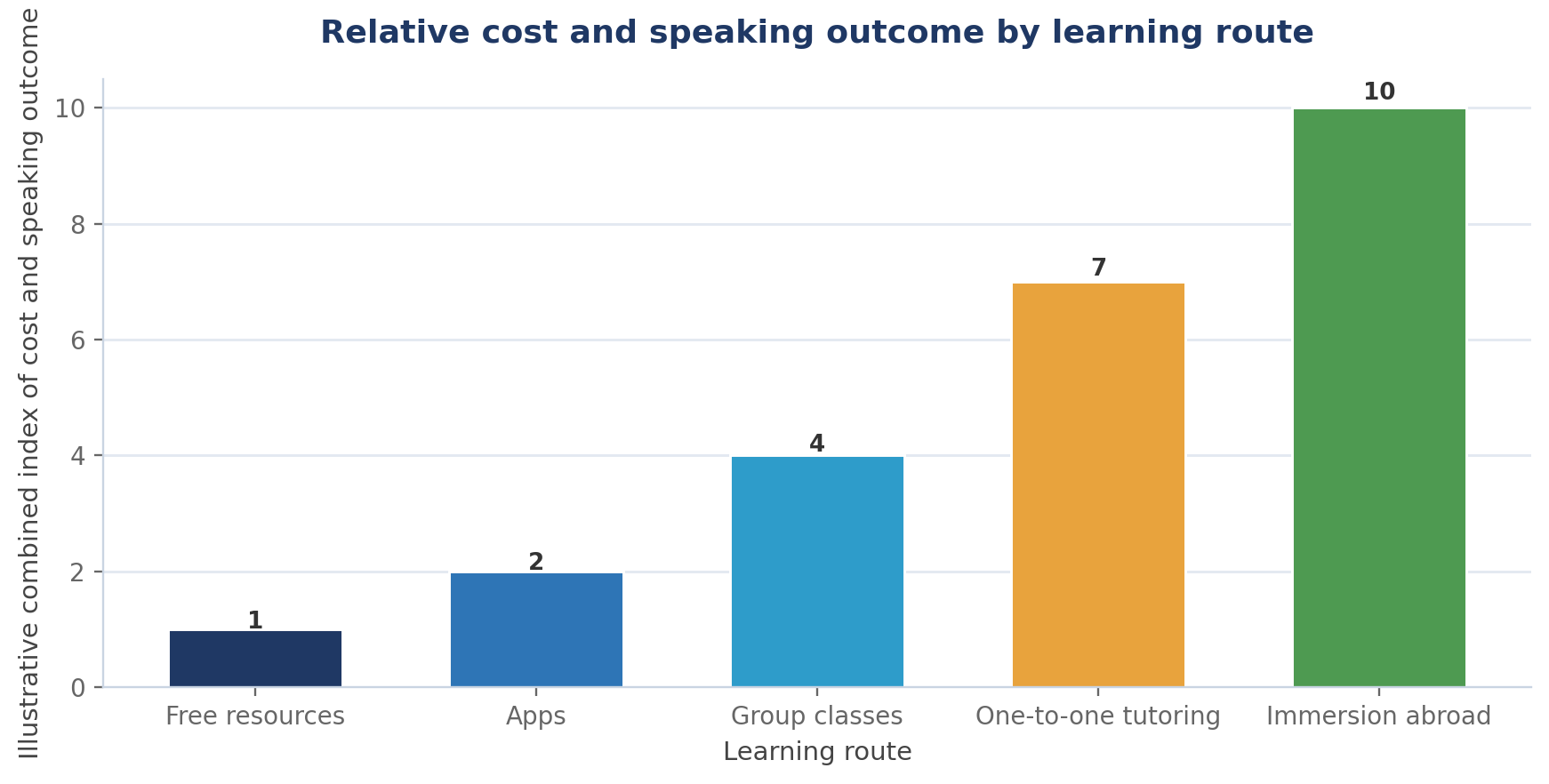
Costs vary enormously by country, provider and format, so treat the rankings as relative rather than absolute. The pattern, however, is remarkably stable: money buys correction and speaking time, not information.
What free actually gives you
This is not a consolation prize. The free ecosystem for French is genuinely strong.
A disciplined learner can reach A2 almost entirely for free. What free resources cannot provide is feedback — no one tells you that your vowels are drifting or that you are misusing a tense consistently.
Where spending money actually helps
Notice that every row is about human interaction. Buying more content — another course, another app, another textbook — rarely changes outcomes. Buying correction does.
Spend where it changes the result: speaking and correction
A Course Pass (French) gives you a personal AI voice tutor for structured lessons and speaking practice with feedback, which is the single highest-return investment in language learning. Not more content — better feedback.
Compare French course options →Create a free accountThe hidden costs people forget
That last row deserves attention. A learner who starts, quits and restarts three times has spent more money and far more time than a learner who paid for structured teaching once. Cheap methods that get abandoned are the most expensive thing in this table.
Three sample budgets
The balanced budget is the sweet spot for most learners. It uses free and cheap tools for volume — vocabulary, listening, reading — and pays for the one thing that money uniquely buys: a person who listens and corrects.
Is immersion worth the price?
Immersion accelerates everything, and it is genuinely the fastest route if you can afford it. But be honest about the danger.
Immersion without speaking practice is just an expensive holiday with better groceries. It works best after you already have A2, so you can actually use what surrounds you.
How to cut costs without cutting results
The logic is consistent: keep the cheap channels for volume and use your budget exclusively on interaction.
A budget that buys progress, not content
A self-paced AI voice tutor concentrates your spending exactly where it counts — speaking, correction and accountability — instead of another library of resources you never finish.
Start your French course pass →Create a free accountFrequently Asked Questions
Can I learn French for free? Yes, to around A2 with discipline, using free audio, reading and language exchanges. Progress slows after that without feedback on your speaking.
How much do French lessons usually cost? Prices vary widely by country and format — self-paced lessons are cheaper per hour, one-to-one tutoring costs more but delivers faster speaking progress. Always compare per hour of speaking time.
Is it worth paying for a tutor? If your bottleneck is speaking or your errors keep repeating, yes. Tutoring is the most efficient way to buy correction.
What is the cheapest effective approach? Combine free resources for vocabulary and listening with one paid weekly AI tutor session. That balance outperforms either free-only or expensive-only strategies.
References & Further Reading
- Institut français — French courses and learning resources
- France Éducation international — DELF and DALF examination fees and information
- TV5Monde — Apprendre le français: free exercises by level
- RFI — Journal en français facile, daily slow-news audio
- Council of Europe — CEFR levels and descriptors