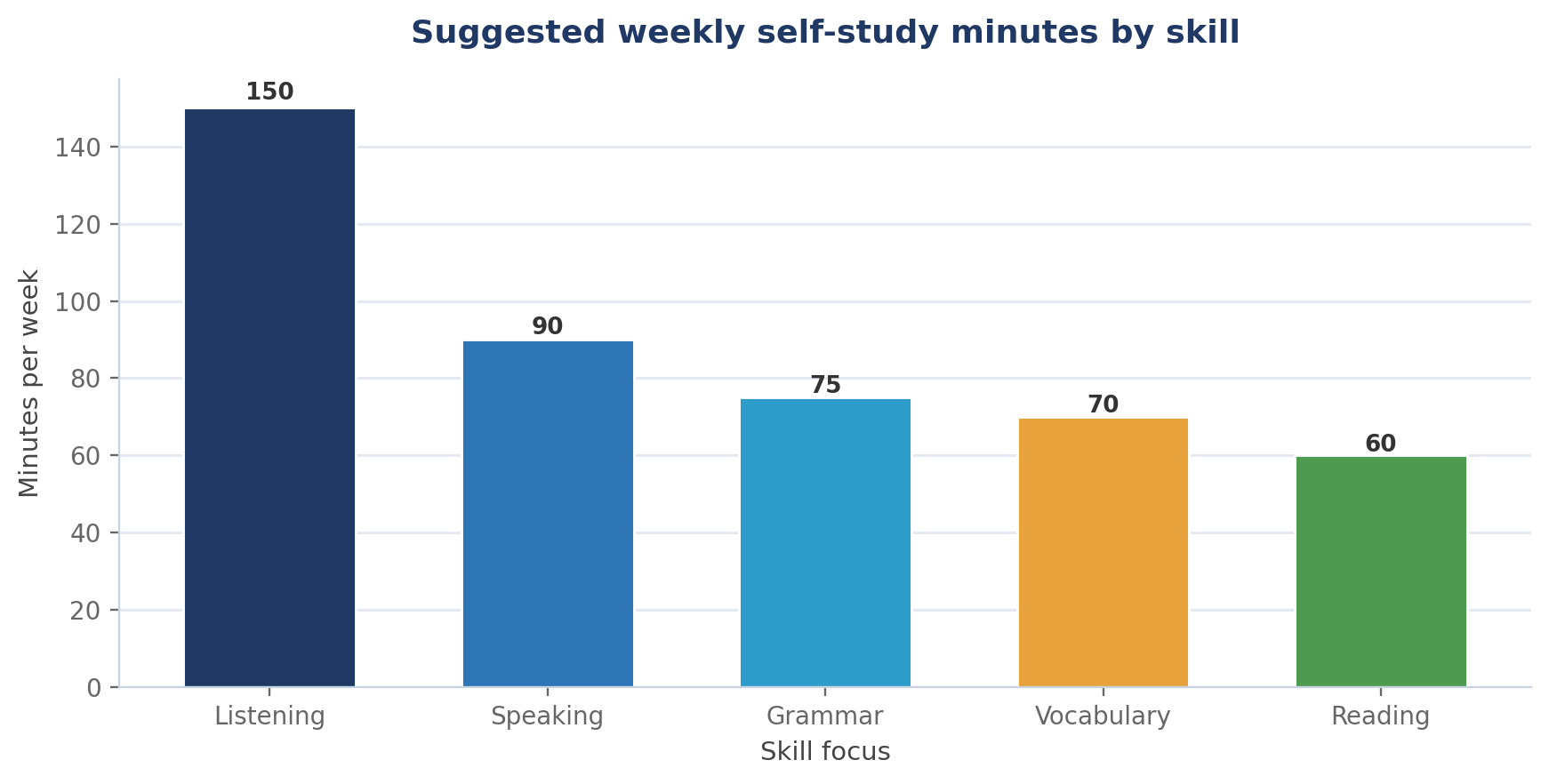
Self-study is not the cheap version of learning French. Done properly, it is faster than a bad class — no waiting for the slowest student, no wasted hour, no tuition invoice you resent. Done badly, it is eighteen months of app notifications and no ability to order a coffee.
The difference is structure. This roadmap gives you the order of operations, the honest limits of working alone, and the one thing that self-study cannot supply.
What you will get from this guide
- A five-stage self-study roadmap, from zero to conversational
- The study order that prevents wasted months
- How to practise speaking without a partner
- The honest limit of self-study, and what to do about it
Stage 1: sounds before words
Most learners skip pronunciation. It is the single most expensive shortcut in French, because French spelling and French sound have a complicated relationship, and unlearning a bad accent takes far longer than learning a good one.
Spend two weeks here. Learn the nasal vowels, the silent endings, the liaison rules, and the difference between the u in tu and the ou in tout. Say everything aloud from the first day.
Stage 2: the grammar order that works
Grammar alone is fine — but only in the right sequence. Learn the highest-frequency structures first and you can say real things within weeks.
Study one topic, then immediately write five sentences about your own life using it. Grammar that never touches your biography evaporates inside a week.
Stage 3: vocabulary that sticks
Learn une décision, not just décision. Learn prendre une décision, not just une décision. Phrases are the unit of fluency.
A roadmap is only as good as the feedback you get
Self-study supplies content; it does not supply correction. An AI voice tutor tells you exactly which sound, tense or gender is holding you back — usually in the first session.
Add AI voice practice →Create a free accountStage 4: practising speaking without a partner
This is where most solo learners stall. There is no one to answer, so they read silently and call it study. Here is how to practise speaking alone, honestly and effectively.
Recording is uncomfortable and non-negotiable. Your ear forgives your accent while you are speaking; the recording does not.
Stage 5: real input, real speed
Once you can handle short texts, move your listening to natural speed. Start with slow-news broadcasts, then move to podcasts for learners, then to native content. Keep subtitles off for the second listen — always.
Where self-study stops working
There is one thing you cannot do alone, and it is the most important thing in the language: notice your own errors in real time. You cannot hear the gender slip you make consistently, the vowel that drifts, or the tense you reach for when you should reach for another.
That is why most successful self-taught learners eventually add a feedback element — an AI voice tutor, a partner or a class. Not because they failed, but because a roadmap needs a mechanic. You can start with a free account and add AI voice sessions when you hit that wall.
Keep your roadmap, add a voice tutor
A Course Pass (French) slots into the plan you already have, supplying the one thing self-study cannot: an AI voice tutor that notices your mistakes before they become permanent.
Get your French course pass →Create a free accountThe four-week check-in
Every four weeks, ask three questions. Which skill improved? Which stalled? What single change would fix it? Then change one variable only. Sustainable progress looks boring from the inside and impressive from the outside.
Frequently Asked Questions
Can I really learn French by myself? Yes — self-study can take you to a solid A2 or B1, and with discipline beyond that. Most learners eventually add a tutor or conversation partner for speaking practice and correction.
How long does it take to learn French alone? With 30–60 focused minutes daily, many learners reach conversational B1 in roughly 8–12 months. Consistency matters far more than the total number of hours.
What should I study first? Pronunciation, the present tense of regular verbs, and noun gender with articles. Those three unlock most simple sentences immediately.
Do I need grammar if I just want to talk? You need less than a textbook suggests, but not zero. Basic tenses and pronouns prevent the plateau where learners can only talk about the present.
References & Further Reading
- TV5Monde — Apprendre le français: free graded exercises
- RFI — Journal en français facile, daily slow-news audio
- France Éducation international — DELF and DALF official examinations
- Institut français — French courses and learning resources
- Council of Europe — CEFR level descriptions