Dutch has an unfair reputation as "easy for English speakers". The vocabulary is friendly, the grammar looks familiar, and then you discover that a house is het huis, a door is de deur, and there is no rule that explains why.
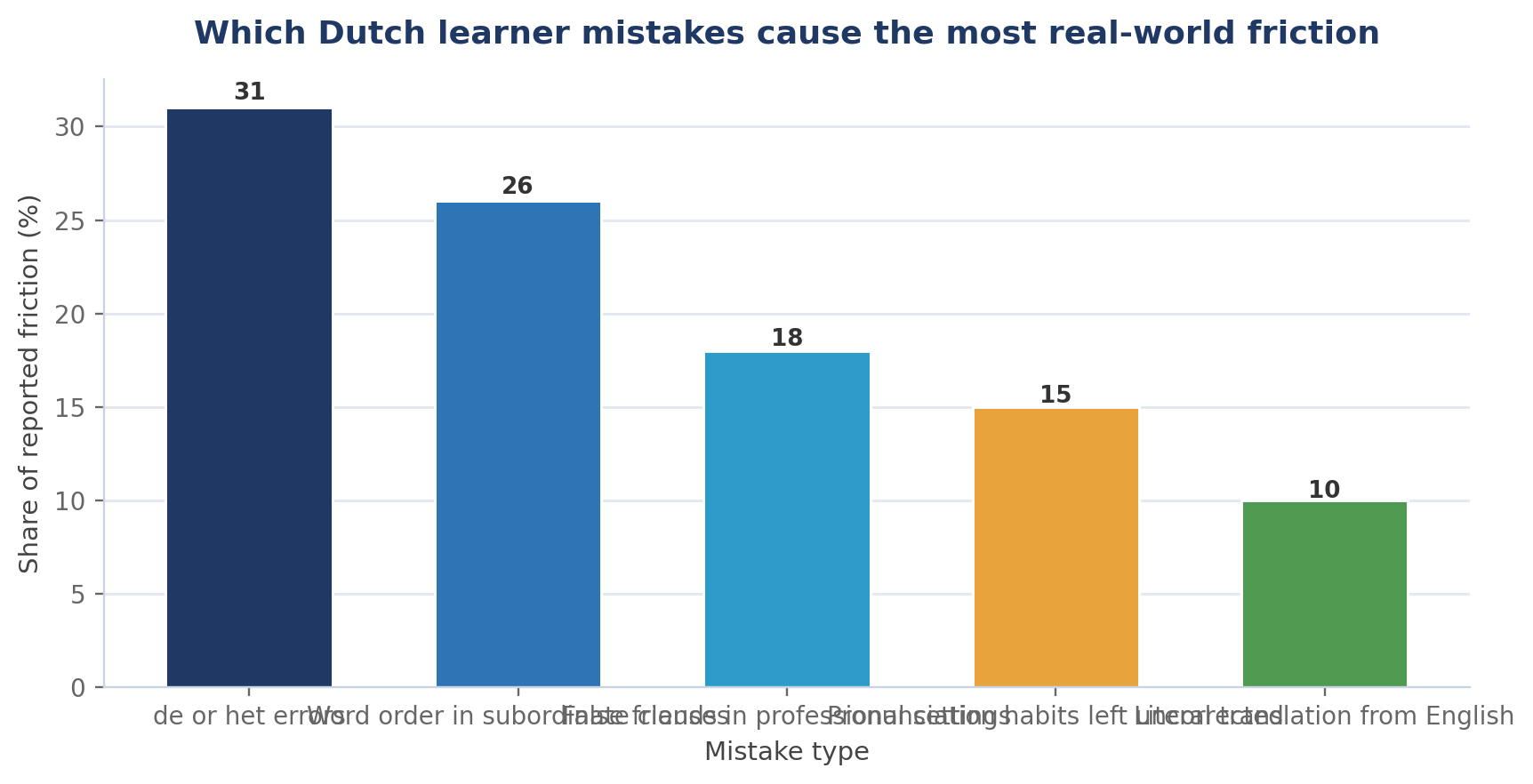
That friendliness is precisely the trap. Dutch is close enough to English that learners import English habits without noticing. Here are the mistakes that cause the most damage — ranked by how often they appear and how much they cost you.
What this guide covers
- The mistake almost every learner makes in week one
- Word order errors that make Dutch sound wrong
- False friends that embarrass you at work
- Pronunciation habits that never self-correct
- How to fix each one, concretely
Mistake 1: learning nouns without de or het
By far the most common, and the most expensive to fix later. Learners memorise huis, tafel, boek — then discover every one needs an article that cannot be guessed.
There is no shortcut. Learn the article with the noun, every single time, and the problem never arises. Learn nouns bare and you will be relearning hundreds of them in a year.
Two useful patterns soften the blow: around two-thirds of Dutch nouns take de, and every diminutive ending in -je takes het (het huisje, de tafel → het tafeltje).
Mistake 2: English word order
Dutch and English share a Germanic skeleton, but Dutch moves the verb in ways English does not. This is the error that most reliably marks a learner.
The one-line version: in Dutch, the second element is the verb, and subordinate clauses send the verb to the back. Read that twice and half of your word order errors disappear.
Mistake 3: false friends at work
Dutch is full of words that look English and mean something else entirely. In casual conversation they are funny. In a meeting they are costly.
Mistake 4: pronunciation habits that never self-correct
Most learners fix vocabulary mistakes because someone corrects them. Pronunciation errors often survive for years, because people can understand you and therefore never mention it.
That last row is worth pausing on. Dutch genuinely devoices final consonants, so hond sounds like hont. Learners often "correct" this and end up wrong — a rare case where trusting your ear beats trusting your intuition.
Mistake 5: translating in your head
Every learner does it at first, and everyone should stop as early as possible. Real-time translation is a bottleneck: you cannot listen and convert simultaneously, so conversation collapses.
The escape route is chunking — learning phrases as whole units rather than assembling them word by word.
Chunks arrive whole, which is exactly how native speakers produce them.
Fluency is not speed of thought. It is having the sentence already built before you need it.
Ready to turn reading into real Dutch? Start your self-paced course today.
Start the Dutch course →Create a free accountGet your mistakes corrected before they set
The hard truth about errors is that the ones you never notice are the ones that last. A personal AI voice tutor hears the de/het slip, the inverted verb and the flat ui — and fixes them while they are still fixable.
Button: Explore the Dutch Course Pass →
Mistake 6: studying Dutch without ever speaking it
Quiet study feels productive. It is not sufficient. Reading builds recognition; only speaking builds production, and they are separate skills with separate learning curves.
A useful rule: if a study session contained no out-loud Dutch, it was a half-session.
The fix list, in one table
Six mistakes, six fixes. Do the last one properly and the others solve themselves faster, because regular speaking practice with feedback beats a rule you read once.
Ready to turn reading into real Dutch? Start your self-paced course today.
Start the Dutch course →Create a free accountStart with a level check, not a guess
Most Dutch learners are one full band off in their self-assessment. A free account gives you an honest level check and a plan built around the errors you actually make.
Button: Create your free account →
Frequently Asked Questions
Is Dutch hard to learn? Dutch is one of the easier languages for English speakers, but its similarities create a specific trap: learners import English word order and never notice the errors.
**How do I remember de or het?** Learn the article with every noun from day one. Two shortcuts help: around two-thirds of nouns are de, and every -je diminutive is het.
What is the most common Dutch word order mistake? Putting the verb in the English position. In Dutch the verb is second in main clauses and moves to the end in subordinate clauses.
How long does it take to learn Dutch? With regular practice including speaking, most learners reach comfortable everyday Dutch in six to twelve months, depending on hours per week.
References & Further Reading
- Nederlandse Taalunie — Dutch language standards, usage and learning resources
- Nuffic — Dutch language requirements and study guidance
- NOS — Authentic Dutch listening material
- SLO — Dutch curriculum and language-level frameworks
- Council of Europe — CEFR levels and self-assessment descriptors