Most Dutch learning plans die the same death. Not from lack of motivation — from being designed for a version of you that does not exist. The one with two free hours and a quiet desk.
The routine below is built the opposite way. It assumes interruptions, tired evenings and weeks where everything goes wrong. And it still works, because it has a fifteen-minute floor you can always hit.
What you will get from this guide
- A 15-minute minimum routine and a 45-minute full routine
- What to do in each slot, and why it belongs there
- How to sequence vocabulary, listening and speaking
- The three habits that decide whether you actually continue
The mistake almost every learner makes
They front-load grammar. Six weeks of de and het rules, then they meet a Dutch person, freeze, and conclude they are "bad at languages".
The order should be the reverse of the textbook: sound first, words early, grammar as repair. You learn the rules to fix sentences you are already trying to say — not to build sentences you will never speak.
The 15-minute minimum routine
For days when life wins. Non-negotiable but genuinely small.
The last slot matters most. Three spoken sentences a day is fewer than 1,100 a year — and it is the difference between knowing Dutch and using it.
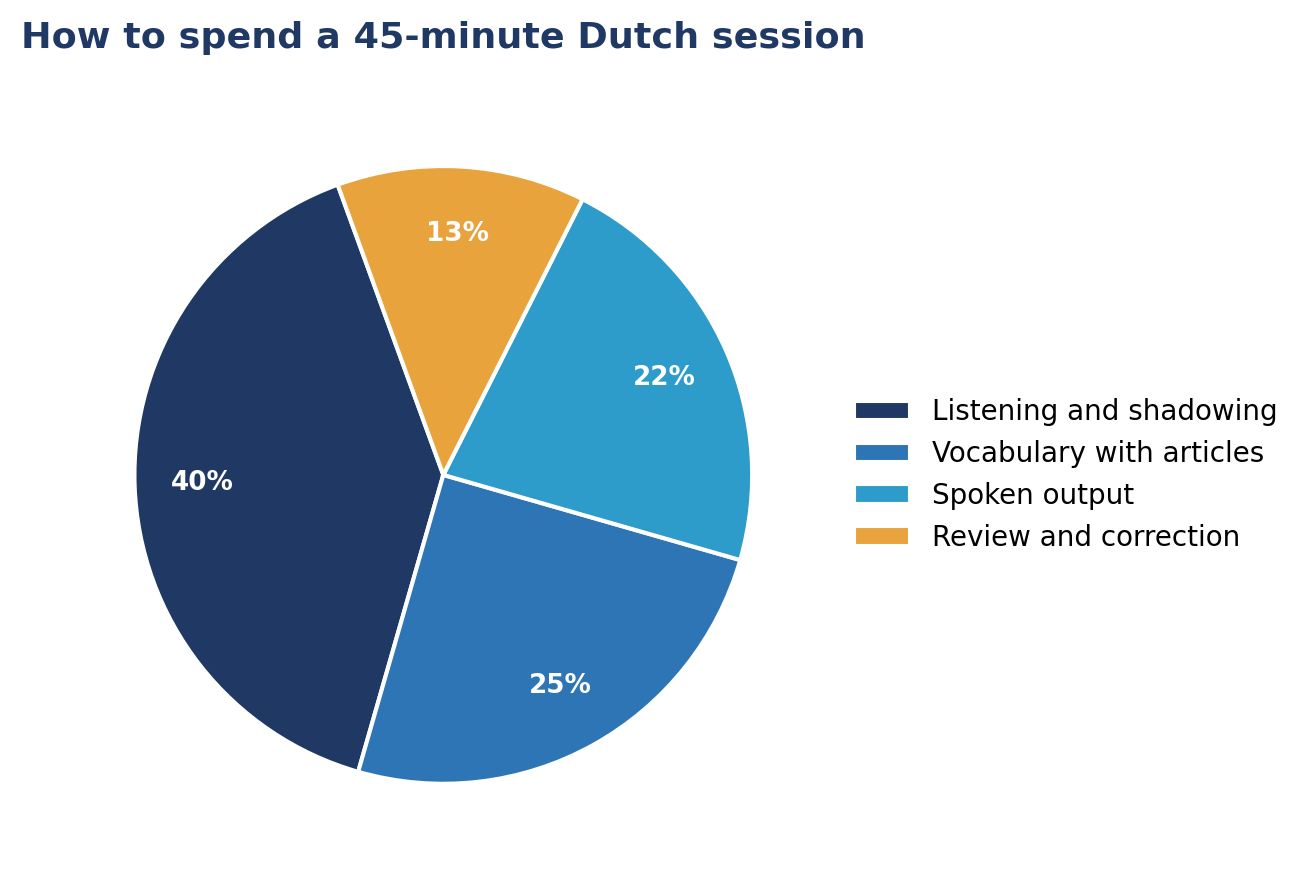
The 45-minute full routine
For normal days. Split it into two blocks if a single sitting is impossible.
Notice that grammar has no dedicated block. It enters through correction — when a sentence fails, you look up the rule, fix the sentence, and move on. That is how grammar sticks.
The weekly shape
Daily practice needs a weekly rhythm, or it flattens into the same comfortable activity over and over.
Speaking appears twice a week on purpose. Everything else supports it.
Three habits that decide your result
Habit one: always pronounce out loud. Silent study builds recognition, not speech. If you cannot say a word, you do not own it.
Habit two: learn every noun with its article. Het huis, not huis. Dutch gender is not guessable, and unlearning a bare noun later is far harder than learning it correctly once.
Habit three: keep a failure list. Every time you are corrected or stuck, write the sentence down. This list becomes your syllabus — the most personal, efficient one you will ever have.
Ready to turn reading into real Dutch? Start your self-paced course today.
Start the Dutch course →Create a free accountLet a personal AI voice tutor keep you honest
A routine works right up until the week you skip it. A personal AI voice tutor gives you structured lessons you can study at your own pace, any time, and hears the de/het slip before it becomes permanent.
Button: Explore the Dutch Course Pass →
Adapting the routine to your real life
The principle underneath is simple: never let a day be zero. A three-minute review keeps the chain alive, and the chain is what carries you to B1.
Free, authentic listening material is everywhere once you know where to look: NOS for news, NPO for programming, and the Nederlandse Taalunie for guidance on levels and learning pathways.
Ready to turn reading into real Dutch? Start your self-paced course today.
Start the Dutch course →Create a free accountStart the routine with structure around it
A free account gives you a level check and a practice plan matched to your available time — even if that is fifteen minutes a day.
Button: Create your free account →
Frequently Asked Questions
How long should I study Dutch every day? Fifteen minutes daily beats two hours weekly. If you can do more, 45 minutes is a strong target — but consistency matters far more than duration.
Should I study grammar separately? Not as a standalone block. Learn grammar to repair sentences you are already speaking; that way the rules attach to real situations.
Is it better to study in the morning or the evening? Whatever time you will actually repeat. The best slot is the one that survives a bad week.
How long until I can speak Dutch? With a daily routine, most learners reach simple everyday conversation in three to six months and comfortable workplace Dutch in around a year.
References & Further Reading
- Nederlandse Taalunie — Dutch language levels, policy and learning resources
- Nuffic — Studying and living in the Netherlands, language requirements
- NOS — Dutch news for authentic listening practice
- NPO — Dutch public broadcasting programmes
- Council of Europe — CEFR levels and self-assessment descriptors