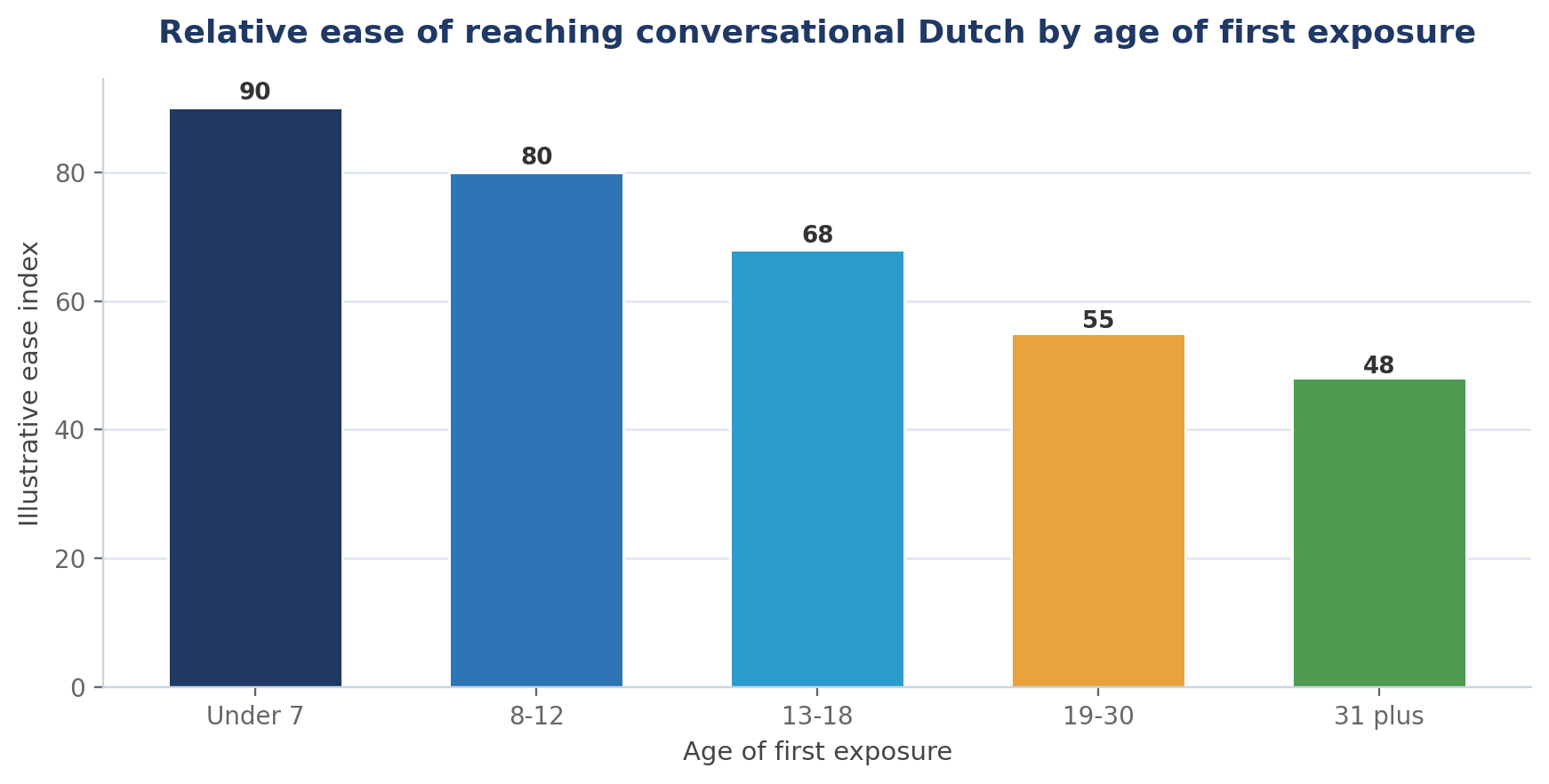
There is a question parents ask at playgrounds and adults ask quietly at midnight: am I too late? The honest, slightly boring, completely liberating answer is that every age has an advantage, and the best age to start learning Dutch is the one you are living through right now.
That is not motivational filler. It is what the research actually says — and it matters, because the myth of the vanished golden window stops thousands of capable people from ever beginning.
What you will get from this guide
- What each age group genuinely does better
- What the research on critical periods really concludes
- Why adult learners often outpace children in real conversation
- A practical playbook by age, for parents and adults alike
Age by age, without the fairy tales
Read that table again and notice what is missing: a column for "impossible".
Why the early years feel like magic
Babies are born as universal listeners. They can distinguish sound contrasts that adults find almost impossible to hear — a flexibility that narrows as the brain tunes itself to the languages it actually encounters. That tuning process is the heart of the so-called critical period, and it is far more gradual than the popular version suggests.
Dutch makes this especially visible. The language has sounds English speakers fight for years: the ui in huis, the eu in neus, and the notorious g and ch. A four-year-old hears them as ordinary. A forty-year-old hears them as obstacles. Both can succeed — one simply starts with fewer repairs to make.
What the research actually shows
Two studies are worth knowing by name. Johnson and Newport's classic 1989 work on learners who arrived in the United States at different ages found that earlier starters generally reached higher ultimate grammar accuracy. Later, Hartshorne, Tenenbaum and Pinker (2018) analysed an unusually large online dataset and estimated that learning ease declines most sharply in the late teens, with a slower decline continuing afterwards.
Note the language. A decline, not a cliff. A gradient, not a gate slamming shut. And crucially, these studies measure ultimate attainment in a second-language environment — not whether a motivated adult in Amsterdam, or in an online class, can become fluent.
Start Dutch today, whatever your age
One free account gets you a level check, a starting point and a plan that fits the time you actually have — five minutes a day or fifty.
Create your free account →Create a free accountAdults: the advantage nobody mentions
Adults are told they lost the race before they begin. In reality they hold tools children simply do not have.
What adults need is not a younger brain. It is a system: short daily sessions, speaking out loud from day one, and someone who corrects them. Do that and the adult disadvantage largely evaporates.
The parent's playbook
The principle is simple: match the method to the age, not the dream to the age. A seven-year-old needs songs and repetition. A fifteen-year-old needs a Dutch-speaking friend on a chat app. A forty-year-old needs a plan with a deadline.
Three myths, quickly dismantled
Myth: only children become fluent. Children often sound better; adults often communicate faster and further.
Myth: you must live in the Netherlands. Helpful, but not required. Daily input beats geography, and online conversation is available in minutes.
Myth: Dutch is too hard after thirty. Dutch is one of the friendliest languages for English speakers, with thousands of shared and near-identical words. Huis, boek, water, brood — you already know more than you think.
Give every age the right kind of Dutch
Whether it is a toddler humming Dutch songs or an adult preparing for a move to Amsterdam, the AI voice tutor adapts to the learner, not the other way round.
Explore Dutch courses →Create a free accountA simple rule to take away
Start now, at whatever age you are, with the method that fits your stage of life. Three short sessions a week beat one heroic Sunday. A single Dutch-speaking person in your week beats a shelf of unused textbooks. And beginning badly today beats beginning perfectly never.
Frequently Asked Questions
What is the best age to learn Dutch? Any age works. Starting before roughly age ten tends to make accent and grammar feel easier, while adults often progress faster in vocabulary and real conversation because they study deliberately.
Can an adult still become fluent in Dutch? Yes. Many adults reach comfortable fluency, especially with daily practice and regular speaking. Accent may need more work, but communication is fully achievable.
Should my child learn Dutch if we do not speak it at home? Yes, provided there is real input: a class, a tutor, shows, songs or a Dutch-speaking relative. Consistency matters more than a perfect environment.
How long does it take to learn Dutch? Estimates vary by learner and hours of practice, but many consistent beginners reach conversational Dutch within about a year of daily study.
References & Further Reading
- Johnson, J. S., & Newport, E. L. (1989) — Critical period effects in second language learning, *Cognitive Psychology*
- Hartshorne, J. K., Tenenbaum, J. B., & Pinker, S. (2018) — A critical period for second language acquisition, *Cognition*
- Nederlandse Taalunie — Dutch Language Union, policy and resources
- Nuffic — Dutch language and education information
- Council of Europe — CEFR framework and language learning