Dutch and English are a gift pairing. They are close enough that your child gets vocabulary for free, and different enough that he or she will genuinely hold two ways of thinking. It is also one of the easiest bilingual combinations to support, because English surrounds you anyway — which means the real work is keeping Dutch alive.
This guide covers the practical strategies, the milestones worth watching, the myth you should ignore, and what to do when your family does not live in the Netherlands.
What you will get from this guide
- The three proven strategies for dividing two languages
- Realistic Dutch and English milestones by age
- The truth about bilingualism and language delay
- How to keep Dutch strong outside a Dutch-speaking country
The three strategies that actually work
Consistency matters far more than the strategy you choose. Children tolerate bilingualism easily; they do not tolerate unpredictability. Whatever you choose, choose it clearly and hold it.
Realistic milestones: speaking
Mixing languages — Ik wil dat Apple — is normal and temporary. It means the child is using every tool available, not that bilingualism confused them.
Realistic milestones: reading and writing
This is where heritage-language children most often fall behind, because spoken Dutch comes from home while written Dutch comes from school.
If formal Dutch lessons are not available locally, structured online Dutch lessons are not a luxury. They are the piece that stops the language drifting into a comfortable dialect of your family alone.
Give your child Dutch that does not depend on luck
A free account gets you a level check for your child and a plan built around their age and current Dutch — whether they are two or twelve.
Create a free account →Create a free accountThe language-delay myth
The most damaging myth in bilingual parenting is that two languages cause speech delay. It is not supported by the mainstream research consensus. Bilingual children may reach some milestones slightly later than monolingual norms, and vocabulary is often split across two languages — 300 words in Dutch plus 400 in English is a 700-word child, not a delayed one.
If you are ever worried, speak to a professional who assesses the child in both languages. Assessing a bilingual child in one language only produces misleading results.
Keeping Dutch alive abroad
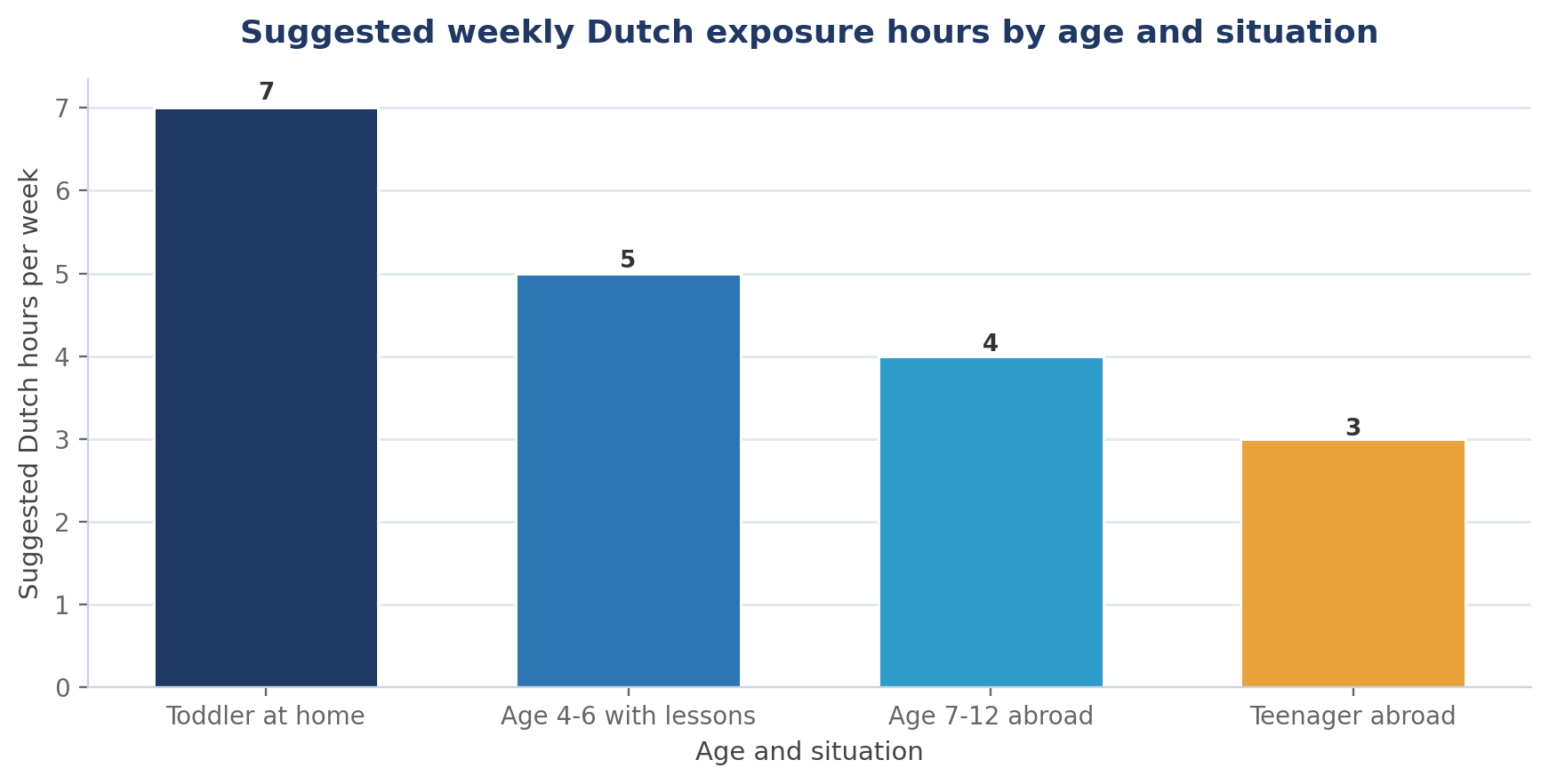
This is the central challenge for most families. English wins by sheer volume; Dutch needs deliberate protection.
The most effective of all is a Dutch-speaking adult who is not a parent — a grandparent, a tutor, a family friend. Children quickly learn that Dutch is a language they use with people, not a subject they study.
What to expect year by year
Around the teenage years the language becomes a choice, and the best thing you can do is make Dutch useful: family, travel, work, music, friends.
Structured Dutch without moving country
Self-paced Dutch lessons with a personal AI voice tutor give your child structured practice and speaking feedback — the structure that keeps a heritage language from quietly fading.
Explore Dutch for children →Create a free accountFrequently Asked Questions
Does raising a child bilingually cause speech delay? The mainstream research consensus does not support that claim. Bilingual children develop within normal ranges, though their vocabulary is divided across two languages.
What is the best strategy for Dutch and English? One person, one language is the classic approach, and minority language at home works well abroad. Consistency matters more than which you choose.
Should we speak Dutch if we are not native speakers? Yes, with support. Non-native Dutch is far better than none, as long as your child also hears fluent Dutch regularly — from media, relatives or a teacher.
When should formal Dutch lessons start? Around age six to eight for reading and writing, and earlier for conversation if the child has little Dutch exposure at home.
References & Further Reading
- Nederlandse Taalunie — Dutch Language Union: education and language policy
- Nuffic — Dutch language and education information
- SLO — Curriculum and language objectives in Dutch education
- Council of Europe — CEFR and plurilingual education
- Stichting NOB — Dutch language and culture education worldwide