You do not need to be fluent in Korean to raise a child who loves it. You need a plan, a few songs, and the patience to make the whole thing feel like play.
And you have one enormous advantage: Hangul. Korea's writing system was designed in the 1440s to be learned quickly — deliberately, systematically, against the wishes of scholars who preferred complexity. That single design decision changes everything about how children learn to read Korean.
King Sejong's scholars built Hangul so that ordinary people could read within days, not years. Your five-year-old is standing on the same shortcut.
Start with sound, not spelling.
Children who hum Korean before they read it recognise the script far faster once it finally arrives. Sing first. Decode second.
Why Hangul is a gift to young learners
Most scripts ask children to memorise hundreds of symbols before they can read a single word. Hangul asks for 24 basic letters, arranged into neat syllable blocks that look like little puzzles.
That consistency is the real gift. A child who learns ㄱ, ㅏ and ㅁ can read 감 — persimmon — on day one, and feel like a genius. Kids who feel like geniuses keep going.
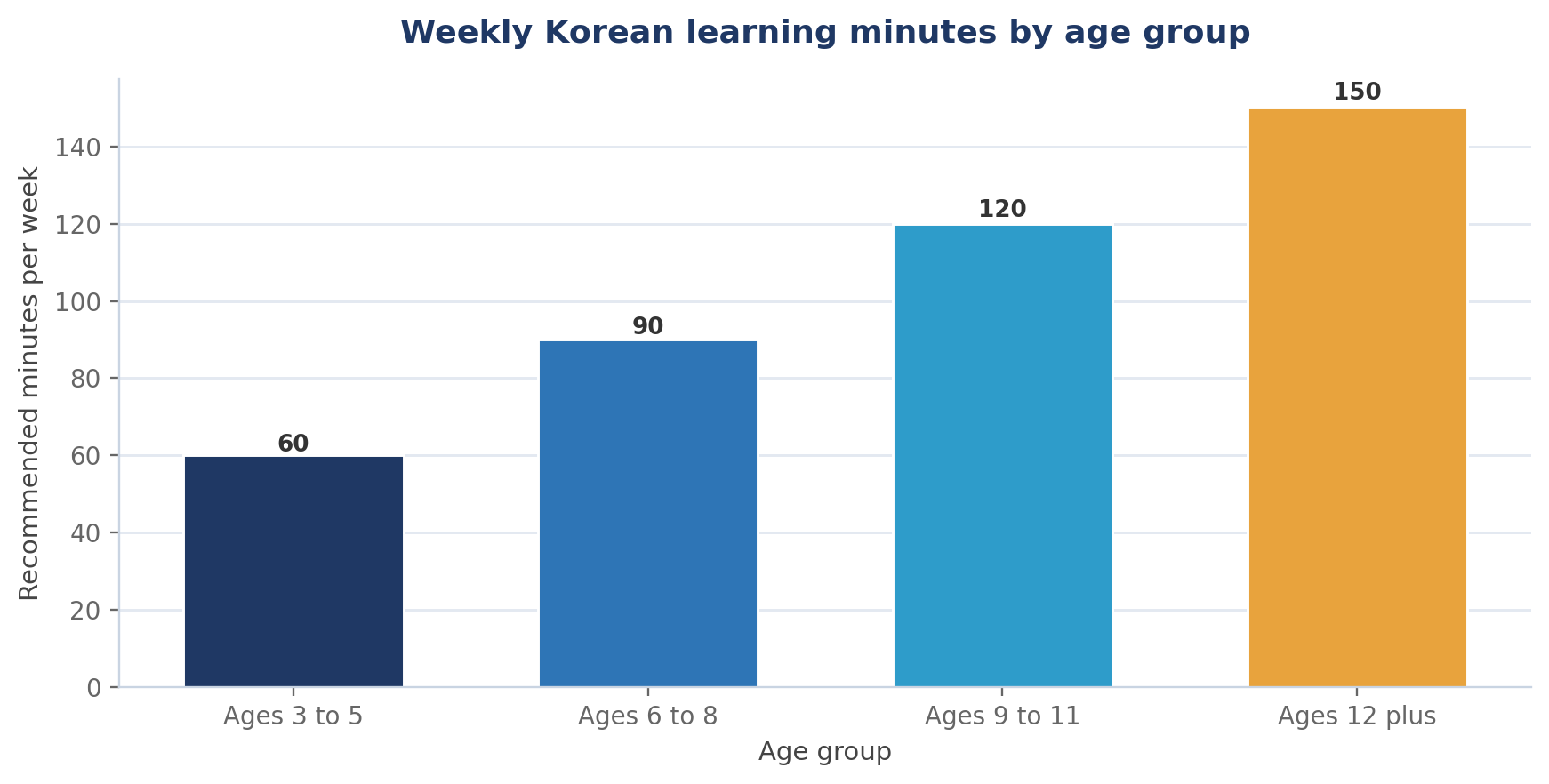
Ages and stages: what works when
Every age wants something different. Push reading at three and you get tears; wait until nine and you get boredom. Match the task to the brain in front of you.
Games and songs that actually stick
Forget flashcards alone. If it makes a child laugh, it sticks.
The Korean version of "head, shoulders, knees and toes" is a genuinely efficient teaching tool: four body words, a melody that survives repetition, and a physical action for every word. Children learn it in a week and never forget it.
A song your child begs to replay teaches more Korean than a perfect lesson plan they resist.
Screen time that teaches instead of sedating
Screens are not the enemy. Passive screens are. Fifteen minutes of active Korean video beats an hour of subtitled noise.
The test for any screen session is simple: did your child speak Korean during it? If yes, it counted. If they only watched, it was entertainment wearing a language costume.
Ready to turn reading into real Korean? Start your self-paced course today.
Start the Korean course →Create a free accountYour child deserves a tutor who makes Korean feel alive
Self-study gets you the alphabet and the songs. A personal AI voice tutor turns those sounds into real conversation and corrects pronunciation before the habits set. The Korean Course Pass gives your family structured, self-paced lessons that fit around school.
Button: Start the Korean Course Pass →
Heritage families vs complete beginners
If Korean is already spoken at home, your child is not starting from zero — they are starting from hearing. If your family is new to the language, you are starting from curiosity. Both paths work; the pacing differs.
The heritage-family risk deserves emphasis. A child who understands Korean but always answers in English can coast for years and then lose the language entirely — usually between ages six and twelve, when school life takes over.
Five myths, gently debunked
When a tutor beats a parent
A parent is unbeatable for warmth, routine and encouragement. A tutor is unbeatable for pronunciation accuracy, correction and pace. The skill is knowing when to hand over the wheel.
Most families bring in a tutor somewhere between six and nine — the point where the child starts forming original sentences and the parent's own Korean becomes the ceiling.
Ready to turn reading into real Korean? Start your self-paced course today.
Start the Korean course →Create a free accountTry the lessons before you commit
Create a free account and see how the self-paced AI voice tutor actually feels — the pacing, the feedback, the energy. It takes a minute, and your child could be saying their first full Korean sentence this week.
Button: Create your free account →
Frequently Asked Questions
How long does it take a child to learn Hangul? Most children aged five to eight recognise all 24 letters within two to four weeks of short, playful daily practice.
Can I teach Korean to kids if I do not speak it myself? Yes. Learn alongside them, lean on songs and verified resources, and bring in a tutor once your child starts forming sentences.
What is the best age to start? Any age works, but four to eight is a golden window — children are still fearless about making strange sounds in front of you.
Should my child aim for TOPIK? Not before eleven or twelve. Younger learners should chase fluency and fun first, with TOPIK's structured levels as a later milestone.
References & Further Reading
- King Sejong Institute Foundation — Korean language and culture education worldwide
- TOPIK, National Institute for International Education — Proficiency test and level descriptions
- National Institute of Korean Language — Authoritative Korean orthography and usage
- KBS World — Korean-language broadcasts for young listeners
- Council of Europe — CEFR levels and descriptors