You do not need to be a teacher to teach your child English. You need roughly fifteen minutes a day, a handful of games, and the patience to let your child be bad at it for a while. That is genuinely it.
What you must not do is turn it into school. Children acquire language through play, repetition and warmth — not worksheets. Get the tone right and English becomes something your child does, not something done to them.
What you will get from this guide
- What works at each age, from toddler to tween
- Games and routines that build real English
- How much time is actually needed
- The five mistakes that make children resist English
What each age can actually do
The most common parental mistake is using material for the wrong age. A ten-year-old will refuse a cartoon made for five-year-olds, no matter how good the English is.
Games that actually teach
Keep every game in English. If you explain the rules in your own language and then switch, the child learns that English is only for the game's decorative parts.
The daily routine that works
You do not need an hour. You need small, predictable moments.
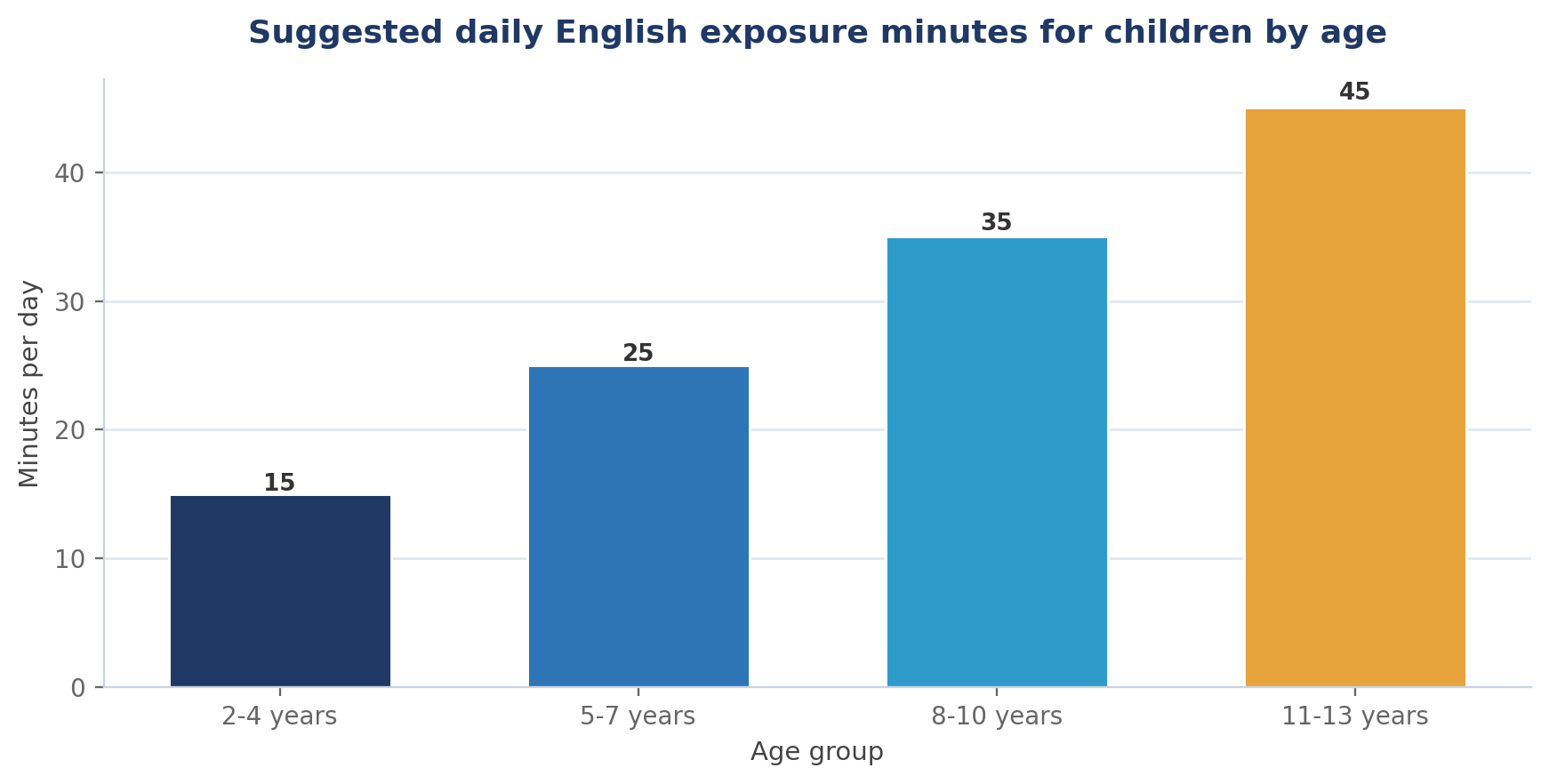
Fifteen to twenty minutes spread across the day beats a single weekly session, because frequency builds language and intensity does not. Little and often is not a slogan; it is how children's brains work.
Start with a free account and a proper level check
Find out where your child actually is in English, then follow a plan built for their age — no guessing, no wasted months.
Create a free account →Create a free accountReading aloud: the highest-value activity
If you do only one thing, do this. Read a picture book aloud, slowly, twice. Point at the pictures as you name them. Let your child finish familiar lines.
A child who has heard the same twenty books fifty times has a stronger English foundation than a child who has seen fifty apps once.
The five mistakes parents make
The most important row is the second. If your child says I goed to school, do not say "wrong". Say back: Oh, you went to school? What did you do there? You have corrected the form and kept the conversation alive.
When to add an AI tutor
At some point your child needs a third party: someone who is not a parent, who expects English, and who knows what to teach next.
That is not a failure of your parenting. It is the natural division of labour: parents supply warmth and time, teachers supply structure and expertise.
Give your child an AI voice tutor that makes English fun
Age-appropriate, self-paced English lessons with a personal AI voice tutor turn your child's games and songs into structured progress — and you get your evenings back.
Explore English for kids →Create a free accountFrequently Asked Questions
Can I teach my child English if I am not fluent? Yes, especially with songs, books and games. Pair your daily input with media or a teacher so your child also hears fluent models.
How much English should a child hear each day? Roughly fifteen to twenty minutes for toddlers, rising to about forty-five minutes for children aged eleven to thirteen.
At what age should formal English lessons start? Most children benefit from structured lessons around age six to eight, once they can read in their first language. Conversation and games work well earlier.
What if my child refuses to speak English? Normal, and usually temporary. Reduce pressure, keep the input going, and let another adult — a tutor or relative — be the English speaker for a while.
References & Further Reading
- Council of Europe — CEFR and language learning at a young age
- British Council — LearnEnglish Kids: free songs, stories and games
- Cambridge English — Young Learners qualifications and resources
- Council of Europe — Plurilingual and intercultural education resources
- OECD — Education and early learning research publications