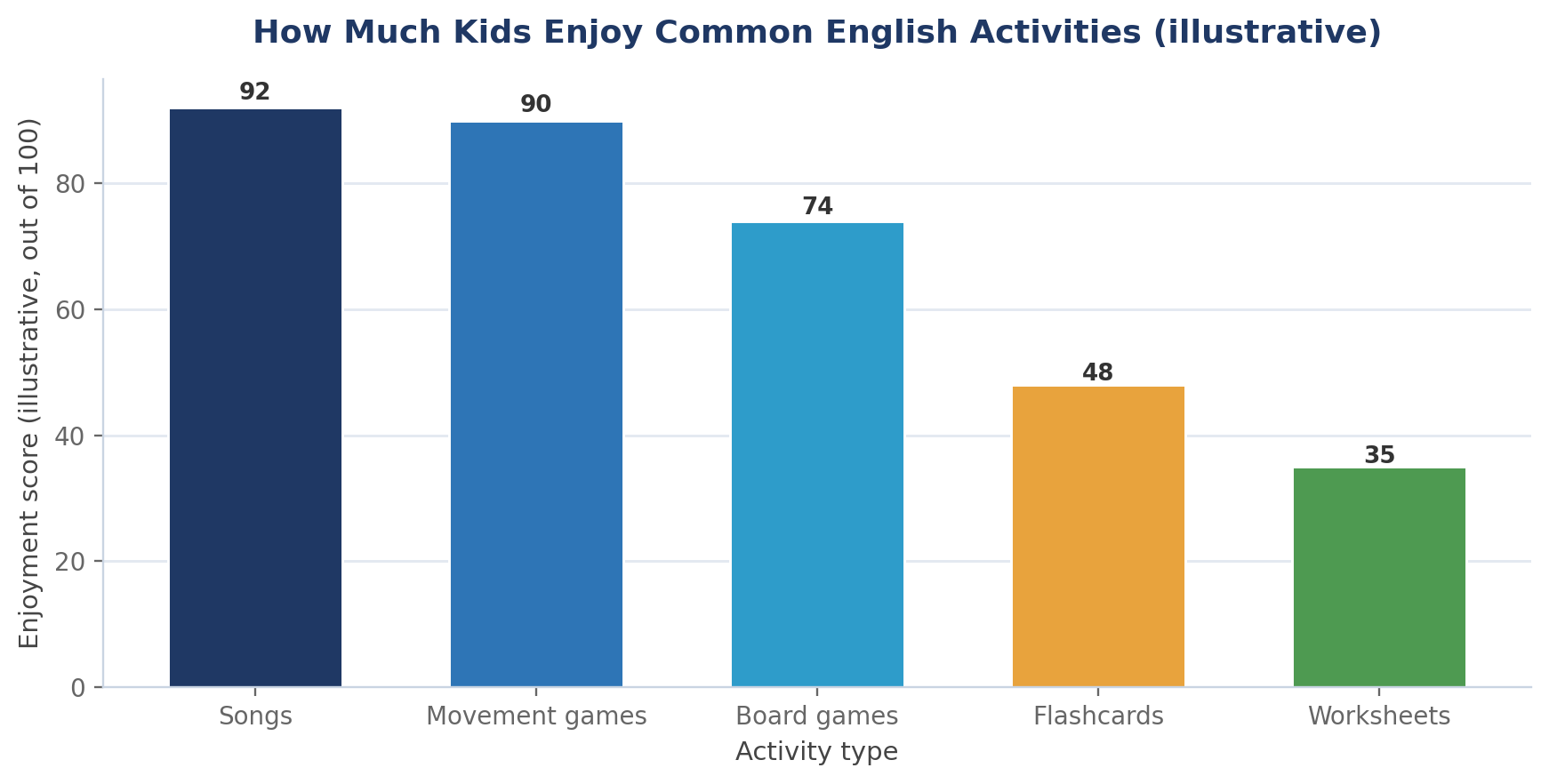
Kids don't learn English by staring at a grammar table. They learn it by laughing, shouting, jumping, and begging for "one more round!" That's the beautiful secret behind every great English games for kids session: when the game is fun, the language sneaks in through the back door and stays there. So let's crank up the joy, because teaching English to children works best when it feels like pure play.
Why Games Beat Flashcards (Almost) Every Time
Think about how children acquire their first language. Nobody hands a toddler a vocabulary list. They hear a song, copy a rhyme, point at a dog and scream "doggie!" — and the word sticks forever. Games recreate that magic: they lower anxiety, spike motivation, and give kids a reason to speak. A child who is shy about repeating a sentence will happily shout it while racing to a chair. That's the whole trick.
The research backs this up. Linguists like Stephen Krashen argue that language grows from comprehensible, low-stress input, not from pressure. Games supply exactly that — meaning first, grammar second, giggles throughout. And when you add movement and music, you double the number of memory hooks your child builds. Learning English at home or in a classroom should feel like recess with a hidden mission.
The Classic Playbook: English Games for Kids That Always Work
Some games are timeless because they're simple, loud, and endlessly repeatable. Here's your starter kit.
The genius of these games is that they need almost nothing — a ball, a few cards, your voice. Rotate them so novelty stays high. Kids adore repetition, but they adore fresh repetition even more.
Movement Games: Learning English With Your Whole Body
Children are basically small rockets. If you try to make them sit still, you're fighting gravity. So let's use that energy instead! Movement-based activities are the MVPs of teaching English to children.
Try "Walk, Jump, Run!" — call out an action and kids perform it. Then escalate: "Run to something blue!" Now they're combining verbs, colors, and prepositions in one glorious blur of sneakers. Or play musical chairs where the "out" child must name five animals before rejoining. Suddenly vocabulary practice feels like a reward, not a punishment.
Total Physical Response (TPR), a method developed by James Asher, is built on this idea: the body learns language through action before the mouth has to produce it. It's why kids who "can't speak yet" often understand everything and then surprise everyone.
Songs and Rhymes: The Melody Memory Hack
Have you ever noticed you can still sing a jingle from childhood? Music welds language into long-term memory like nothing else. English songs for kids are therefore a secret weapon, and the sillier, the better. "Head, Shoulders, Knees and Toes" teaches body parts in ninety seconds flat. "The Wheels on the Bus" sneaks in verbs. Action rhymes add movement, so kids hear, see, and feel the words at once.
Want to make it infectious? Change the lyrics together. "Old MacDonald had a... dinosaur!" Now you're building vocabulary and creativity simultaneously. Singing also fixes pronunciation — rhythm and intonation are absorbed naturally, without a single boring drill.
Turn Every Song Into a Speaking Superpower
Our guided lessons turn nursery rhymes into real conversations your child will love. Create a free account and unlock a joyful path from singing to speaking.
Start Learning Free →Create a free accountStorytelling and Role Play: Where Words Come Alive
Reading aloud is wonderful, but acting it out is unforgettable. After reading a picture book, hand out roles: "You're the bear, you're the lost rabbit." Kids improvise simple English lines, and suddenly they're using past tense and question forms without noticing. This is how English activities kids truly remember are born.
Puppet shows are magical for shy children — the puppet speaks, not them, which dissolves self-consciousness. Even a sock with googly eyes can coax a whisper into a sentence. As confidence grows, swap puppets for full costume drama and watch mini-performers bloom.
Screen-Time That Actually Teaches
Let's be honest: children love screens. Instead of banning them, curate them. Interactive apps, sing-along videos, and story-based lessons channel that fascination into real learning. The key is active screen time — where kids repeat, click, respond, and sing along — not passive staring.
A balanced diet is best: twenty minutes of active screen learning plus plenty of offline play beats an hour of passive watching every time.
Building a Weekly Rhythm
Consistency beats intensity. A short daily game is far more powerful than a marathon weekend session. Aim for ten to twenty joyful minutes, and let your child sometimes pick the game — ownership fuels motivation.
Track wins on a sticker chart. Celebrate effort, not perfection. Mistakes are simply proof your child is brave enough to try — and brave learners become fluent speakers.
Give Your Child a Head Start This Week
Fun is the fastest route to fluency, and we make it effortless for busy families. Join free and watch your child go from giggles to full sentences.
Create Free Account →Create a free accountFrequently Asked Questions
How many English games should a child play each day? Ten to twenty minutes of focused play is plenty for young learners. Consistency across the week matters far more than long, tiring sessions.
What if my child refuses to speak English? Start with listening games and songs that require no speech. Confidence grows quietly, and speaking usually appears on its own once the child feels safe and amused.
Do games really help older kids, not just toddlers? Absolutely. Teenagers love competitive quizzes, trivia, and role-play challenges just as much — the content simply gets more sophisticated.
Can I teach English at home without being fluent myself? Yes! Songs, picture books, and interactive lessons carry the language input, and you can learn alongside your child. Many families grow together this way.
References & Further Reading
- Stephen Krashen's Hypotheses on Second Language Acquisition — Wikipedia
- Total Physical Response — Wikipedia
- American Council on the Teaching of Foreign Languages (ACTFL)
- British Council — LearnEnglish Kids
- Nicolas Pino-Silva, "Using games to teach English" — Academia.edu