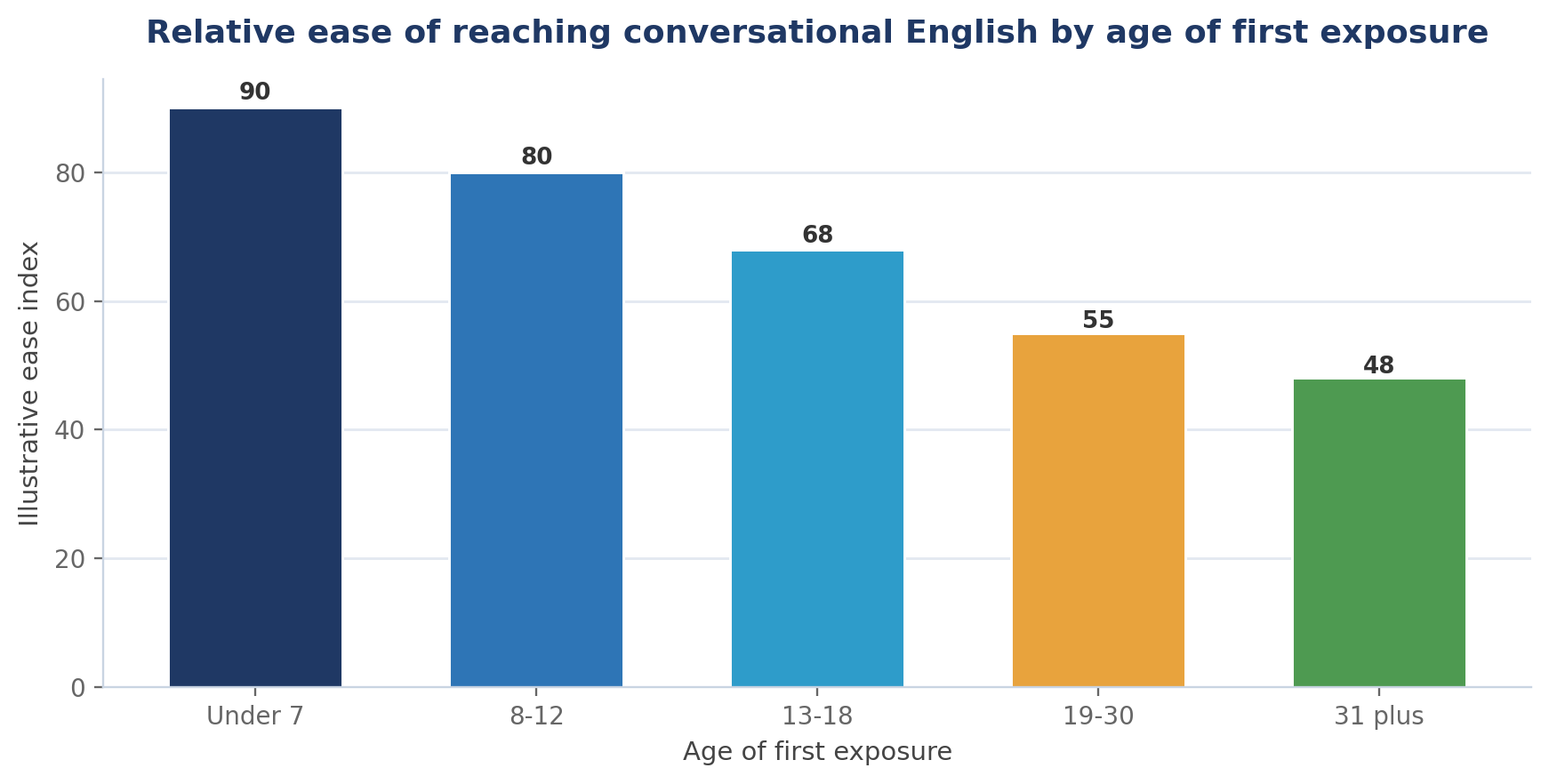
Parents ask it constantly, usually while watching a four-year-old sing a nursery rhyme in a second language they themselves cannot pronounce. Have we missed the window? The answer is reassuring and slightly unglamorous: every age has advantages, and the research does not support the idea of a door that slams shut.
That said, "any age works" does not mean "all ages are identical". Children and adults learn differently, and understanding those differences is what lets you choose the right method.
What you will get from this guide
- What each age group does better, and why
- What the critical-period research actually concludes
- Why adults often progress faster in the early stages
- Practical advice for parents and for adult learners
Age by age, honestly
Notice what is missing from that table: a row saying "too late".
What the research says about the critical period
The best-known study is Johnson and Newport's 1989 work on learners who arrived in the United States at different ages. It found that earlier starters generally reached higher ultimate grammatical accuracy. Later, Hartshorne, Tenenbaum and Pinker analysed an unusually large online dataset and estimated that learning ease declines most sharply in the late teens, with a slower decline continuing afterwards.
Read the language carefully. A decline, not a cliff. A gradient, not a gate. And these studies measured ultimate attainment in a full immersion environment — not whether a motivated learner can become fluent with good teaching.
Start at the right level, whatever the age
A free account gives your child — or you — a level check and a plan that fits. No guessing, no wasted months.
Create a free account →Create a free accountWhat children get for free
Children acquire pronunciation with astonishing ease, and they do it through hours of input that feels like play.
The last row is the real superpower. A child will say a wrong word fifty times without discomfort. An adult says it twice and starts apologising.
What adults do better
Adults are routinely told they lost the race. They did not.
What adults need is not a younger brain. It is a system: short daily sessions, speaking aloud from day one, and someone who corrects them.
The parent's playbook
The principle: match the method to the age, not the dream to the age.
How much time is enough?
Frequency beats intensity at every age. Twenty minutes daily outperforms three hours on a Sunday, because language is built by repeated contact rather than heroic effort.
Give every age the right kind of English
From toddlers singing songs to adults building real skills, self-paced lessons adapt to the learner — with a personal AI voice tutor, not self-paced lessons.
Explore English courses →Create a free accountFrequently Asked Questions
What is the best age to learn English? Any age works. Starting before roughly age ten tends to make accent and grammar feel easier, while adults often progress faster at first because they study deliberately.
Can an adult still become fluent in English? Yes. Many adults reach high fluency, especially with daily practice and regular speaking. Accent may need more work; communication is fully achievable.
Should my child learn English if we do not speak it at home? Yes, provided there is real input: a class, a tutor, shows, songs or a relative who speaks English. Consistency matters more than a perfect environment.
Is it too late to start at 40? No. Learners start in their forties, fifties and sixties every day and reach comfortable, professional English. Strategy matters more than age.
References & Further Reading
- Johnson, J. S., & Newport, E. L. (1989) — Critical period effects in second language learning, *Cognitive Psychology*
- Hartshorne, J. K., Tenenbaum, J. B., & Pinker, S. (2018) — A critical period for second language acquisition, *Cognition*
- British Council — LearnEnglish Kids: free songs, stories and games
- Cambridge English — Young Learners qualifications and resources
- Council of Europe — CEFR and language learning at a young age