Children do not learn languages by being taught. They learn by being played with. That is not a cute sentiment — it is the mechanism. Play creates repetition without boredom, and repetition is the only thing that makes a language stick.
Korean gives you a particular advantage here, because Korea has a deep tradition of physical, rule-based children's games that come with their own vocabulary built in. Learning the game means learning the words. Nobody has to be persuaded.
What this guide gives you
- Traditional Korean games and the language inside them
- Hangul activities that do not feel like homework
- Songs and rhymes for every age
- A weekly activity plan by age band
- Screen-free and screen-based options
Traditional games with language built in
These four games have been played by Korean children for generations — and every one of them teaches vocabulary as a side effect.
Yutnori is the standout for families. It is a New Year tradition, it works with any number of players, and it produces natural counting practice without anyone noticing they are practising.
Hangul activities that feel like play
Hangul's design makes it unusually game-friendly. The letters are shapes rather than abstractions, which means they can be built, drawn and hidden.
The body-letters game is the one children request again and again, and it does something valuable: it attaches a physical memory to each shape, which is exactly how Hangul was designed to be remembered.
Songs and rhymes by age
Music does something no worksheet can: it makes repetition pleasant.
Two cautions. Keep sessions short — young children lose focus fast, and a five-minute daily song beats a thirty-minute forced session. And sing with them. A recording teaches listening; singing teaches production.
Games for siblings and classmates
Language becomes social the moment a second child is involved, and social language is the language that survives.
Role-play is the quiet champion here. A child running a pretend shop will say 얼마예요? — how much is it? — thirty times in ten minutes, and never once feel like they are studying.
Ready to turn reading into real Korean? Start your self-paced course today.
Start the Korean course →Create a free accountGive your child a patient AI voice tutor
Games build vocabulary and joy. A personal AI voice tutor adds the thing no parent can reliably supply: pronunciation feedback and a structured path, delivered through guided lessons your child can work through at their own pace, any time.
Button: Explore the Korean Course Pass →
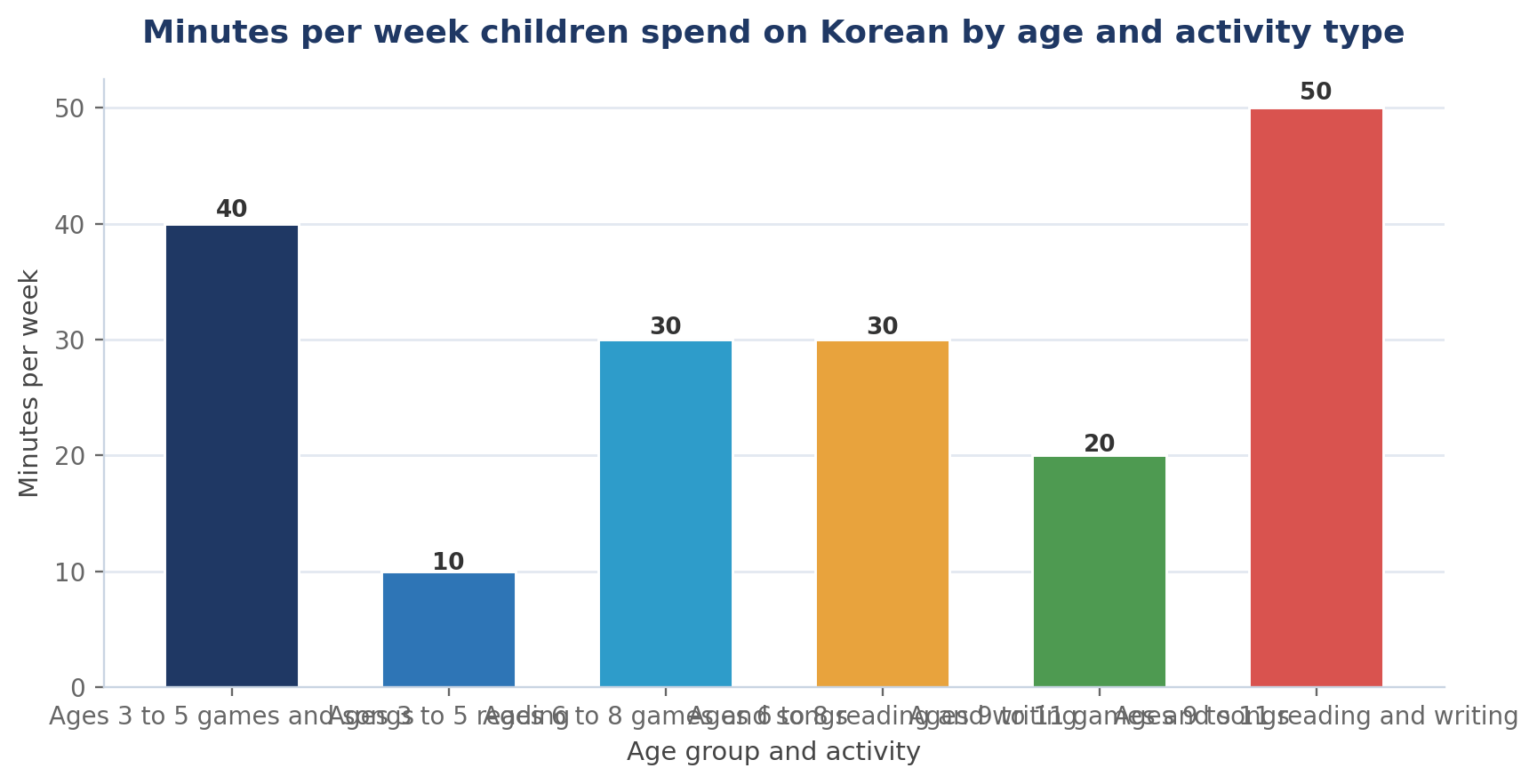
A weekly plan by age
The single rule that makes this work: every session ends with your child speaking Korean out loud. A session of listening and nodding was entertainment. A session with a spoken sentence was learning.
Screen-free versus screen-based
Screens are neither villain nor hero. The test is always the same: did the child speak Korean during it? If yes, it counted.
Ready to turn reading into real Korean? Start your self-paced course today.
Start the Korean course →Create a free accountTry a free lesson and see what your child does with it
Create a free languageskills.net account to try a children's Korean lesson with a personal AI voice tutor — designed around games, songs and real speaking, not worksheets.
Button: Create your free account →
Frequently Asked Questions
What is the best Korean game for young children? For ages three to six, songs and body-letter games work best. From six upward, yutnori combines counting, turn-taking and genuine family fun.
Do these games work if I do not speak Korean? Yes. Learn alongside your child, use audio for pronunciation, and rely on a personal AI voice tutor once they begin forming sentences.
How long should an activity last? Five to fifteen minutes depending on age. Short and repeatable beats long and exhausting every time.
Can games alone teach a child Korean? Games build vocabulary, confidence and enthusiasm remarkably well, but pronunciation feedback and structured progression are worth bringing in a personal AI voice tutor for.
References & Further Reading
- King Sejong Institute Foundation — Korean language and culture education
- National Institute of Korean Language — Authoritative Korean orthography and usage
- TOPIK, National Institute for International Education — Proficiency levels and guidance
- KBS World — Korean-language broadcasts for young listeners
- Council of Europe — CEFR levels and young-learner guidance