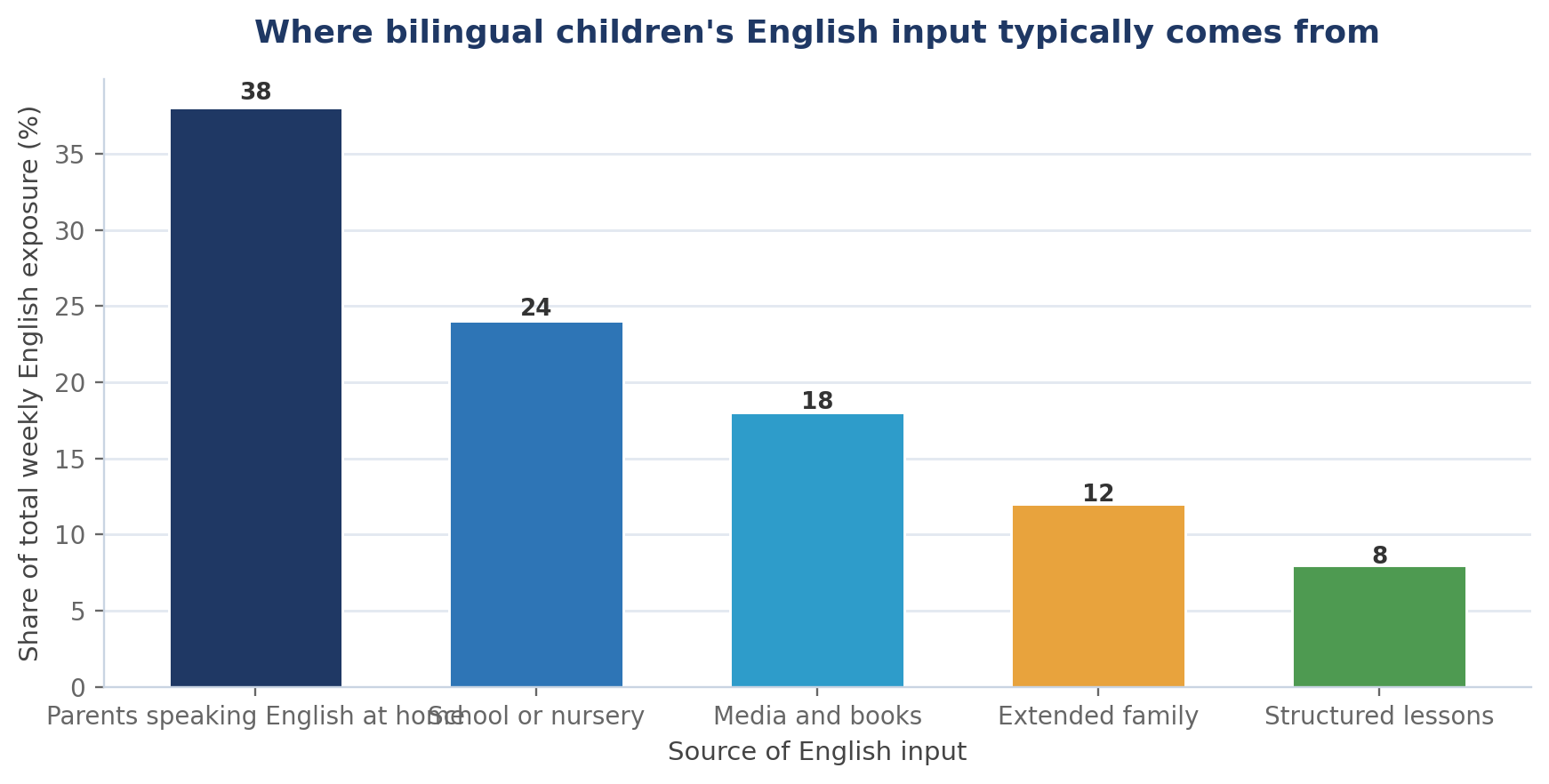
The decision usually arrives quietly. Your child says their first word — in one language — and you suddenly realise you have no plan for the other. Do you push English at home? Will the community language crowd it out? Is it already too late?
It is not too late. But "bilingual" is not a switch you flip at birth either. It is a habit you maintain, sometimes for years, and the families who succeed are rarely the ones with the most resources — they are the ones with the clearest plan.
What you will get from this guide
- What bilingual actually means for a child
- The three methods families use, and which fits you
- Realistic milestones by age
- Myths that cause parents to give up too early
- How to keep English alive once school starts
What "bilingual" really means for a child
Bilingualism is not perfectly balanced fluency. Almost no bilingual child has two equal languages, and trying to force symmetry is the fastest route to frustration.
That last row is where most families end up by accident. It is also entirely reversible — with input, not pressure.
The three methods families actually use
None is superior. What matters is consistency and volume of input — a child needs to hear a language often enough for it to feel normal, not special.
A language a child only hears on request is a language they will eventually stop requesting.
Realistic milestones by age
Every child is different, but broad patterns help you notice when something needs attention — and when it is simply normal.
Two things worth knowing. First, a temporary silent period when a new language arrives is normal — comprehension comes before production. Second, code-mixing (*"I want the appel"*) is not confusion. It is a sign the child has two systems and is using the word that fits.
Five myths that make parents give up
The one genuine risk is not confusion — it is language loss. A heritage language with no structured input fades, quietly and completely, usually between ages six and twelve.
Keeping English alive once school starts
This is the make-or-break decade. Once the community language dominates a child's day, English survives only if you give it a job.
The last one is underrated. A child who has someone to talk to in English will maintain it; a child who only has a parent prompting them will not.
Ready to turn reading into real English? Start your self-paced course today.
Start the English course →Create a free accountGive your child a reason to speak, not just a rule to follow
A personal AI voice tutor turns the language into something social — games, stories, real back-and-forth speaking practice that gets children talking instead of reciting, at their own pace, any time.
Button: Explore the English Course Pass →
What the research actually supports
Three findings hold up consistently across the literature. Earlier, richer input predicts stronger outcomes. Interaction beats exposure — a conversation teaches more than a video. And literacy in one language supports literacy in the other, which is why reading in the stronger language is never wasted.
The practical upshot: stop counting languages and start counting conversations.
Ready to turn reading into real English? Start your self-paced course today.
Start the English course →Create a free accountFind the right level for your child
A free account includes a friendly level check so your child starts where they are comfortable — building confidence first, vocabulary second.
Button: Create your free account →
Frequently Asked Questions
Will two languages confuse my child? No. Bilingual children reach language milestones on the same timeline as monolingual children and routinely separate their two systems without difficulty.
What if my child refuses to speak English? Refusal is usually about motivation, not ability. Give the language a social purpose — friends, games, a class they enjoy — rather than more pressure at home.
Is it too late to start at age six? Not at all. Older children learn faster in some respects because they can read, reason and study deliberately.
How much exposure does a child need? There is no exact number, but consistency matters more than volume. Daily short interactions outperform long, occasional sessions.
References & Further Reading
- British Council — English learning and teaching resources for families
- Cambridge English — Young learner qualifications and level guidance
- Council of Europe — CEFR levels and the European Language Portfolio
- UNESCO — Multilingual education and mother-tongue research
- European Commission — Multilingualism and language-learning policy