Somewhere between 600 and 800 hours is the honest answer — and if you are starting from zero, closer to 800. That number sounds brutal until you break it down, because the real question is never how many hours but which hours. Goethe-Zertifikat B2 study hours spent with an AI voice tutor that gives you instant feedback on your Nebensätze are worth triple the hours spent alone with an app, guessing why your grammar still sounds off.
This guide gives you the concrete numbers, what the exam actually tests, and a weekly schedule you can steal today.
The CEFR hour estimates, translated into German
The Council of Europe's CEFR framework describes levels qualitatively, not in hours. The hour ranges below come from guided-learning estimates used by Goethe-Institut course planning and by autonomous-learning research — treat them as bands, not handcuffs.
These are guided hours — study time with feedback, correction and speaking practice. Passive listening in the background is lovely for your mood and nearly worthless for your exam score.
Read that table twice, because it contains the single most useful insight in this article: the closer you are to B1, the shorter the runway. If you already hold a Goethe-Zertifikat B1 certificate, you are not starting from scratch. You are polishing, not building.
What the Goethe-Zertifikat B2 actually tests
Four modules, four very different beasts. Knowing the shape of each one tells you where your hours should go.
Speaking and writing are where most candidates lose points, and they are precisely the skills a self-study routine cannot fix. You cannot hear your own Dativ error. An AI voice tutor can flag it, in the second it happens.
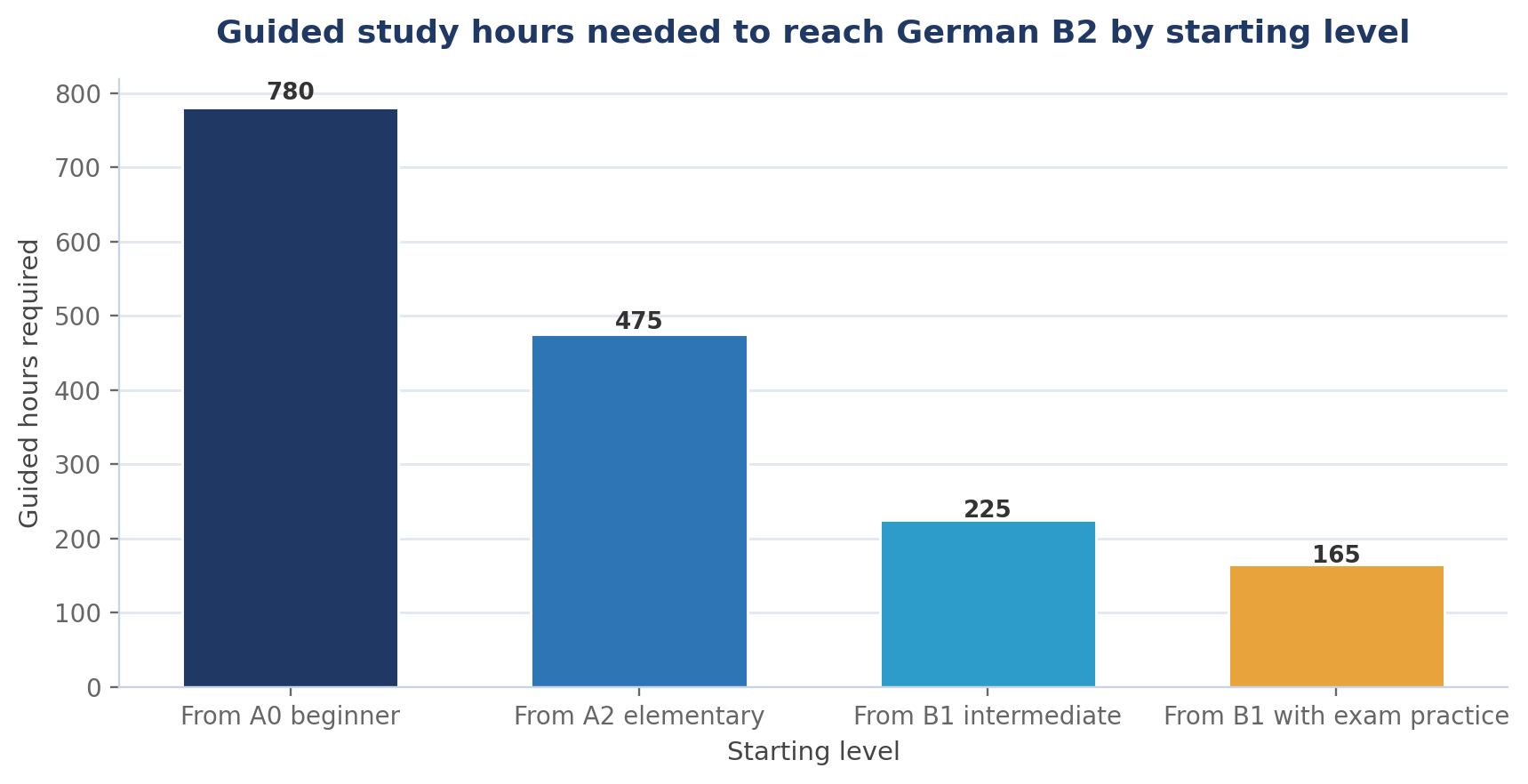
Notice the shape of that chart. It is not a straight line downward — it collapses. Every certificate you already earned slashes your remaining Goethe-Zertifikat B2 study hours dramatically.
A realistic weekly schedule that survives actual life
Six hours a week is the minimum rhythm that keeps German alive between sessions. Twelve is where progress becomes visible month to month.
The magic is in Saturday. One full module under exam conditions every week turns exam day into just another Saturday.
Consistency beats intensity. Four honest hours every week for a year will beat one heroic weekend a month, every single time.
Time-to-B2 by starting level: the honest version
- From A0: budget 800 guided hours. This is a marathon with a finite finish line.
- From A2: 450-500 hours. Grammar foundations exist; you are widening vocabulary and fluency.
- From B1: 200-250 hours. This is the sweet spot — most learners can pass within a year at 6 hours weekly.
- Already B1 and exam-experienced: 150-180 hours of targeted format training can be enough.
Beware the 200-hour myth that floats around forums. That figure describes learners who already live in Germany, read Duden daily and speak German at work. If that is you, wonderful. If not, plan for more.
Why guided hours beat self-study hours
Self-study hours teach recognition. Guided hours teach production — and the exam grades production.
A learner with 300 guided hours routinely outperforms one with 700 solitary hours. The second learner has read about German. The first one can use it under pressure.
Turn your study hours into exam-ready German
You have the numbers and the schedule — now you need the feedback loop. AI voice tutor lessons give you instant feedback on your writing, push you to speak through the awkward middle, and keep every hour earning interest toward B2.
Start your German Course Pass →Create a free accountFAQ: Goethe-Zertifikat B2 study hours
Is 300 hours enough to pass Goethe-Zertifikat B2? Only if you already sit comfortably around B1 and use those hours purely for exam technique. From a lower starting point, 300 hours is not enough — the CEFR expects roughly 200-250 hours from B1 and far more from A2 or A0.
Can I pass B2 with self-study only? Some do, usually learners with daily immersion. But writing and speaking carry 55% of the risk, and nobody self-corrects reliably. Add AI speaking practice at minimum; see the Course Pass options for a structured route.
How long does it take to go from B1 to B2? Plan 200-250 guided hours. At six hours a week that is about nine months; at twelve hours a week, four to five. Add two or three weeks of pure exam-format practice before booking.
Does the Goethe-Institut publish official hour counts? No. The Institute publishes level descriptors and course structures rather than fixed hour targets, because learning speed varies. The ranges here come from CEFR-guided planning and commonly reported preparation times.
References
- Goethe-Institut — Goethe-Zertifikat B2 exam overview
- Council of Europe — Common European Framework of Reference for Languages
- Deutsche Welle — Learn German, free courses by level
- telc — Language exams aligned to CEFR levels
- Duden — German dictionary and grammar reference
Map your hours before you spend them
Get a free account and we will help you find your current CEFR level, so every one of your Goethe-Zertifikat B2 study hours lands on the skill that actually needs it.
Create your free account →Create a free account