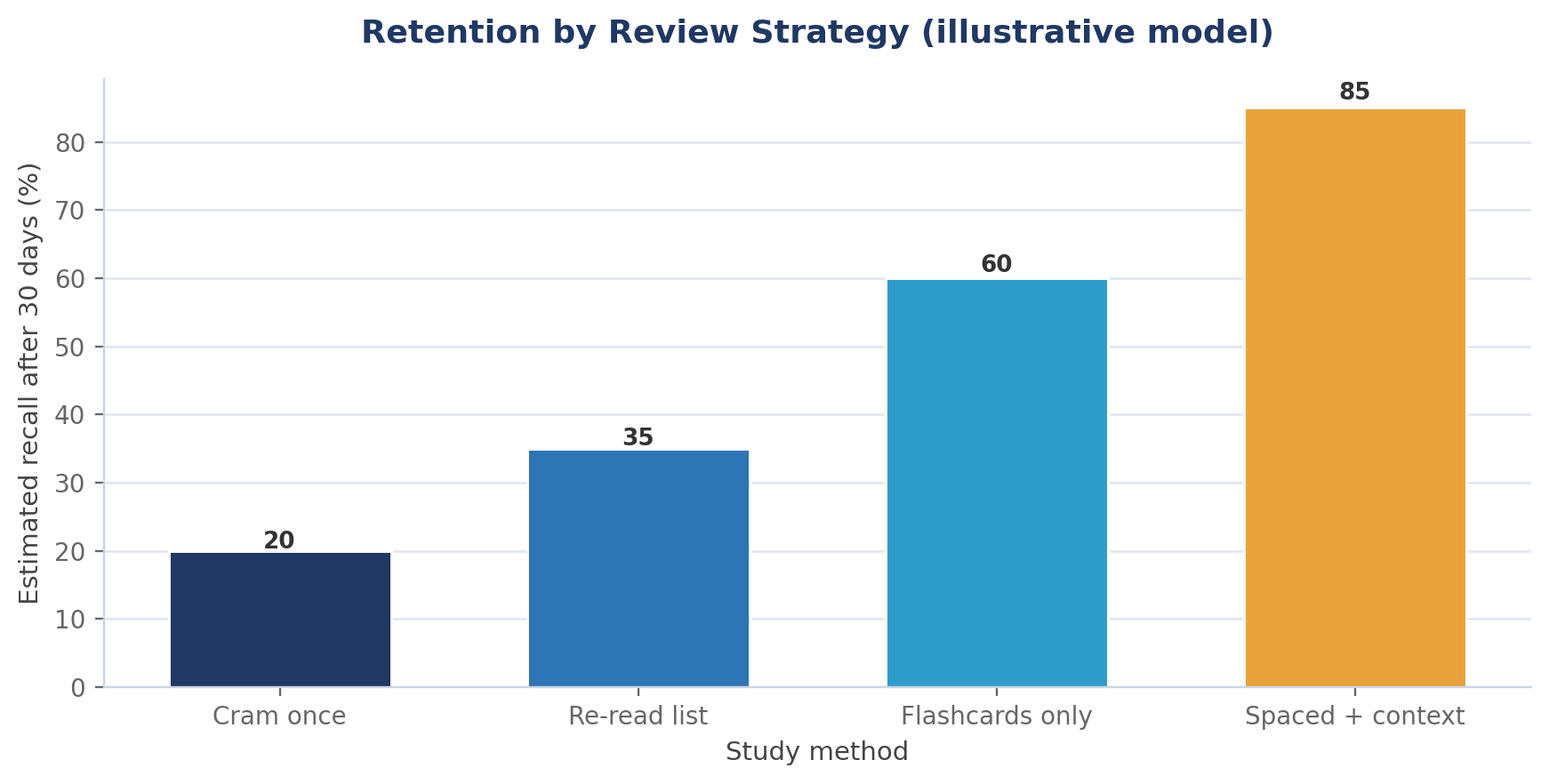
You've been there. You studied de fiets forty times, nodded proudly, and three days later stared at a bicycle like it was a stranger. Meanwhile a word you heard once in a Dutch podcast — gezellig — is welded to your brain forever. Annoying, right? The difference isn't talent. It's method. If you want to remember Dutch vocabulary, you need to work with how memory actually behaves, not against it. Let's fix this properly.
Why Dutch Words Slip Away So Fast
Your brain isn't a bucket that leaks. It's a filter that deletes what looks useless. A word repeated ten times in one sitting feels familiar, but familiarity is not memory. The moment you stop feeding it, the forgetting curve kicks in — fastest in the first 24 hours, then flattening out. Dutch adds its own twist: de and het, separable verbs, and words that look English but betray you (bellen means to call, not to ring a bell). So you're not just storing a word; you're storing a word plus a tiny grammar decision. No wonder plain repetition fails.
The fix is to rehearse at the right moments, in the right context, and with the right effort.
The Core Method: Spaced Repetition, Done Properly
Spaced repetition is the backbone of Dutch vocabulary memory. You review a word just as it's about to fade, and each successful recall pushes the next review further out. Tools like Anki, or a paper Leitner box, automate this. But automation alone isn't magic — the quality of the card decides whether the word survives.
Keep these rules:
- One idea per card. A word plus one meaning. Not five.
- Always add the article. het huis, not huis.
- Add a sentence, not just a translation. Context is glue.
- Say it out loud. Dutch sounds are physical; use your mouth.
- Fail honestly. If you guessed, mark it wrong.
Build Dutch Flashcards That Don't Bore You
A Dutch flashcard should make your brain work, not just flip. Try these card types and rotate them so your deck stays lively.
Add a picture when you can. Add an absurd detail when you can't. "De kat zit in de soep" is far stickier than "de kat" alone — your brain keeps what's strange.
Context Beats Lists: The Dutch Word List Trap
Here's the uncomfortable truth: a pure Dutch word list is a starting point, not a strategy. Words learned in isolation decay because they have nowhere to live. Words learned inside a phrase attach to a memory, a feeling, a situation — and those survive.
So take that list and immediately do something with it:
- Write one true sentence per word about your own life.
- Group by situation — supermarket, doctor, weather, work.
- Record yourself reading the sentences and replay them on your commute.
- Revisit the same 20 words for a week instead of 140 words for one day.
Stop collecting words — start owning them
Our Dutch course pass turns vocabulary into conversations with structured lessons, audio, and review built in. Get the full Library and finally use what you learn.
Unlock the Dutch course pass →Create a free accountMake Dutch Vocabulary Memory Physical and Social
Memory improves when more of your senses show up. Dutch rewards this because the language is full of brilliant sounds — g, ui, sch, the double vowels — that your ears can grab onto.
- Say words out loud. Exaggerate. Feel the g in goed scratch your throat.
- Walk while you review. Movement boosts encoding.
- Teach someone. Explaining gezellig to a friend cements it instantly.
- Talk to real people. A Dutch conversation or a language exchange makes words matter.
- Sing it. Dutch pop is surprisingly catchy, and choruses are free spaced repetition.
A Simple 15-Minute Daily Routine
You don't need four hours. You need consistency and a little structure.
Do this five days a week and, by most learners' experience, a few hundred words become genuinely usable within a couple of months. That's not a guarantee — it's pacing, and your mileage will depend on how much you speak.
Common Mistakes That Kill Retention
- Learning words you'll never use. Choose high-frequency Dutch first.
- Skipping articles. You'll relearn every noun twice.
- Only recognising, never producing. Speaking is the real test.
- Reviewing in random order only. Mix blocks and interleaving on purpose.
- Quitting after a bad day. Missing one session is fine. Missing ten resets you.
Turn stubborn words into second nature
With a Dutch course pass you get guided lessons, native audio, and review systems that handle the hard parts for you. Learn once, remember longer — and actually enjoy it.
Start your Dutch course pass →Create a free accountWant to see how the whole programme works before you commit? You can create a free account and explore the Dutch materials at your own pace.
Frequently Asked Questions
How many Dutch words should I learn per day? Most learners do well with 5–10 new words daily alongside steady review. Consistency matters far more than volume — 7 words a day for a year beats 50 words once.
Are Dutch flashcards worth it? Yes, especially for spaced repetition — but only if cards contain context like a full sentence and the correct article (de or het). Bare translation cards fade fast.
Do I need to learn de and het words separately? Always learn the article with the noun. Treat het huis as one single word. Relearning articles later costs you double the effort.
How long until Dutch vocabulary sticks permanently? Words typically need five to seven successful spaced recalls before they feel stable. With daily practice, many learners reach that within weeks for each word — but only words you actually use stay.
References & Further Reading
- Ebbinghaus, H. — *Memory: A Contribution to Experimental Psychology* (1913, archive.org)
- Anki — official manual on spaced repetition
- Cepeda, N. J. et al. — "Spacing effects in learning" (*Psychological Bulletin*, 2006)
- Dutch Grammar — nouns and articles (de/het)
- Language Skills — Dutch courses and resources