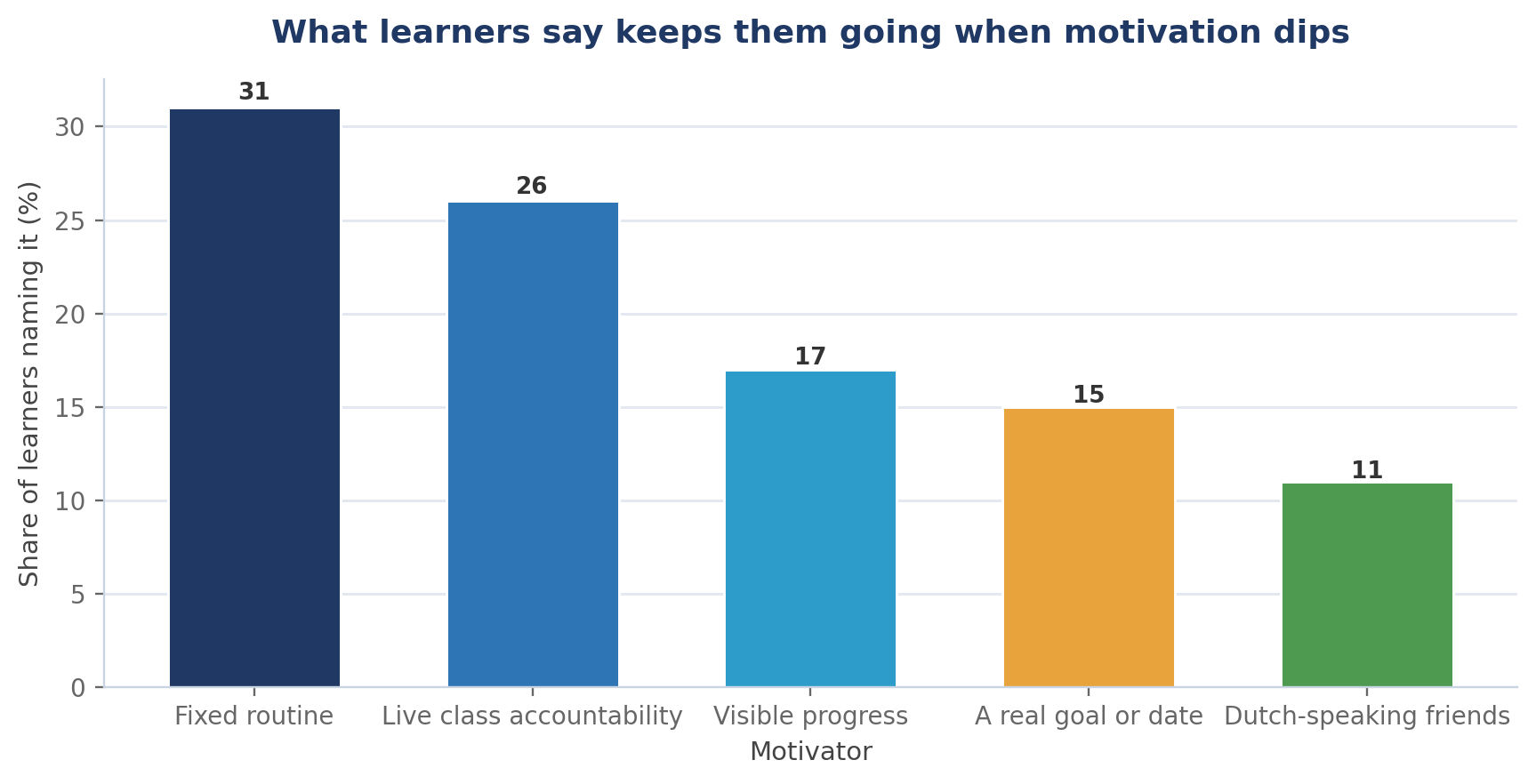
Nobody quits Dutch in week one. They quit in week six, when the novelty has worn off, the grammar has stopped being cute, and the gap between what they understand and what they can say has become uncomfortably visible. Motivation is not the problem at that point. The absence of a system is.
Here is the practical truth: motivated learners are not more enthusiastic than you. They have simply arranged their lives so that continuing is easier than stopping.
What you will get from this guide
- Why motivation always dips, and when
- The difference between motivation and habit
- Six systems that survive a bad week
- How to measure progress when it feels invisible
The motivation curve, honestly
The dip is not a signal that you are bad at languages. It is the normal shape of learning anything. The learners who succeed are the ones still present in week seven.
Motivation versus habit
Motivation is a feeling. Feelings are weather. Habit is architecture.
The goal is to make Dutch so ordinary that skipping it would feel strange — like brushing your teeth.
Six systems that survive a bad week
A scheduled AI tutor session deserves a special mention. A voice tutor waiting for you at a set time is a highly effective anti-quitting device, because it converts intention into appointment.
Turn Dutch from a mood into an appointment
A Course Pass (Dutch) gives you a personal AI voice tutor at a fixed time, every week — the accountability that keeps learners going through week six and beyond.
Start Dutch lessons →Create a free accountMaking progress visible
Feeling "not good enough" is usually a measurement problem. Fix the measurement and the feeling follows.
That last list is the secret weapon. Most learners track what they still get wrong. Track what you have stopped getting wrong, and the plateau suddenly has steps.
The two-week rule
Never let two weeks pass without Dutch. Not "two weeks without serious study" — two weeks without any Dutch at all. Once a language disappears from your week entirely, restarting costs far more than the maintenance would have.
On bad days, do the minimum: five minutes of listening, or one voice note, or two sentences written down. The point is not the learning. The point is that Dutch remains part of your life.
When it is genuinely time to change something
Sometimes the problem is not discipline but design.
Change the method before you abandon the goal. Most people who quit Dutch were using the wrong method, not lacking willpower.
Get the accountability and the variety in one place
Self-paced Dutch lessons with a personal AI voice tutor mean structured material that changes with your interests, and feedback that proves you are moving. That is what keeps learners learning.
Explore Dutch courses →Create a free accountFrequently Asked Questions
Why do I lose motivation learning Dutch? Motivation naturally dips around weeks four to eight, when novelty fades and the plateau appears. This is normal; the cure is a routine rather than more enthusiasm.
How do I stay consistent with Dutch? Fix a daily time, set a five-minute minimum, and schedule one AI tutor session each week. External appointments beat internal promises.
How long does it take to feel comfortable in Dutch? Progress varies by learner and depends heavily on speaking hours. There are no guaranteed fluency timelines.
Should I stop if I lose interest? Reduce rather than stop. Maintaining a small weekly contact with Dutch preserves most of your progress and makes restarting easy.
References & Further Reading
- Nederlandse Taalunie — Dutch Language Union: learning resources
- Nuffic — Dutch language and education information
- Council of Europe — CEFR levels and self-assessment checklists
- NPO — Dutch public broadcaster for listening practice
- Dutch for Children — Dutch learning materials and activities