Let's be honest: the difference between people who speak Dutch and people who "started Dutch once" is almost never talent. It's repetition. A dutch study habit beats a heroic weekend cram every single time — and it isn't about willpower, it's about design.
Here's the good news. Dutch is one of the friendliest languages in Europe for English speakers to practise daily. Short words, familiar sentence order, and a mountain of free media. The only missing piece is a routine you'll actually keep. So grab a coffee, and let's build one together.
Why Daily Beats Marathon
Your brain doesn't consolidate new vocabulary in one long sitting; it consolidates it between sittings. Ten focused minutes today, tomorrow, and the day after will outperform a four-hour slog next Saturday. Memory researchers call this the spacing effect, and it's one of the most reliably reproduced findings in learning science.
There's a second reason too: Dutch pronunciation is physical. Your mouth needs reps, not lectures. Saying "goedemorgen" thirty times across a month beats reading about it thirty times in one night.
Attribute honestly: the exact number of repetitions needed for a word to stick varies wildly by person and by word. Treat any "you need X reps" claim — including this article's — as an estimate, not a law.
Pick Your Time Block (And Defend It)
Consistency doesn't require an hour. It requires a slot that happens every day regardless of mood. Choose one:
Pick one. Not three. A habit you can't miss is worth more than a habit that looks impressive on paper.
Then apply the classic rule: attach it to something you already do. "After I pour my morning coffee, I open my Dutch deck." That's an implementation intention, and it's the closest thing to a cheat code in habit-building.
The 20-Minute Daily Dutch Routine
Here's a template that balances input, output, and review. You don't have to follow it exactly — you just have to follow something.
That final two minutes matters more than it sounds. Write one line: what I did, how it felt. You're building a visible chain — and chains are motivating.
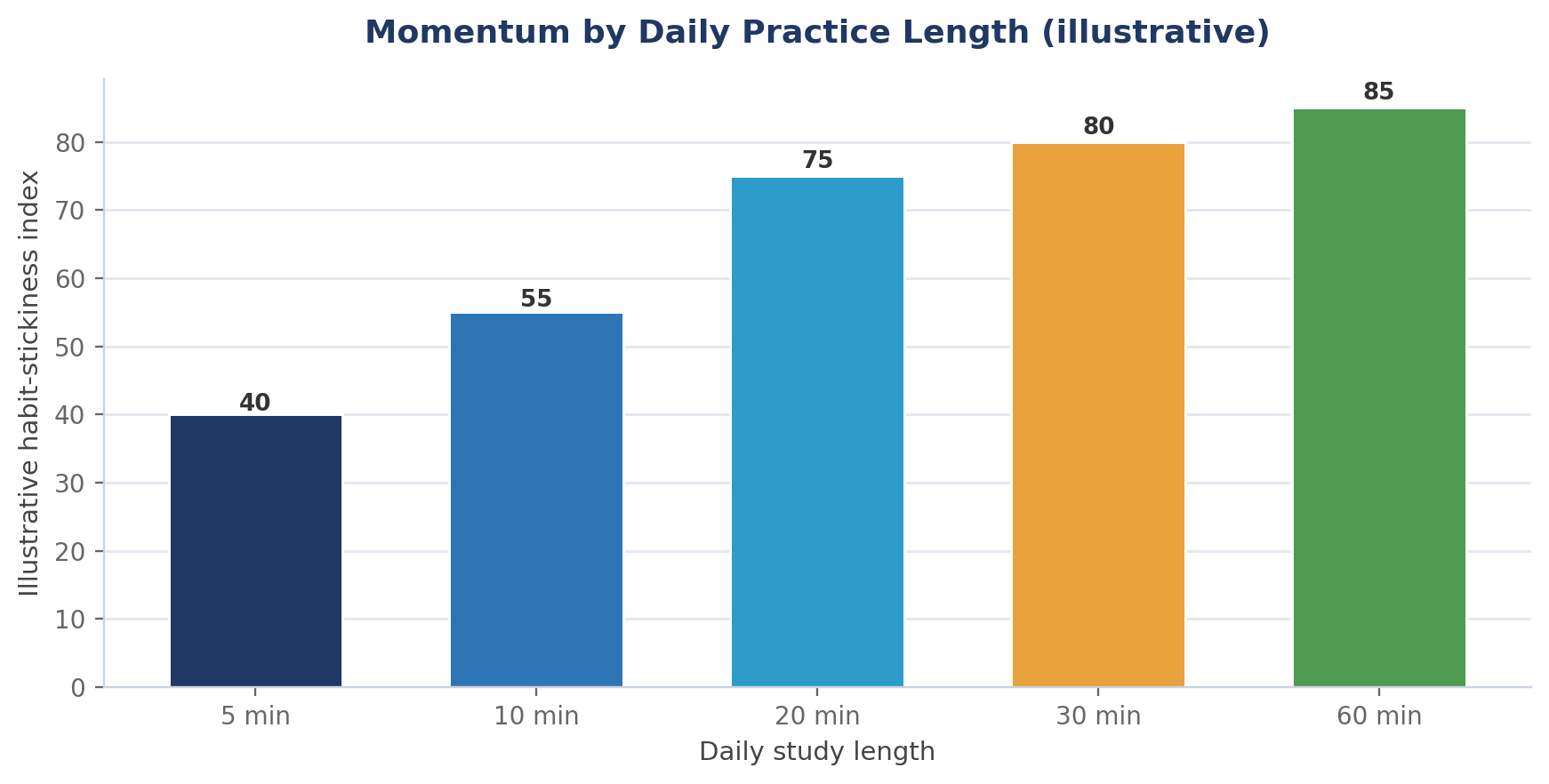
Notice the curve flattens fast. The jump from 5 to 20 minutes is enormous; the jump from 30 to 60 is modest. If you're short on time, protect the streak, not the duration.
Turn twenty minutes into real progress
A structured course removes the "what do I study today?" tax that kills most streaks. Follow a proven path and let your daily habit compound into actual conversation.
Start the Dutch course →Create a free accountMake Starting Ridiculously Easy
The hardest part of any daily dutch practice is the first thirty seconds. Lower that bar until it's almost embarrassing.
- Keep your flashcards open on a browser tab you'll see.
- Leave a Dutch book on your pillow.
- Pre-download three podcast episodes for offline listening.
- Set your phone's language to Dutch for one app you use daily.
Friction removal beats motivation every time. Motivation is weather; friction is architecture.
Track It Without Obsessing
Tracking helps — but gamified tracking can backfire if missing one day feels like failure. Try a two-day rule instead: never miss twice. One skipped day is life. Two skipped days is a new, worse habit forming.
A useful check: record yourself speaking for 60 seconds on the first of each month. Do nothing else with it. Play it back in three months. The difference is the point — and it's far more motivating than any app streak.
Handle the Inevitable Slump
You will have a bad week. Travel, illness, a deadline, a Netflix binge. Here's the playbook:
- Shrink, don't stop. Two minutes counts as a win.
- Change the mode. Too tired to study? Listen to Dutch music instead.
- Re-anchor. Return to your original time block and trigger.
- Forgive fast. Guilt consumes exactly the energy you need for practice.
People who stay consistent learning Dutch long-term aren't the ones who never miss. They're the ones who miss and come back the next day without a story about it.
Level Up When It Gets Easy
Once the habit feels automatic — usually a few weeks in — add a weekly stretch session. Fifteen extra minutes for something genuinely hard: a conversation partner, a news article without subtitles, a short essay you write and get corrected.
Keep the daily habit boring and the weekly goal ambitious. That combination is what actually moves you forward.
Stop guessing, start progressing
Our Dutch course gives you the daily structure, corrections, and sequencing that self-study alone rarely supplies. Build the habit — we'll handle the roadmap.
Get your Dutch course pass →Create a free accountFrequently Asked Questions
How long does it take to form a daily Dutch habit? Estimates vary widely — commonly cited figures range from about three weeks to several months, and the original habit-formation research found huge individual variation. Treat any single number as a rough guide rather than a deadline.
Is 10 minutes a day really enough to learn Dutch? Ten minutes daily is a strong foundation and beats sporadic long sessions for retention, though absolute progress toward fluency also depends on total hours overall. Many learners pair short daily practice with one longer weekly session.
What if I miss a day? Skip the guilt and simply resume the next day. A useful rule is to never miss two days in a row, since that's when a habit starts to unravel.
Should I study grammar or vocabulary first? Start with a blend. High-frequency vocabulary and simple sentence patterns give you quick wins, while grammar explains the patterns you're already hearing. Alternating keeps motivation high.
References & Further Reading
- Duolingo Research — learning science and habit reports
- Netherlands Institute for Curriculum Development (SLO) — Dutch as a second language
- European Commission — Common European Framework of Reference for Languages
- Lally et al. (2010), *How are habits formed?*, European Journal of Social Psychology
- Create your account and start today at LanguageSkills