The Dutch learning market has never been busier. Free apps with bright green owls, paid apps with friendly chatbots, video courses, textbooks, and self-paced lessons that cost more than the first three combined. Which one actually gets you speaking Dutch?
The honest answer is that they are not competing for the same job. One is brilliant at vocabulary volume. The other is the only thing that teaches you to speak. Choosing between them is the wrong question — the right one is in what order and in what proportion.
What you will get from this guide
- What apps genuinely do better than any course
- The exact point where app learning plateaus
- What live courses provide that apps structurally cannot
- A combined plan that uses each for what it is good at
Where apps genuinely win
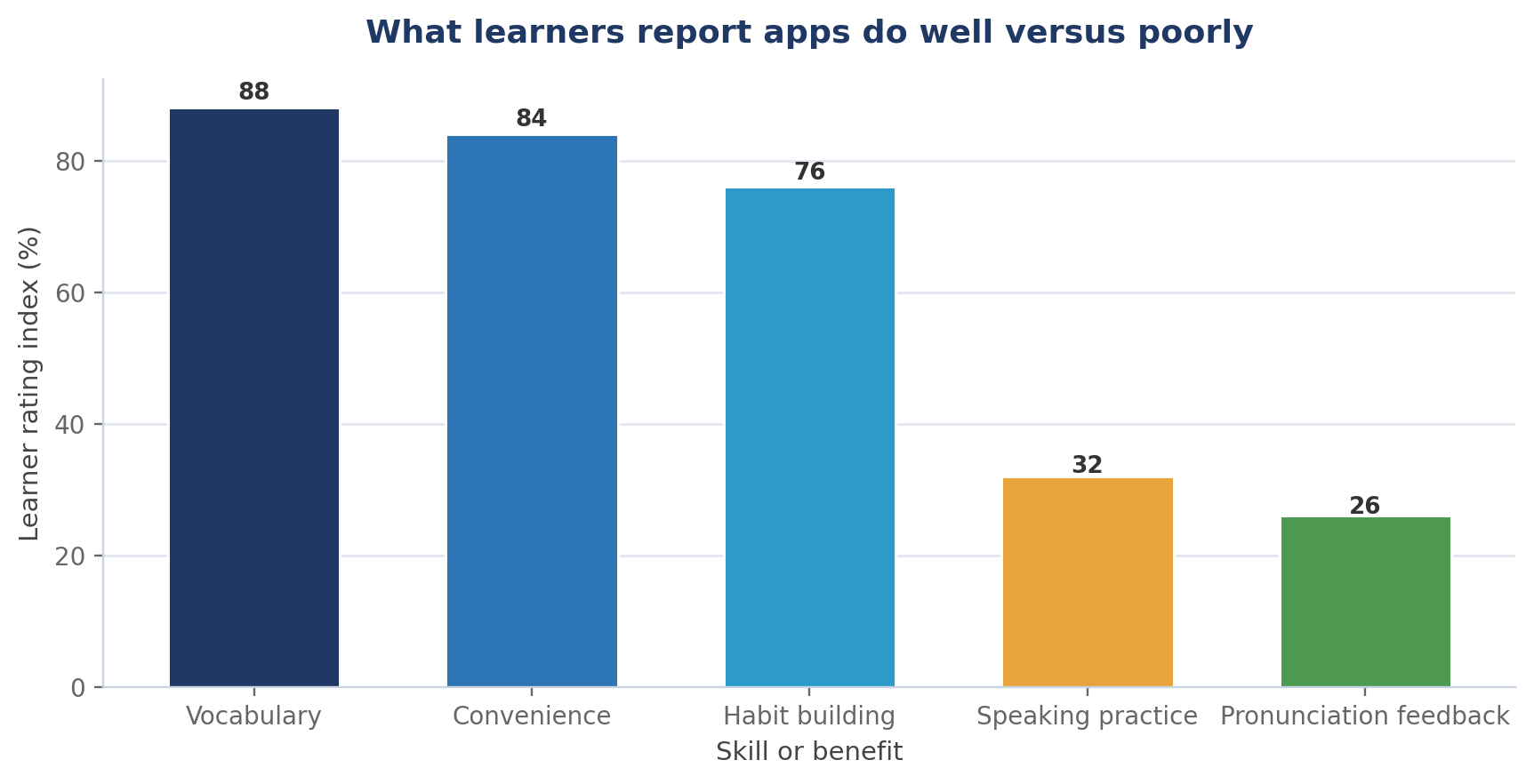
Let us be fair to the apps. For two specific jobs, nothing else comes close.
If your goal is to build a base of a thousand Dutch words, an app is a superb tool. The repetition volume alone justifies it.
Where apps structurally cannot help
Then there is the part that no app solves, not through lack of effort but by design.
Notice the shape of that list. Every item is about interaction. Apps are excellent at transmission and terrible at interaction.
The plateau, described precisely
The plateau usually arrives around A2. Learners can read, recognise a lot, and construct careful sentences. Then they meet a real Dutch speaker and everything falls apart.
The uncomfortable truth is that the plateau is not caused by the app being bad. It is caused by doing only one kind of practice.
Keep the app. Add the thing it cannot give you.
A Course Pass (Dutch) adds a personal AI voice tutor to your week, so the vocabulary you build in an app finally gets used in structured speaking practice — with AI feedback, at your own pace.
Try the AI voice tutor →Create a free accountWhere a structured course wins
The critical difference is structured speaking practice with feedback. Language is a skill built through use, and the AI voice tutor gives you that practice any time.
The honest cost comparison
Costs vary by provider and country, so treat these as relative rather than absolute. The pattern is what matters: the cheapest option is the slowest, and the difference is measured in months, not euros.
The combined plan that works
Do not delete your app. Reposition it.
That is roughly two hours a week plus structured speaking practice — enough to move steadily from A1 towards B1 within a year. Apps handle the volume. A course handles the transformation.
What to look for in a Dutch course
If a course does not make you speak, it is a video library — useful, but not what you are paying for.
The best of both, in one week
Keep your app for vocabulary and add a personal AI voice tutor for everything else. Most learners notice the difference within a month — because they finally start talking.
Start your Dutch course pass →Create a free accountFrequently Asked Questions
Can I learn Dutch with an app alone? You can reach a reasonable A2 reading and listening level, but speaking rarely develops. Almost all successful app learners eventually add structured speaking practice.
Are Dutch apps a waste of money? No. They are efficient for vocabulary and habit building. They simply cannot teach interaction, pronunciation diagnosis or register.
How long until I can speak Dutch? With an app plus regular speaking practice, many learners hold basic conversations within three to five months and reach B1 within a year.
Is an online Dutch course as good as an in-person one? For conversation practice, online is often better, because you get more speaking time and flexible scheduling. In-person wins mainly for local immersion and social contact.
References & Further Reading
- Nederlandse Taalunie — Dutch Language Union: resources and policy
- Nuffic — Dutch language and education information
- Council of Europe — CEFR levels and descriptors
- Dutch for Children — Dutch learning materials and activities
- NPO — Dutch public broadcaster: audio and video for listening practice