Short answer: yes — for most learners who actually want to use Dutch, not just admire it from a distance. But the longer answer is the one that saves you money, because "worth it" depends entirely on your deadline, your discipline, and what's waiting on the other side of fluency. Let's pull the price tag apart and see what's really inside.
The Real Question Behind "Is a Dutch Course Worth It"
Nobody wakes up craving grammar drills. You're asking this question because something is pushing you: a job in Amsterdam, an inburgering exam, a Dutch partner's family dinner where everyone switches to English the second you open your mouth. That pressure is the actual price of not learning. Every year you stall, the gap between "I'll start soon" and "Ik spreek een beetje Nederlands" costs you opportunities.
Free resources are brilliant. They're also a buffet with no closing time — you can graze forever and never finish a plate. A paid course does one unglamorous thing incredibly well: it gives you a map and a deadline.
What You're Actually Paying For
Here's the honest breakdown. When you buy Dutch lessons, you're not buying words — you're buying structure, feedback, accountability, and speed. Words, sadly, are free everywhere.
Notice the pattern: everything money buys is about feedback and pressure. Those are the two things self-study quietly can't give you.
Dutch Course Cost: What the Numbers Look Like in 2026
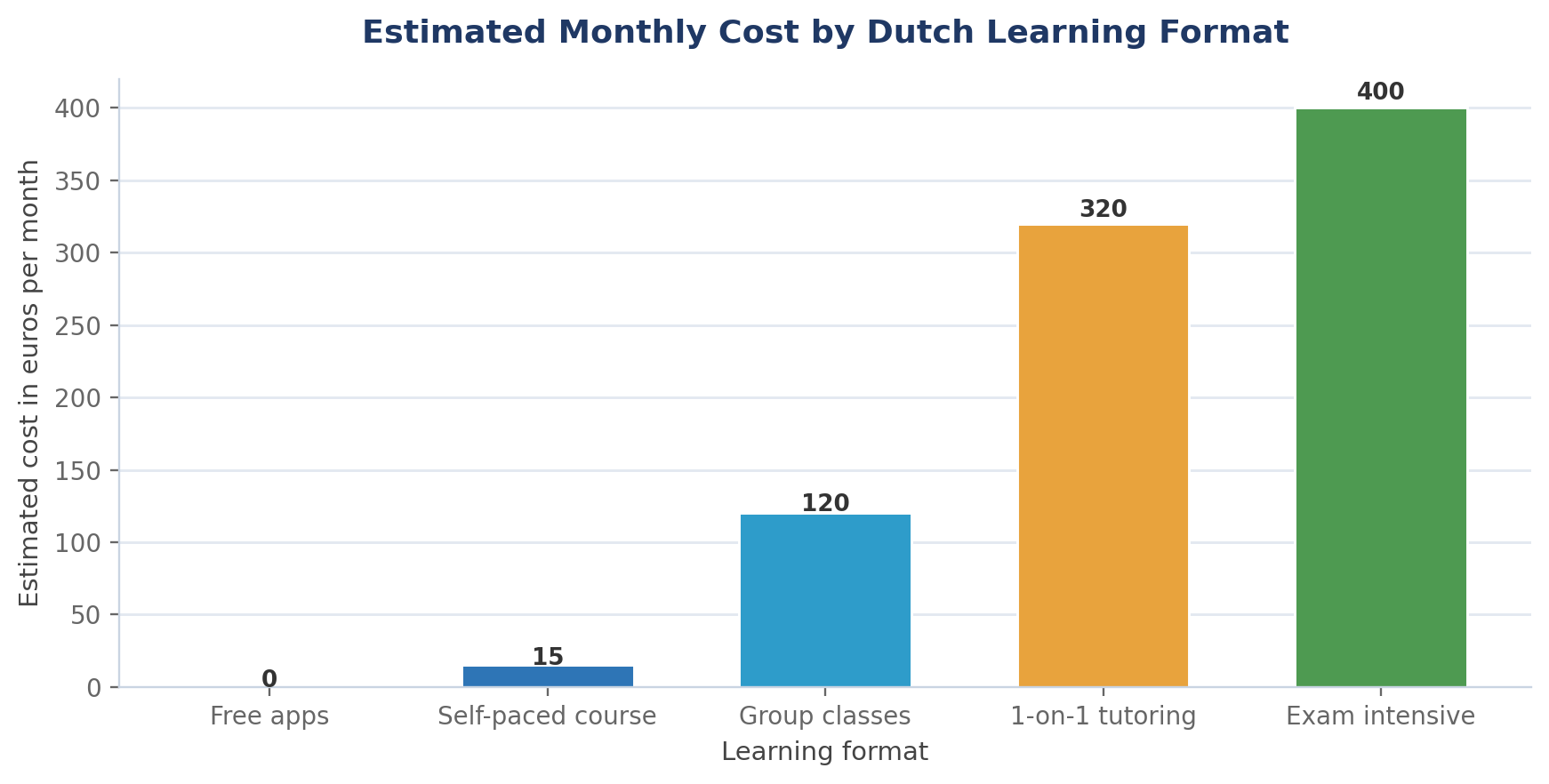
Prices vary wildly, so treat any specific figure as an estimate rather than gospel — platforms repackage and reprice constantly. What stays stable is the shape of the market.
A single café lunch per week, redirected, covers most self-paced courses. That comparison usually ends the debate.
Free vs Paid: The Hidden Costs Nobody Mentions
Free is never free. It costs time, and time has a price you pay whether or not you invoice yourself.
If your time is worth anything — and it is — the free path is often the expensive one in disguise. Ten months of drifting costs more than three focused ones.
Stop Guessing, Start Speaking
Enroll once, get a structured path, and finally hear yourself say real Dutch sentences out loud. Your future self, ordering coffee in Utrecht, says thanks.
Get the Dutch Course Pass →Create a free accountWho Should NOT Pay (Yes, Really)
Honesty is a sales skill too. Skip the checkout if you're purely curious and have zero deadline — a free playlist will serve you fine. Skip it if you genuinely enjoy unstructured wandering; that's a hobby, not a failure.
But if any of these sound like you, paying is less a purchase and more a shortcut to a life you actually want:
- You've studied for months and still freeze when spoken to.
- You have an exam, visa, or job interview with a date attached.
- You keep restarting at chapter one.
- You want to be in the conversation, not beside it.
That last one is the whole game. A second language is a membership card, not a certificate on a wall.
How to Choose the Best Dutch Course Without Getting Burned
Use this checklist before you hand over a cent. It'll save you from pretty platforms with shallow content.
If a course ticks speaking, feedback, and clear progression, the price stops being the question — only the timeline is.
The ROI of Fluency
Dutch fluency isn't a line item; it's leverage. It widens your job pool, deepens your friendships, and turns everyday bureaucracy from a maze into a hallway. Compare that against the monthly cost of a course and suddenly the maths isn't close.
Want a smoother start and a community around you? Create your free account and poke around before you commit.
Pay Once, Speak for Years
A Dutch course is the rare expense that keeps paying you back at every family dinner and job interview. Start today and make fluency a decision, not a someday.
Unlock Your Dutch Course Pass →Create a free accountFrequently Asked Questions
Is a Dutch course worth it if I can learn free on YouTube? Yes, if you have a deadline or you keep stalling — YouTube is fantastic for input but weak on feedback and accountability, which are exactly what fluency requires.
How much do Dutch lessons cost in 2026? Estimates range from free apps to roughly €15/month for self-paced courses, around €120/month for self-paced lessons, and €300+ for one-on-one tutoring; treat these as market ballparks, not official figures, since providers reprice often.
Can I learn Dutch without paying anything? Absolutely — it's slower and relies on strong self-discipline, but plenty of people reach conversational Dutch free. Paid options mainly compress the timeline.
What's the best Dutch course for beginners? The one that includes speaking practice, AI feedback, and a clear level progression — matching your specific goal (work, exam, or daily life) matters more than brand names.