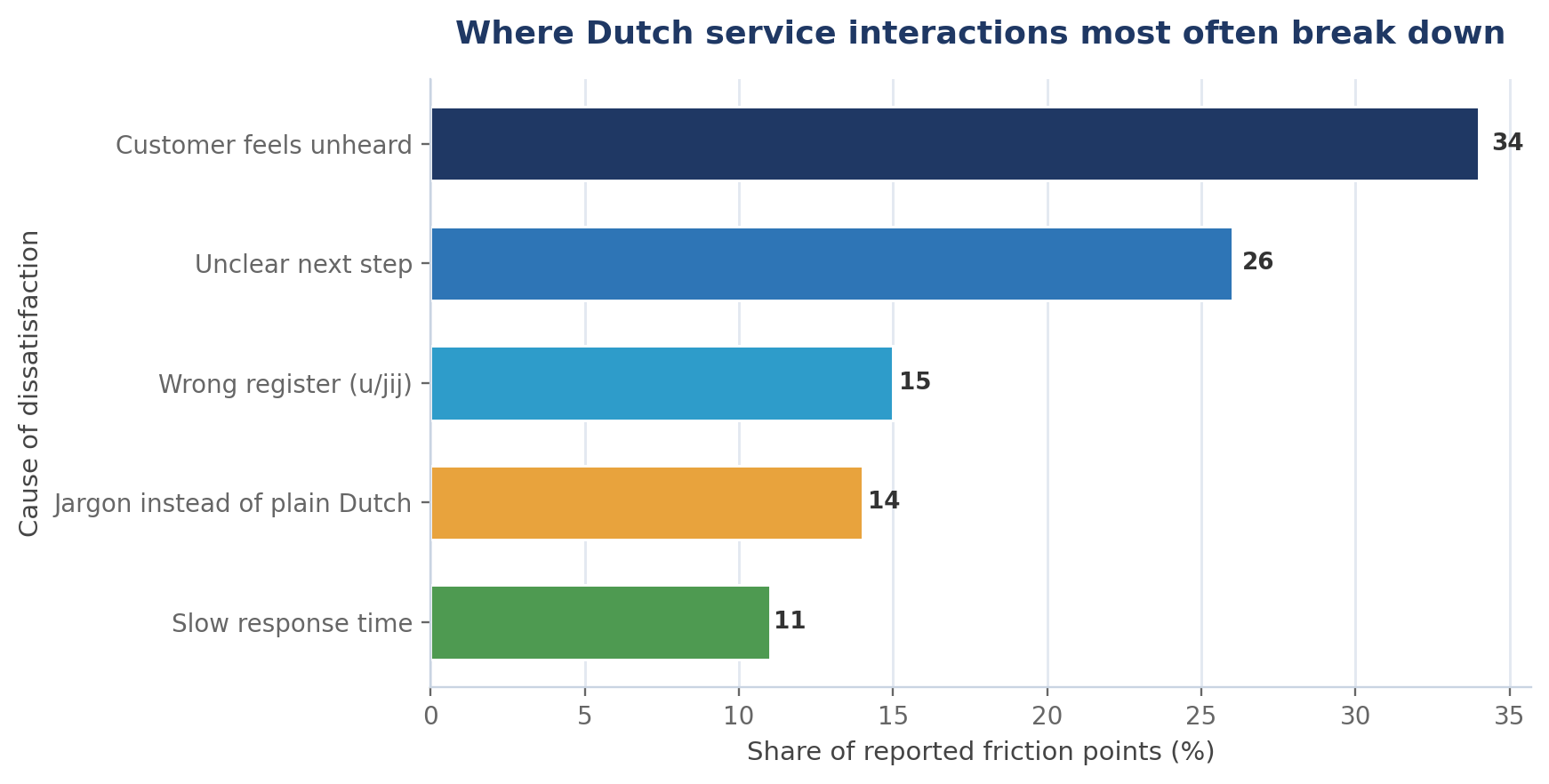
There is a particular silence that follows a badly handled phone call. You have the vocabulary. You have the product knowledge. What you do not have is the Dutch sentence that says "I understand why this is frustrating, and here is what I am doing about it" — politely enough to keep the customer, firmly enough to keep control.
Dutch customer service is its own register. It is more direct than English professional speech, more formal than Dutch friends talking, and ruthless about one thing: never leaving the customer without a next step.
What you will get from this guide
- Greetings and openings that set the right tone
- Phone and email phrases by situation
- Complaint handling and de-escalation language
- U vs jij: the choice that decides the whole call
- Closing phrases that protect your CSAT score
The register question: u or jij?
This is the first decision in every Dutch interaction, and getting it wrong colours everything after it. Default to u with customers. Switch only if they switch first.
One rule saves you entirely: mirror the customer. If they write je, you may write je. Until then, u is never rude — but a premature jij can absolutely land badly.
Opening a call or conversation
Note the pattern: Dutch service language leans on kunnen and mogen for politeness rather than long apologetic chains. Shorter is politer.
Handling complaints without escalating them
This is the skill that separates a junior agent from a senior one. The Dutch expectation is directness plus ownership — acknowledge, do not over-apologise, then state the action.
Three phrases to avoid: dat kan ik niet without a follow-up, dat is niet mijn afdeling, and anything that blames the customer. In Dutch service culture, ownership beats deference.
Written Dutch: email and chat
Written Dutch has its own conventions, and the formality curve is steep.
Consistency matters more than perfection. Pick a register and hold it through the whole thread.
Ready to turn reading into real Dutch? Start your self-paced course today.
Start the Dutch course →Create a free accountSound professional from the first sentence
Reading phrases is one thing. Delivering them under pressure, on a live call, with a frustrated customer waiting, is a different skill entirely. Self-paced Dutch lessons with an AI voice tutor rehearse exactly that — real scenarios, instant feedback, real confidence.
Button: See the Dutch Course Pass →
De-escalation and difficult moments
The rule behind all of them: never deliver a refusal without an alternative. Dutch customers accept no far better than they accept being left with nothing.
Building the habit
Ten minutes of role-play a day transforms this faster than any phrase list. Read each phrase aloud, then say it as though a real customer were on the line — because eventually, one will be. For authentic professional listening, Dutch public broadcasting and the Nederlandse Taalunie's resources are excellent free inputs.
Ready to turn reading into real Dutch? Start your self-paced course today.
Start the Dutch course →Create a free accountPractise before you are tested
A free account gives you a level check and scenario practice in Dutch — so your first difficult call is your second difficult call.
Button: Create your free account →
Frequently Asked Questions
**Should I use u or jij with Dutch customers?** Always start with u, even with younger customers, and switch only when they use jij first. Mirroring is the safest strategy.
What is the standard Dutch sign-off for business email? Met vriendelijke groet, is the universal professional standard. Hartelijke groet, is slightly warmer and still appropriate for most service contexts.
How do I apologise politely in Dutch? Use Mijn excuses or Het spijt me briefly, then move straight to the solution. Over-apologising reads as weak in Dutch service culture.
What Dutch level do I need for customer service work? Around B1 is the practical minimum for phone and chat support; B2 is usually expected for complex complaints and written correspondence.
References & Further Reading
- Nederlandse Taalunie — Dutch language standards, register and professional usage
- Nuffic — Dutch language requirements for study and work
- NOS — Authentic Dutch listening material
- SLO — Dutch language curriculum and level frameworks
- Council of Europe — CEFR levels and interaction descriptors