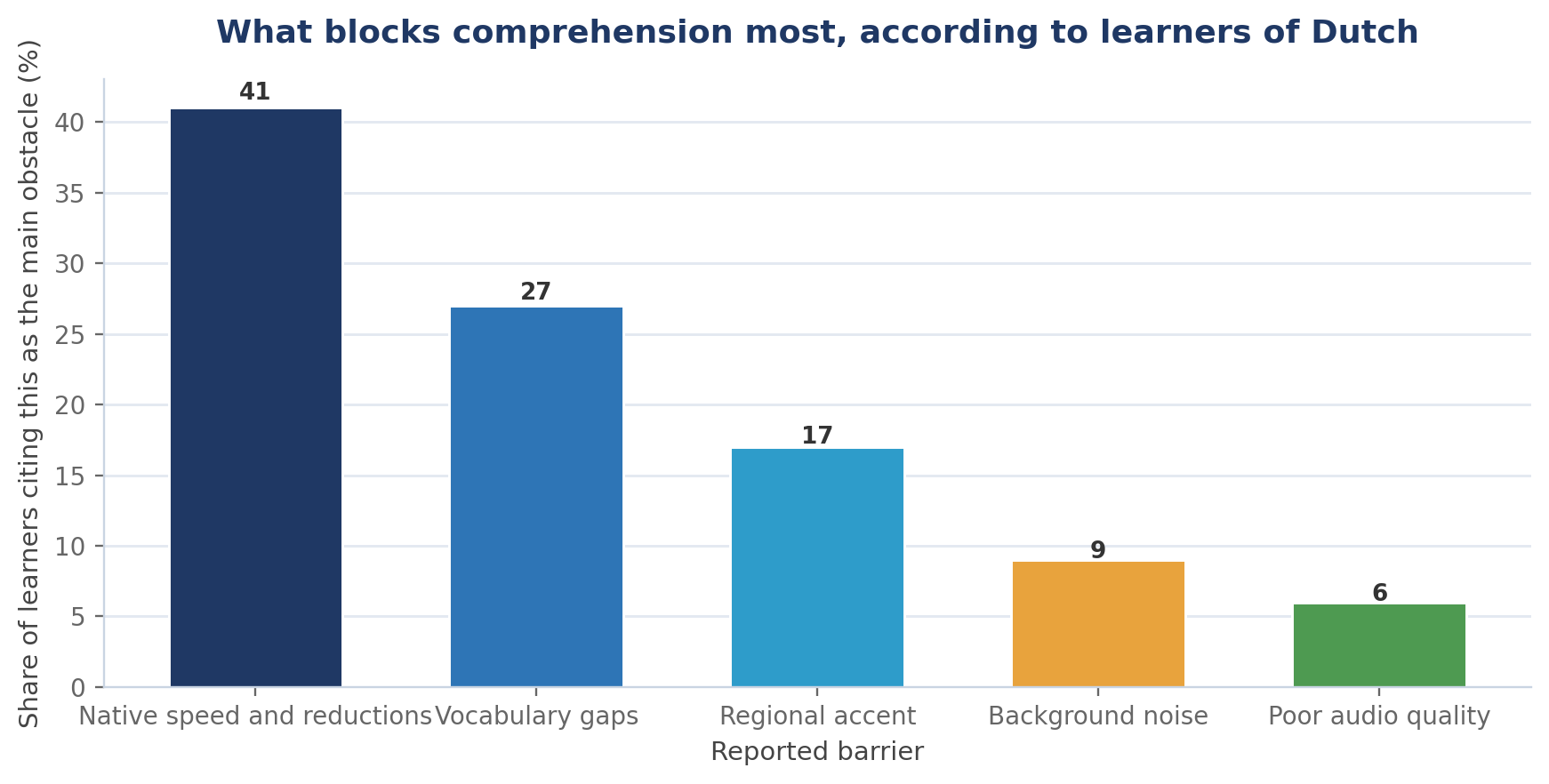
You studied for months. You can read a Dutch news article, order lunch, and understand your textbook audio perfectly. Then a colleague from Rotterdam says six words and you catch exactly none of them.
This is the single most common complaint among Dutch learners, and it is not a vocabulary problem. It is a sound problem. Native Dutch speakers do not speak too fast — they compress. Here is what they are doing, and how to train your ear to hear it.
What you will get from this guide
- Why Dutch sounds faster than it is
- The five compression habits native speakers use
- Why Dutch words you know vanish in speech
- A four-stage listening progression that works
- Drills you can run in 15 minutes a day
Why Dutch sounds fast (it isn't, quite)
Dutch has a dense consonant inventory and a habit of stacking syllables into single clusters: schrijven, sproeien, herfst. English ears are not trained for it, so the same number of syllables feels like more work.
But the real culprit is timing. Dutch is stress-timed, like English — unstressed syllables get squashed almost to nothing. Measured speech rates for Dutch and English are broadly similar; perception differs because those squashed syllables carry meaning.
The five compression habits
None of these is sloppy speech. They are the standard mechanics of the language at natural speed. Your textbook audio taught you the full forms and quietly forgot to mention that nobody uses them.
Why words you know vanish in speech
This is the part that demoralises learners. You have a solid de-and-het vocabulary and it still feels blank. Three reasons:
- Frequency masking. Fast speech has more energy in the mid range, exactly where Dutch consonants live.
- Reduced vowels. Unstressed e becomes a neutral schwa, so the word's shape changes.
- No gaps. Dutch speakers rarely pause between words — you get a single continuous stream to segment in real time.
The four-stage listening progression
Most learners jump from graded audio straight to radio. That is like learning to swim by entering the North Sea. Build the stages instead.
Spend real time at each stage. Two weeks per stage beats rushing through in a weekend, because the ear needs repetition, not novelty.
15-minute daily drills that actually work
Dictation is the one drill learners skip and the one that delivers most. Nothing exposes a hearing gap faster than writing down what you thought you heard and comparing it with the transcript.
Your ear does not need more words. It needs the same words, faster, more times.
Ready to turn reading into real Dutch? Start your self-paced course today.
Start the Dutch course →Create a free accountHear Dutch at real speed, with someone who can slow it down
A personal AI voice tutor lets you listen, respond and get instant feedback at your own pace — an environment where comprehension and production are trained together, with a tutor that can model slower speech and then push it faster.
Button: Explore the Dutch Course Pass →
Free resources worth your time
Background listening will not teach you Dutch on its own, but it does something important: it makes the sound of the language familiar, so your brain stops treating it as noise.
Ready to turn reading into real Dutch? Start your self-paced course today.
Start the Dutch course →Create a free accountTrain your ear with a plan, not a playlist
A free account gives you level-matched Dutch listening practice and a progress record, so you can see comprehension improving week by week instead of guessing.
Button: Create your free account →
Frequently Asked Questions
Is Dutch really spoken faster than English? Not measurably. It feels faster because of syllable density, consonant clusters and heavy reduction of unstressed syllables.
Why can I read Dutch but not understand it spoken? Reading gives you time to segment words. Speech arrives as one continuous stream with reduced forms, so the same vocabulary becomes far harder to decode.
How long until I understand fast Dutch? With daily listening practice, most learners follow simplified news within three months and native-speed conversation within six to twelve.
Should I use Dutch subtitles or none? Use them while training, then remove them. Subtitles build the sound-to-spelling link; removing them builds genuine listening.
References & Further Reading
- Nederlandse Taalunie — Dutch language levels, usage and learning resources
- NOS — Dutch news, including easy-language editions
- NPO — Dutch public broadcasting programmes
- Nuffic — Dutch language requirements for study and work
- Council of Europe — CEFR levels and listening descriptors