Dutch sounds like a locked door until the day it suddenly swings open — and music is one of the fastest keys. A three-minute song repeats the same sounds, the same rhythm and the same handful of words far more often than any conversation ever will. That repetition is exactly what your ear needs. Below you get a curated shortlist of Dutch songs to learn from, a lyric-study method that actually sticks, the vocabulary you absorb almost by accident, and the traps that catch every learner.
Why Music Trains Your Dutch Ear
Listening to Dutch at natural speed is brutal at first: sch scrapes, vowels glide, and whole syllables vanish. Music slows that chaos into loops. Dutch is a stress-timed language, so rhythm carries meaning — and a melody hands you that rhythm for free. Researchers call it prosody, and the Council of Europe's CEFR framework lists listening comprehension as a core skill long before fluency.
One song heard ten times beats ten news clips heard once — repetition is the whole trick.
Songs also lower the stakes. You are not decoding a stranger's question; you are humming along, catching words, missing words, and still enjoying yourself.
Start Here: Genres and Artists
You do not need to like everything below. You need three artists you genuinely enjoy, because you will replay them hundreds of times.
Prefer something gentler? Try Dutch children's songs and Sinterklaas classics; they use short sentences and heavy repetition. For older learners who like introspection, singer-songwriter repertoire by artists such as Maarten van Roozendaal rewards close listening. Stichting NOB, which supports Dutch education abroad, regularly recommends songs as a low-pressure entry point for young and adult learners alike.
The Lyric-Study Method
Do not just play a track in the background and hope. Run this loop instead.
That is under half an hour, and it trains three skills at once: listening, pronunciation and vocabulary. If you want structure around it, a free LanguageSkills account keeps your practice streak honest.
Keep a "song notebook" with one page per track. Write the title, the five words you looked up, and one sentence you can now say out loud. Ten songs later, you own fifty high-frequency words and ten natural phrases.
Vocabulary You Absorb from Songs
Nederpop is your friend here, because it lives in everyday language. These word families appear again and again.
Notice the pattern: high-frequency verbs plus emotional nouns. That is precisely the vocabulary the CEFR A2 and B1 descriptors expect you to control, and it arrives with a melody attached, which makes recall far stickier.
Turn songs into real conversations
Songs train your ear, but they cannot correct your grammar or answer your questions live. With the Course Pass you get a personal AI voice tutor that teaches structured lessons and speaking practice with AI feedback, converting the words you hum into words you actually speak.
Start your Dutch Course Pass →Create a free accountCommon Pitfalls: Dialect, Slang and Speed
Music is brilliant, but it is not a textbook. Watch for these four traps.
The Netherlands has Standard Dutch in the north and a distinctly different sound in Flanders, and regional dialects vary widely. Nederlandse Taalunie and Nuffic both note that learners who mix varieties too early get confused by vowel differences. Pick one anchor — usually Standard Dutch — and let music add flavour rather than replace structure.
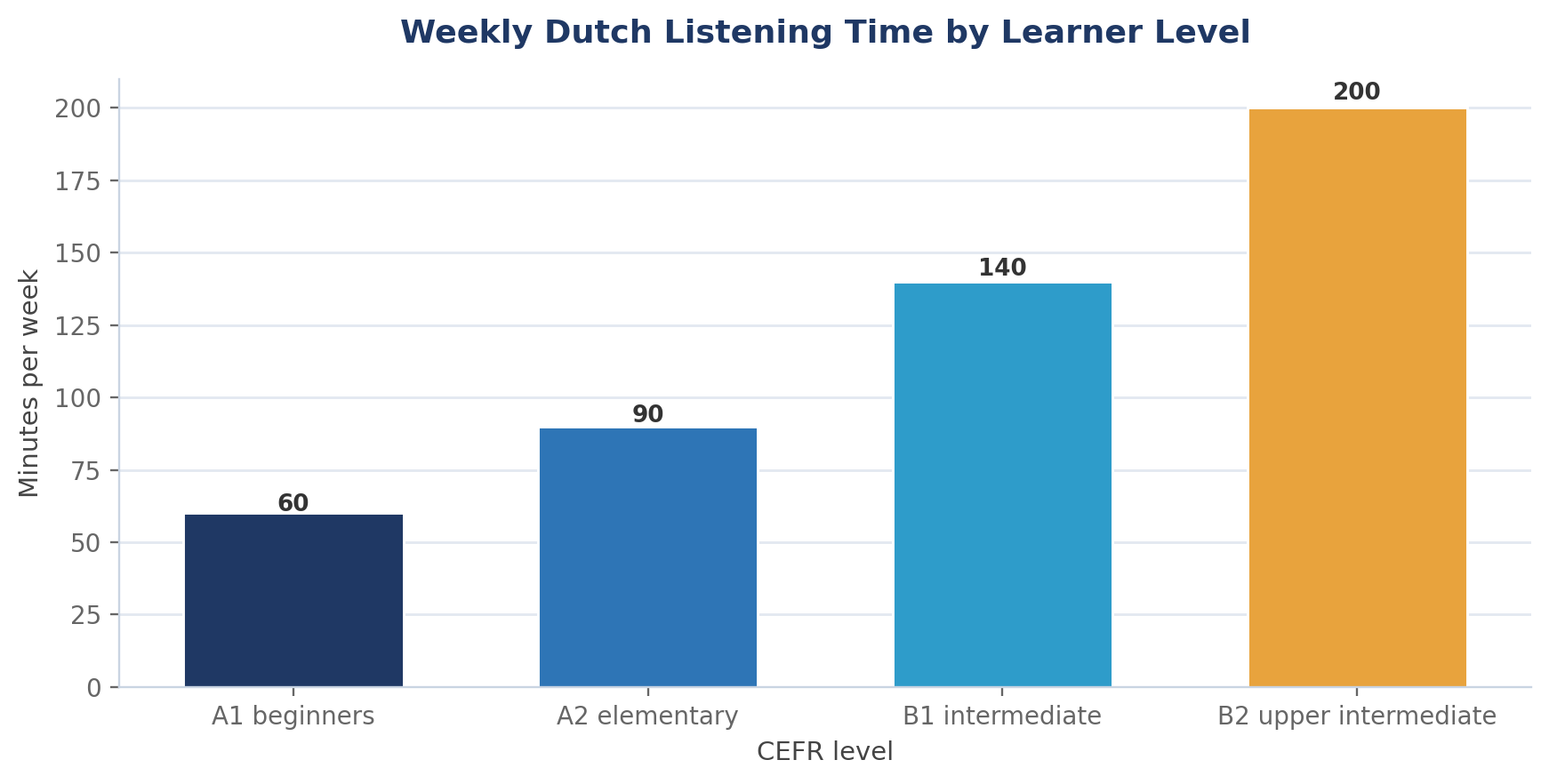
How Much Listening Do You Actually Need?
A rough picture of where learner listening hours typically go, based on CEFR level guidance from the Council of Europe.
FAQ
Can I really learn Dutch from songs alone? No — music is a superb supplement, not a full course. Use songs for listening, vocabulary and pronunciation, then add structured instruction and speaking practice to fix grammar and fluency.
Which Dutch songs suit absolute beginners? Start with children's songs, slow ballads and singers with clear articulation such as Boudewijn de Groot, then move into Nederpop by Acda en de Munnik and Bløf once your ear settles.
Should I learn the northern or Belgian variety first? Choose one and be consistent. Most learners start with Standard Dutch as used in the Netherlands, then add Flemish exposure later once the base is steady.
How often should I do lyric study? Three or four short sessions a week beat one long session. Fifteen minutes a day with one song is enough to build visible listening progress in about a month.
Build your Dutch listening streak today
Track your practice, save your song vocab and study at your own pace whenever you are ready. Creating an account takes seconds and costs nothing.
Create your free account →Create a free accountReferences
- Nederlandse Taalunie — official body for Dutch language policy and resources
- Nuffic — Dutch organisation for internationalisation in education
- NPO / NOS — public broadcaster with Dutch-language news and audio
- SLO — national expertise centre for Dutch curricula and language levels
- Stichting NOB — support for Dutch education abroad
- Council of Europe CEFR — the reference framework for language levels