Watching Dutch television is the most enjoyable homework in language learning. It is also the most commonly wasted. Learners put on a series, read English subtitles for six episodes, and absorb almost nothing but the plot.
The difference between watching Dutch and learning from Dutch is a set of small habits: which shows you choose, which subtitles you use, and how many times you watch the same fifteen minutes.
What you will get from this guide
- Which genres work at which level, and why
- A level-by-level viewing guide with real programme types
- The subtitle rule that makes television useful
- A weekly viewing routine that builds real comprehension
Why television works — when it is watched properly
Television is an input machine. It builds comprehension faster than any textbook, and it will never teach you to speak. Pair it with conversation and it becomes formidable.
Match the genre to your level
Children's news broadcasts are the single best-kept secret in language learning. They explain world events in simple Dutch, at a measured pace, with visual context — and they are made for people who are still learning the language, which is exactly your situation.
A level-by-level viewing guide
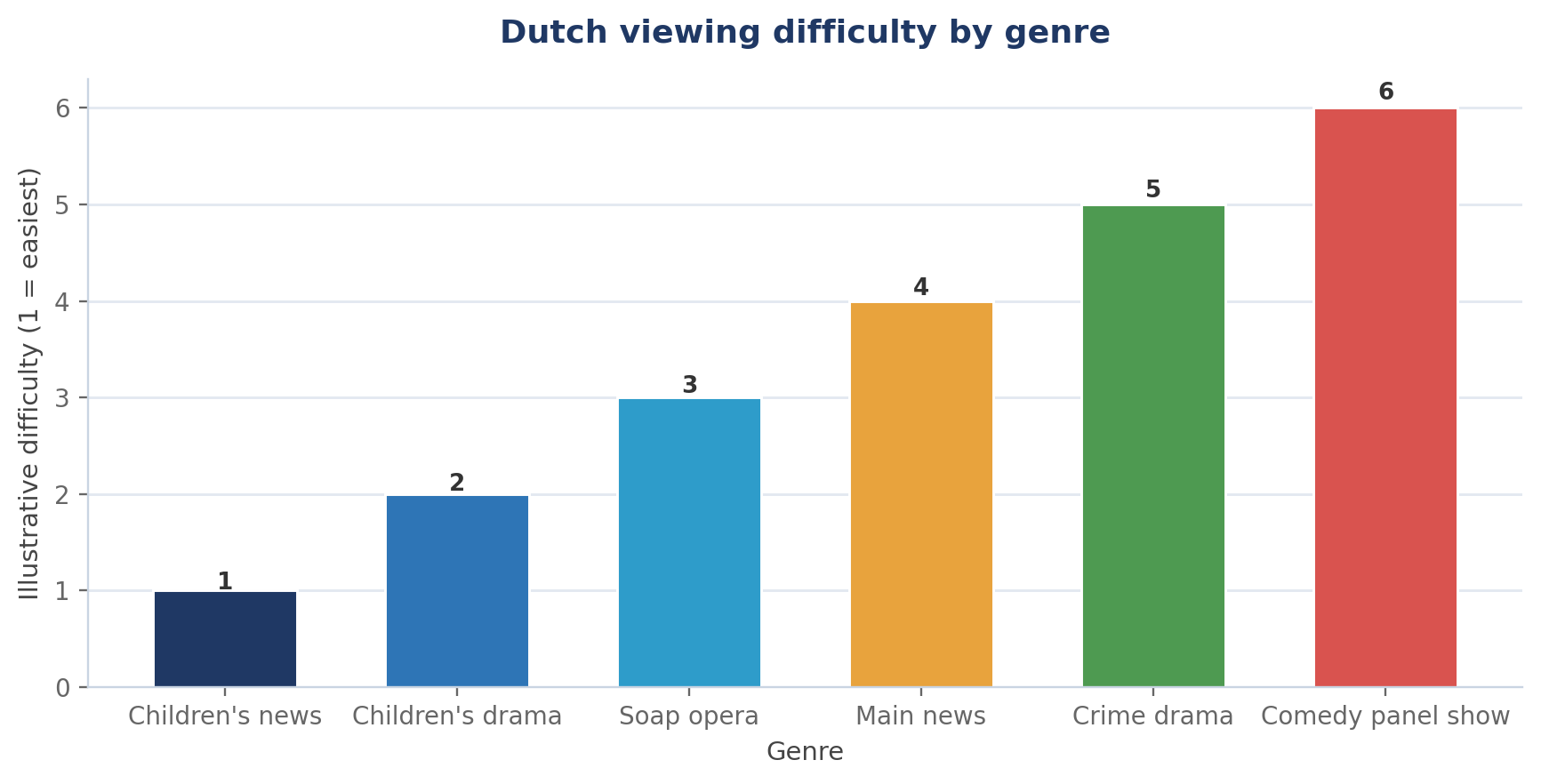
The progression is deliberate: start where the language is adapted for learners, and move towards content made for natives. Trying to start with a fast comedy panel show is like starting piano with a concerto.
Turn watching into listening progress
A personal AI voice tutor gives you the one thing television cannot: speaking practice with feedback on what you missed. Bring the phrases you heard and use them for real.
Practise Dutch listening →Create a free accountThe subtitle rule
The rule that works: watch once with Dutch subtitles, then watch the same section again without any. Watching once with English subtitles is the most common and least useful option, because your eyes do all the work and your ears switch off entirely.
A weekly viewing routine
That Thursday session is what converts television into language. Words you have heard twice and then used once move from recognition into production.
Beware of accents and subtitles on streaming services
Two practical traps. First, some platforms label Dutch audio incorrectly, so check that the audio track is genuinely Dutch rather than a dub in another language. Second, Dutch and Flemish are mutually intelligible but noticeably different; Flemish shows have distinct pronunciation and vocabulary. Both are useful — just know which one you are training on, and stay consistent if your goal is a particular region.
What to do with what you hear
Do not let vocabulary wash past you. Keep one note with ten phrases per week, taken directly from what you watched. Use them the same week in conversation. That pipeline — watch, note, use — is the entire method. Everything else is decoration.
From watching Dutch to speaking Dutch
A Course Pass turns your viewing habits into speaking practice: a personal AI voice tutor, guided speaking practice, and the phrase-work that makes listening stick.
Start your Dutch course pass →Create a free accountFrequently Asked Questions
Can I learn Dutch just by watching shows? Watching builds listening and vocabulary strongly, but it never trains speaking. Combine it with speaking practice for real progress.
Should I use English or Dutch subtitles? Dutch. English subtitles turn the exercise into reading. Watch with Dutch subtitles first, then without.
What should a beginner watch in Dutch? Children's news and educational programmes, because they are designed for people with limited vocabulary and speaking speed.
How much Dutch should I watch per week? Around two to four hours is a strong habit for most learners, provided part of it is active viewing with note-taking rather than passive background play.
References & Further Reading
- NPO — Dutch public broadcaster: series and programmes
- NOS — NOS news and Jeugdjournaal for learners
- Nederlandse Taalunie — Dutch Language Union resources
- Council of Europe — CEFR descriptors for listening comprehension
- Nuffic — Dutch language and education information