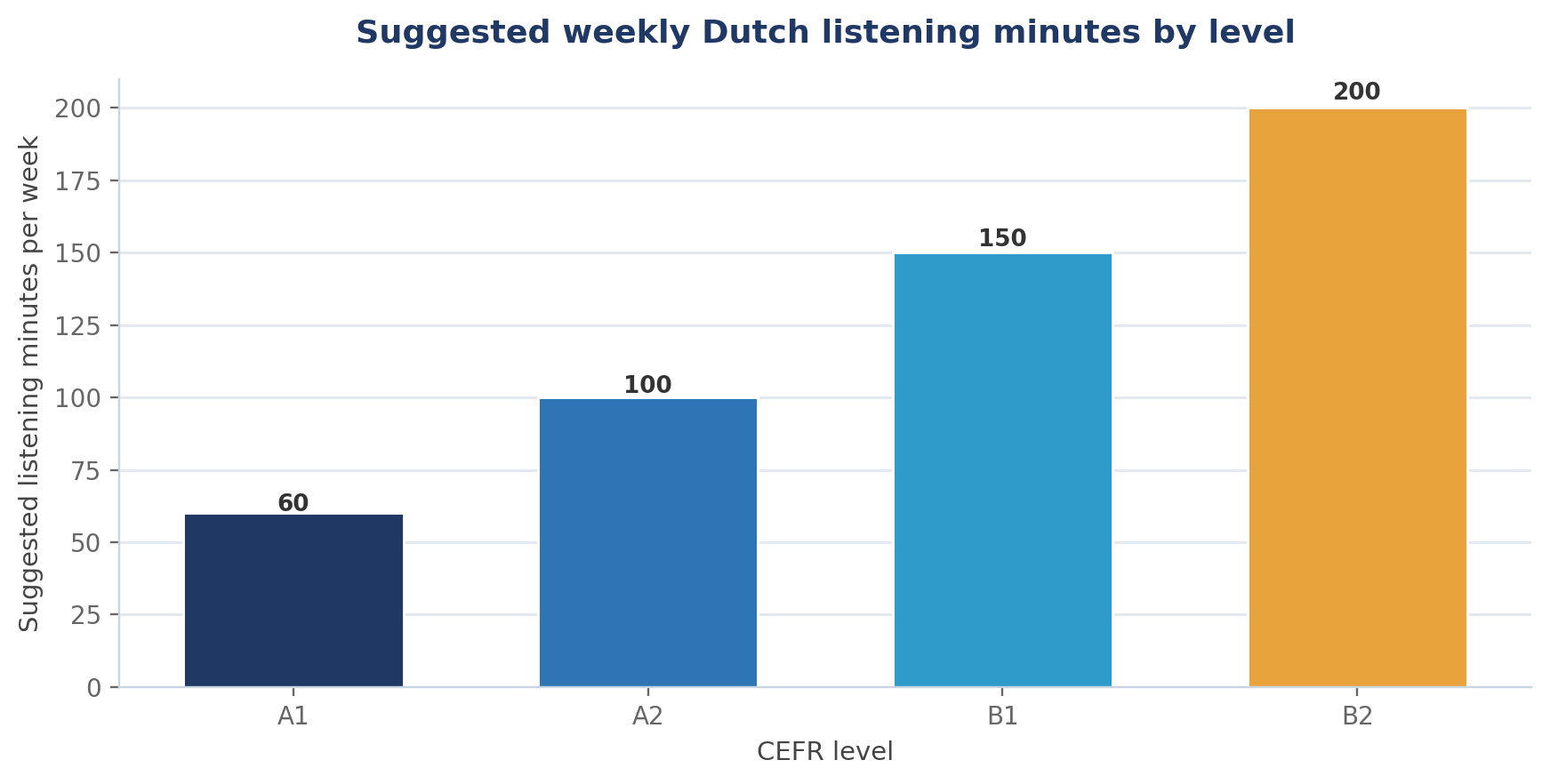
Dutch listening has a peculiar reputation. Learners who read Dutch comfortably will still freeze when a shop assistant says something as ordinary as anders nog iets? It is fast, it is reduced, and it is full of sounds no textbook prepared you for.
The reason is not that Dutch is unusually hard to hear. It is that written Dutch and spoken Dutch are two related but distinct systems, and most learners practise only one of them.
What you will get from this guide
- What actually happens to Dutch words in fast speech
- The three listening levels, and which to practise first
- A daily routine that builds comprehension without burnout
- Real Dutch audio sources graded by difficulty
What fast Dutch does to words
Spoken Dutch compresses relentlessly. Whole syllables disappear, and the ones that survive are not the ones you studied.
None of that is sloppiness. It is normal, systematic reduction — the same process that turns "going to" into "gonna" in English. Until you have heard it deliberately, your brain keeps waiting for the full written form and misses what actually arrives.
The three listening levels
Almost all learners are stuck at level one, and they try to fix it by listening to more material at a level they cannot process. The fix is to shrink the material until level two becomes possible, then rebuild speed.
A routine that actually works
The five-word limit is deliberate. Learners who look up every unknown word spend their energy on vocabulary admin and never rehearse the actual skill, which is tolerating partial comprehension.
Listen to Dutch you can actually understand
A personal AI voice tutor guides structured Dutch listening lessons at your own pace — fast enough to be real, slow enough to be useful — and you can replay and repeat any part as often as you need.
Practise Dutch listening →Create a free accountReal Dutch audio, graded by difficulty
Public broadcasters are the most valuable free resource in the language, because they produce enormous volumes of clearly spoken Dutch across every register.
The habits that slow your progress
Background listening is the most overrated technique in language learning. It is pleasant and nearly useless on its own. Focused listening — short, attentive, repeated — is what changes your ears.
How long until it clicks?
Listening improves more slowly than vocabulary and then seems to jump suddenly. Expect several weeks of feeling stuck, followed by a noticeable threshold where fast Dutch starts arriving as meaning rather than noise. That threshold almost never arrives through reading alone, which is why listening time should be non-negotiable from week one.
Making the jump to real conversation
The final step is a human. Recorded audio is predictable; people are not. They change topic, ask unexpected questions, and speak over themselves. That unpredictability is the last skill to acquire and the one that matters most in daily life.
Move from understanding audio to understanding people
Speaking practice with AI feedback trains real-time comprehension — including the interruptions, the speed and the surprises — so you can build confidence before real conversations.
Start Dutch speaking practice →Create a free accountFrequently Asked Questions
Why can I read Dutch but not understand spoken Dutch? Spoken Dutch reduces and merges words in ways the written language does not. Reading trains recognition; listening trains real-time processing. They are separate skills.
How long does it take to understand spoken Dutch? With daily focused listening, many learners follow clear speech within three to six months, and natural-speed conversation within about a year.
Is it bad to use Dutch subtitles? Watching with Dutch subtitles helps reading but slows listening development. Use subtitles once for context, then watch again without them.
Should I listen to Dutch while I sleep or work? Passive background listening has limited effect on comprehension. Short, focused, repeated listening sessions produce far more progress.
References & Further Reading
- NPO — Dutch public broadcaster: audio and video archive
- Nederlandse Taalunie — Dutch Language Union resources
- Nuffic — Dutch language and education information
- Council of Europe — CEFR descriptors for listening comprehension
- Dutch for Children — Dutch learning materials and activities