It is nine in the evening. You are staring at a Dutch sentence about a gemeente appointment, an app is cheerfully congratulating you on a 43-day streak, and you still cannot order a coffee out loud without rehearsing it first.
That is the exact moment the question lands: should you stay with the AI tutor, or pay for real Dutch classes? The answer is less tribal than the internet makes it sound — and the smartest learners stop choosing altogether.
What this comparison covers
- What AI tutors genuinely do better
- What they structurally cannot do
- A side-by-side on cost, pace and speaking pressure
- The hybrid routine that beats both pure options
What AI tutors are genuinely great at
Let us be fair to the technology. Modern AI language tools are extraordinary at four specific jobs:
For an absolute beginner in Dutch, this is a real gift. There is no social cost to failing at de versus het in front of a screen, and the AI will happily repeat the same word forty times without sighing.
What an AI tutor structurally cannot do
The problems are not bugs. They are the architecture.
An AI can tell you that Ik ben het er niet mee eens is correct. It cannot raise an eyebrow the way a Dutch colleague will when you use it in the wrong room.
Cost, pace and pressure, side by side
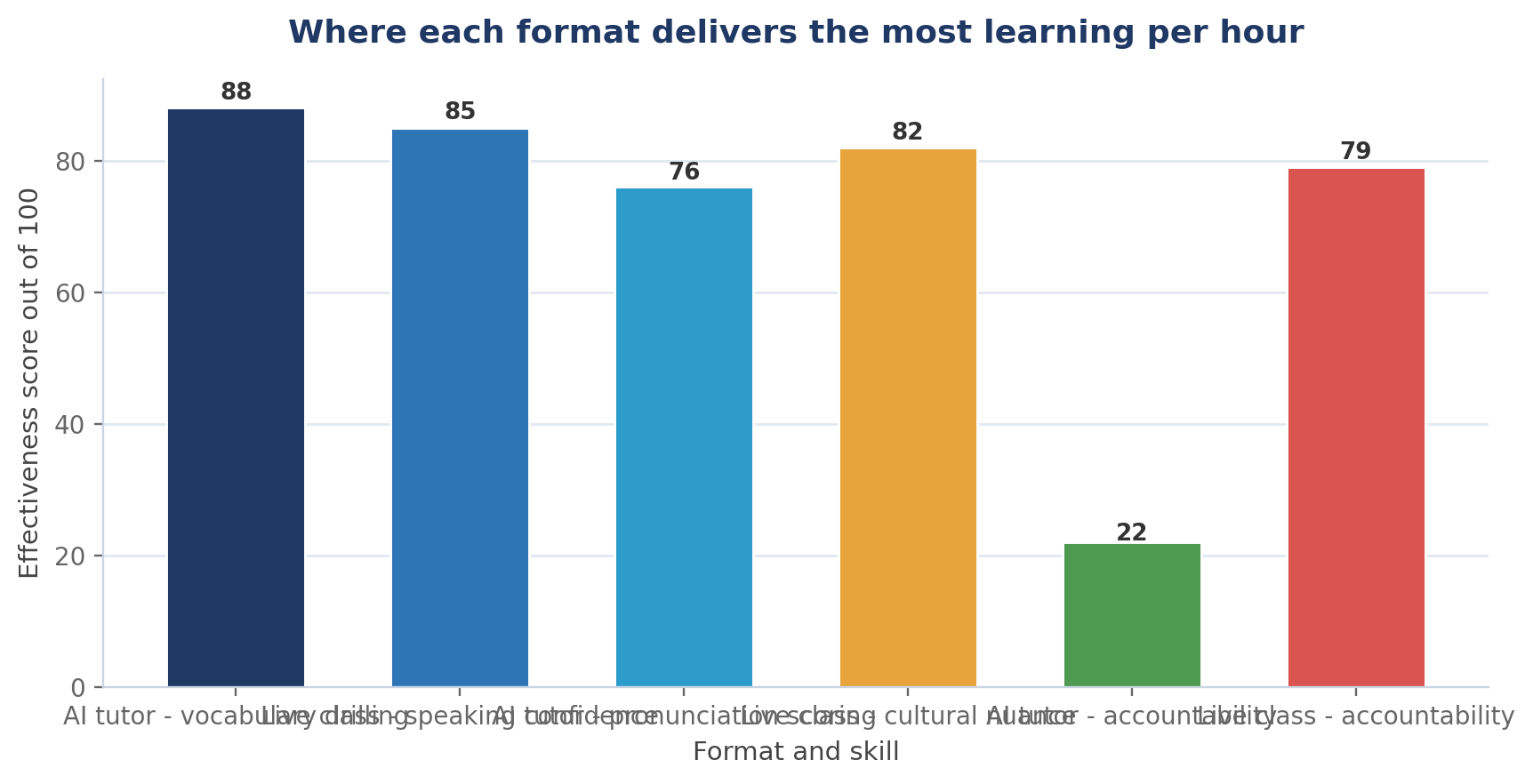
Notice the shape of that table. AI wins on the first two levels. Classes win the moment other people are involved — which is exactly the moment Dutch stops being a puzzle and becomes a life.
The honest verdict
If your goal is recognising Dutch words, an AI tutor is a bargain. If your goal is walking into a Dutch meeting, a Dutch birthday kring or a parent-teacher evening and holding your own, you need humans in the room.
Speaking a language is not a knowledge problem. It is a performance problem, and performance only develops under the mild pressure of another person waiting for your answer.
Ready to turn reading into real Dutch? Start your self-paced course today.
Start the Dutch course →Create a free accountGet the part the app can't give you
Self-paced Dutch lessons with an AI voice tutor that gives instant feedback on your speaking, lets you practise any time, and keeps you moving through A1 to B2. Study at your own pace — the AI tutor is with you whenever you are.
Button: See the Dutch Course Pass →
The hybrid routine that beats both
You do not have to delete the app. You do have to stop expecting it to teach you to speak.
Roughly three hours a week, and every hour has a job. The AI handles volume and structured speaking practice; you handle consistency. Together they cover the whole skill.
What employers and exams actually test
If you are learning Dutch for work or for the inburgering track, the assessment always involves speaking with a person. The Nederlandse Taalunie and Nuffic describe levels in terms of what you can do — hold a conversation, explain a problem, make an appointment — not what you can recognise on a screen.
That last row is the one nobody puts on a syllabus and everybody feels. Confidence is built by speaking badly to a patient human — repeatedly, until it stops being scary.
Ready to turn reading into real Dutch? Start your self-paced course today.
Start the Dutch course →Create a free accountTry the human half for free
Create a free languageskills.net account to try the AI voice tutor and get a level check before you spend a cent. You will hear the difference in a single session.
Button: Create your free account →
Frequently Asked Questions
Can an AI tutor replace Dutch classes entirely? No. It is excellent for vocabulary, drills and pronunciation scoring, but it cannot provide live, unpredictable conversation — the exact skill most learners actually need.
Which is cheaper for learning Dutch? AI tools cost less per month, but structured speaking practice usually delivers more usable ability per hour. The hybrid routine gives the best return on both.
Is an AI tutor enough for the inburgering exam? Unlikely on its own, because the exam tests spoken interaction. Use AI for preparation volume and structured speaking practice for performance.
How long until I can hold a Dutch conversation? With a hybrid routine, most learners manage simple everyday conversations in three to six months and comfortable workplace Dutch within a year.
References & Further Reading
- Nederlandse Taalunie — Dutch language policy, levels and resources
- Nuffic — Dutch education, language requirements and study guidance
- NPO / NOS — Dutch public broadcasting for authentic listening practice
- SLO — Curriculum and language-level reference frameworks
- Council of Europe — CEFR levels and spoken-interaction descriptors