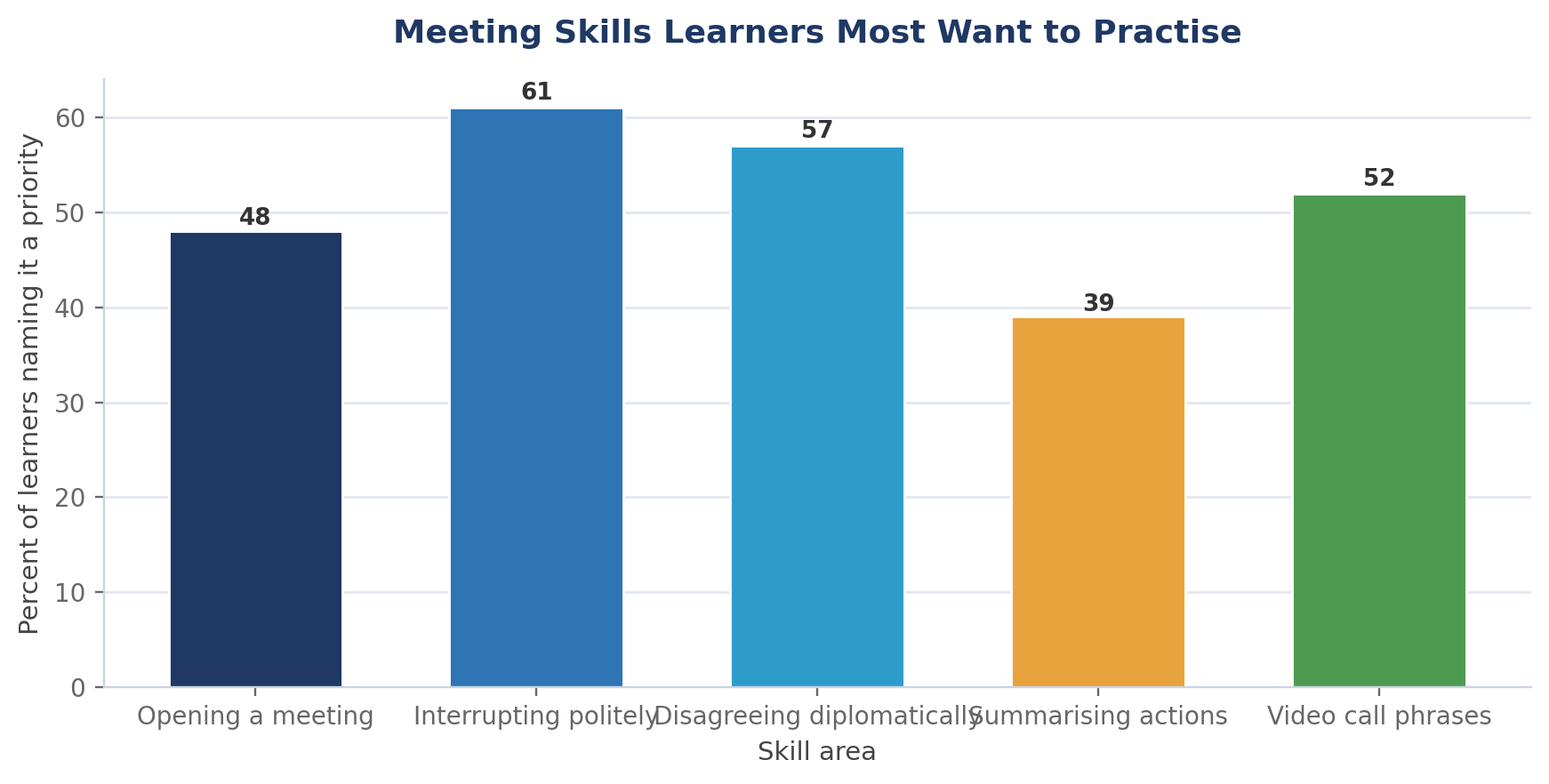
You know the grammar. You can write a clean email. Then the call starts, twelve faces light up, somebody says "Let's circle back to that offline" — and your vocabulary quietly leaves the room. The gap between knowing English and performing in English is where careers slow down. The fix is not more grammar. It is a sharp toolkit of business English phrases you can deploy without thinking.
Why the Right Business English Phrases Change the Room
Meetings are a performance sport, and fluency is timing, not speed. A well-placed "Could I just come in here?" signals control; silent waiting signals hesitation. The Council of Europe CEFR places this functional language at B1 and above, and Cambridge English business qualifications test the same skills.
Fluency is having the next sentence already loaded.
Opening a Meeting with Confidence
The first thirty seconds set your status for the whole call. You need no wit — only a clean, warm frame: welcome, state the purpose, hand over.
Presenting Your Ideas Without Rambling
Presenting in a second language tempts you to over-explain. Do the opposite: signpost, give the point, stop.
B1 trick: slow down on the first sentence of each topic, then speed up. Your accent matters less than your signposts.
Interrupting Politely (and Getting Away With It)
Interrupting is not rude — interrupting badly is. English softens it with a small apology, a reason and a question mark.
Stop rehearsing phrases alone — practise them with your AI voice tutor
Reading a table is step one. Saying it out loud and getting instant AI feedback on your intonation — that is what makes it stick. The Course Pass gives you self-paced, AI-guided lessons built around exactly these scenarios.
Get your English Course Pass →Create a free accountDisagreeing Diplomatically
Disagreement hurts most when you are too direct or too silent. Business English rewards two steps: acknowledge, then qualify. You never say "You are wrong."
Clarifying When You Are Not Sure
Asking for clarification is precision, not weakness — vague agreement costs more than a thirty-second question. Keep these phrases for meetings loaded for fast calls and strong accents: "Just to make sure I've understood — you mean...?", "Sorry, do you mean the Q3 figures or the full year?", and "Could you spell that out for me?" Reflect one back — "So, if I've got this right, we're prioritising X" — and you sound decisive, not lost.
Summarising Action Points Like a Chair
Meetings evaporate without a summary, and whoever summarises leaves looking competent. Close with owners, actions and deadlines: "So, to recap what we've agreed...", then "Ravi, you'll own the pricing update by Friday — is that right?", then "I'll circulate the notes today."
Chairing: Keeping the Meeting on the Rails
A chair's real job is time and air. Time: "We have ten minutes left on this item." Air: "Let's hear from someone who hasn't spoken yet." Rescue any runaway discussion with "Let's park that and come back to it." If you chair in English often, browse the structured course paths that build these skills session by session.
Video-Call Phrases That Actually Work
Remote meetings add new failure modes: frozen screens, hot mics, crossed signals — and a vocabulary that is short and oddly specific.
Try a lesson before you commit
Choose your level, start a self-paced lesson and bring your own meeting phrases to your AI voice tutor. It is free to try.
Create your free account →Create a free accountFrequently Asked Questions
How many business English phrases do I need to sound professional? Far fewer than you think — around forty to sixty cover most meeting situations.
Can I learn these at B1? Yes. The CEFR expects B1 learners to handle familiar work discussions and short prepared contributions.
What is the single most useful phrase? "Could I just come in here?" It interrupts, disagrees and adds information without sounding aggressive.
How do I practise alone? Record a two-minute update and replay it, swapping in a cleaner phrase. AI feedback accelerates this sharply.
References
- British Council — Business English
- Cambridge English — Business Qualifications
- BBC Learning English — English at Work
- Council of Europe — Common European Framework of Reference for Languages
- Harvard Business Review — Communication