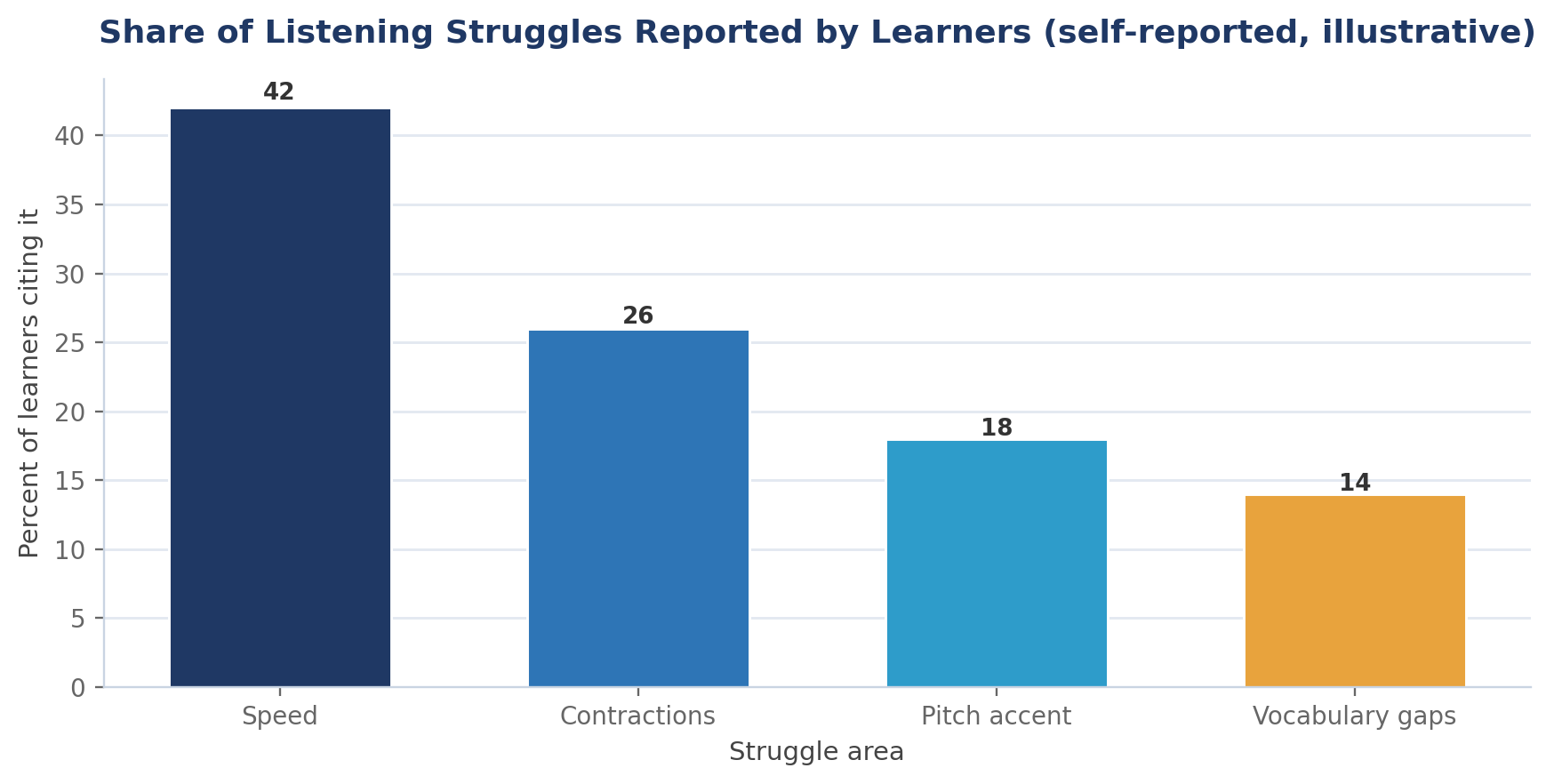
You've studied for months. You know the vocabulary. You can read a manga panel without breaking a sweat. Then a native speaker opens their mouth at full speed and your brain turns to static. Sound familiar?
Here's the good news: fast Japanese isn't a different language. It's the same language wearing running shoes. Native speakers don't add information when they speed up — they compress, clip, and blend sounds you already know. Once you learn where the compression happens, your ears stop panicking and start parsing. This guide is your decompression manual: what's actually happening at native speed, why your textbook ears fail, and the drills that fix it for good.
Why Fast Japanese Feels Impossible (But Isn't)
The core problem is that written Japanese and spoken Japanese are almost two dialects. Textbooks teach the careful, complete forms. Real humans speak the collapsed, efficient versions. Add pitch accent, regional rhythm, and the fact that Japanese packs meaning into verb endings rather than word order, and you get a listening workout that punishes hesitation.
None of these are slang you need a dictionary for. They're standard contractions that appear constantly in anime, dramas, podcasts, and everyday chat. Learn them as sound units, not as grammar curiosities, and your comprehension jumps immediately.
The Four Engines of Speed
Native speed is driven by four mechanisms. Name them and you can hunt them deliberately.
Notice the pattern: the consonant skeleton survives while vowels get eaten. That's why learners who over-rely on vowel-by-vowel decoding fall behind. Train your ear to grab the consonants and let the vowels blur — that's what natives do.
Decode Contractions Before You Chase Speed
The fastest fix for "native speed Japanese" is contraction fluency. Do this in two passes: first, memorize the table above until recognition is instant; second, listen for where the contraction appears in a sentence. Contractions cluster in the grammatical glue — particles, copulas, helper verbs — while content words usually stay intact.
The moment you recognize 〜ちゃう as "oops, it's done," a whole sentence unlocks at once. That's the leverage you're looking for.
Pitch Accent: The Hidden Speed Trap
Japanese distinguishes words by pitch, not stress. When speakers accelerate, pitch contours flatten and closely related words start to sound identical. This is why learners blame "speed" when the real culprit is accent perception. Train pitch by listening to minimal pairs and humming the contour before you identify the word.
Don't obsess over perfection. Even partial pitch awareness dramatically reduces the "word soup" effect, because your brain gains an extra cue for segmentation.
Turn Passive Listening Into Real Comprehension
Stop guessing at native speed and start decoding it with structured drills built around real conversation audio. Our Japanese Course Pass gives you leveled listening practice, contraction training, and pitch-accent work in one guided path.
Start listening better today →Create a free accountShadowing: The Fastest Route to Real-Time Parsing
Shadowing means speaking along with audio almost simultaneously, matching rhythm rather than waiting for comprehension. It rewires your processing speed because you can't pause to translate. Begin with 20-second clips, loop them five times, and only then look at a transcript. Start slow, then push the playback to native pace.
Build a Listening Habit That Survives
Speed tolerance is a stamina skill. Fifteen focused minutes daily beats a three-hour weekend binge. Layer difficulty: start with learner podcasts, graduate to news clips, then unscripted interviews. Keep a "missed sounds" log — the same contractions and pitch traps will repeat, and your log becomes your personal curriculum.
If you want a structured track with measurable progress, create a free account and track your listening milestones over time.
Your Ears Deserve a Real Training Plan
Fifteen minutes a day with the right drills changes everything — and the Japanese Course Pass hands you those drills in order. Build native-speed comprehension without drowning in random YouTube clips.
Get the Japanese Course Pass →Create a free accountFrequently Asked Questions
How long does it take to understand fast Japanese? With consistent daily listening practice, most learners notice clear improvement in six to twelve weeks. Full comfort with unscripted native speech typically takes longer and depends heavily on total hours of focused input.
Should I use subtitles while practicing? Use Japanese subtitles sparingly and in bursts — never as a permanent crutch. Loop audio first, guess, then check the transcript. This forces active decoding instead of passive reading.
Do I need to learn pitch accent to understand natives? You don't need perfect production, but pitch perception matters enormously. Training pitch helps your brain segment fast speech and separate similar-sounding words.
Is anime good listening practice? It can be, but be selective. Slice-of-life and drama series approximate natural conversation better than stylized action shows. Balance anime with podcasts, news, and real interviews for range.