Level labels are abstract until you translate them into real situations. "B1" means nothing to a learner standing in a Madrid pharmacy. Can I explain what is wrong with my stomach, or do I need to point? That is the useful question.
Here is each Spanish level described in concrete, recognisable moments — plus what still defeats you at each stage, because knowing the limits is how you choose what to study next.
What you will get from this guide
- A1 to B2 described through real-life situations
- What each level still cannot do
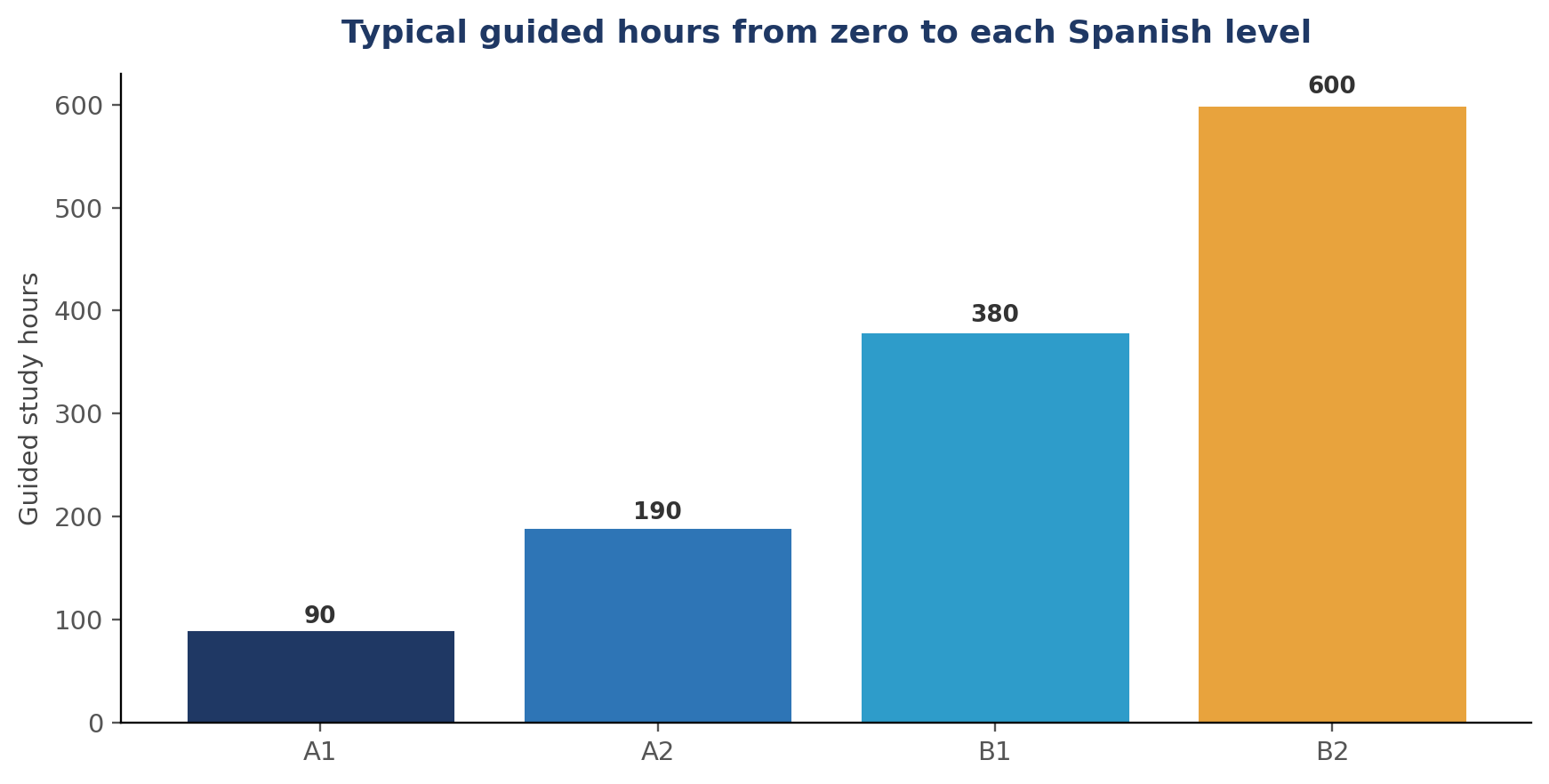
- Typical guided hours behind each stage
- A quick way to identify where you are right now
A1: the survivor
You can introduce yourself, ask and answer simple personal questions, order food and shop for basics.
Guided hours: roughly 60–100. A1 is small on purpose, and being able to greet, ask and thank is genuinely useful on a trip.
A2: the errand-runner
At A2 you can handle predictable transactions and simple social exchanges.
Guided hours: roughly 160–220. A2 is the "survival plus" stage, and it is where the intermediate plateau begins to loom.
B1: the independent user
This is the level where Spanish becomes a tool rather than a subject. You can deal with most situations in daily life and hold a conversation.
Guided hours: roughly 350–420. B1 is often described as the first genuinely independent level, and it is the point where learners either push forward or settle permanently.
Find your real level, then move up deliberately
A personal AI voice tutor assesses your level and identifies which specific skills are missing. Then a Course Pass targets those — no wasted lessons.
Take a Spanish level assessment →Create a free accountB2: the professional
B2 is the level employers, universities and immigration systems ask for, and for good reason: you can operate in Spanish all day.
Guided hours: roughly 550–650. B2 is upper-intermediate and widely treated as professional working ability.
Reading levels versus speaking levels
Here is the reality most learners hide: your reading level is often one or two stages above your speaking level. That gap is normal, and it matters for a practical reason.
Your working level is your speaking level. That is the level you should book a course at, and the skill that needs the most attention.
Six quick questions to place yourself
Answer honestly, and you will probably identify a lower level than you hoped — and a clearer target than you had.
Why the labels matter
Levels are not a judgement. They are a map, and they tell you three useful things: which exam to book, what a job advert really means, and what to study next. Progress feels invisible exactly when you have no criteria to check. Concrete can-do statements solve that.
Turn your level into a plan
A personal AI voice tutor starts exactly where you are and targets the specific can-do statements you have not yet earned — measured, corrected and pushed at your own pace.
Start your Spanish course pass →Create a free accountFrequently Asked Questions
What Spanish level am I? Use the can-do questions above, and be honest about speaking rather than reading. An AI voice tutor assessment is the most accurate answer.
What level is considered fluent in Spanish? B2 is widely accepted as professional working ability.
How long does it take to move up one level? Roughly 90 to 200 hours for the early levels, and 200 or more hours between B1 and B2. Consistency and speaking practice matter most.
Is B1 enough to travel in Spain? More than enough. B1 handles transport, accommodation, restaurants, shops, and most unexpected daily situations.
References & Further Reading
- Council of Europe — CEFR level descriptions
- Instituto Cervantes — DELE diplomas by level
- Instituto Cervantes — Plan curricular: levels and descriptors
- SIELE — International Spanish Language Evaluation Service
- Council of Europe — Common European Framework of Reference for Languages
Keep learning Spanish
- Spanish A1 Guide: What You Learn and How to Reach Beginner Spanish
- Spanish A2 Guide: What You Learn and How to Reach Elementary Spanish
- Spanish B1 Guide: What You Learn and How to Reach Intermediate Spanish
- Spanish B2 Guide: What You Learn and How to Reach Upper-Intermediate Spanish
- Browse all Spanish lessons & guides