B2 is the level where Spanish stops being a subject and becomes a skill. At B1 you can cope. At B2 you can operate — hold your own in a meeting, follow a documentary without subtitles, write a letter that does not sound like a textbook, argue a position and survive being disagreed with.
It is also the level most learners stall at, because the gap between understanding Spanish and controlling it is filled with vocabulary depth, register awareness and pure hours of speech. This guide shows you exactly what fills it.
What you will get from this guide
- The honest difference between B1 and B2
- The grammar and vocabulary B2 actually demands
- What the DELE B2 exam tests that B1 never did
- A realistic plan from B1 to B2, with the traps to avoid
The B1-to-B2 jump, in plain terms
B1 is about survival on familiar ground. B2 is about comfort on unfamiliar ground. The CEFR describes B2 as the ability to understand the main ideas of complex text, interact with fluency and spontaneity, and produce clear, detailed text on a wide range of subjects.
The uncomfortable truth: B2 is less about learning brand-new grammar than about automating what you already know and widening your vocabulary.
The grammar B2 actually demands
Most of it you met at B1. At B2 you must be able to use it without thinking.
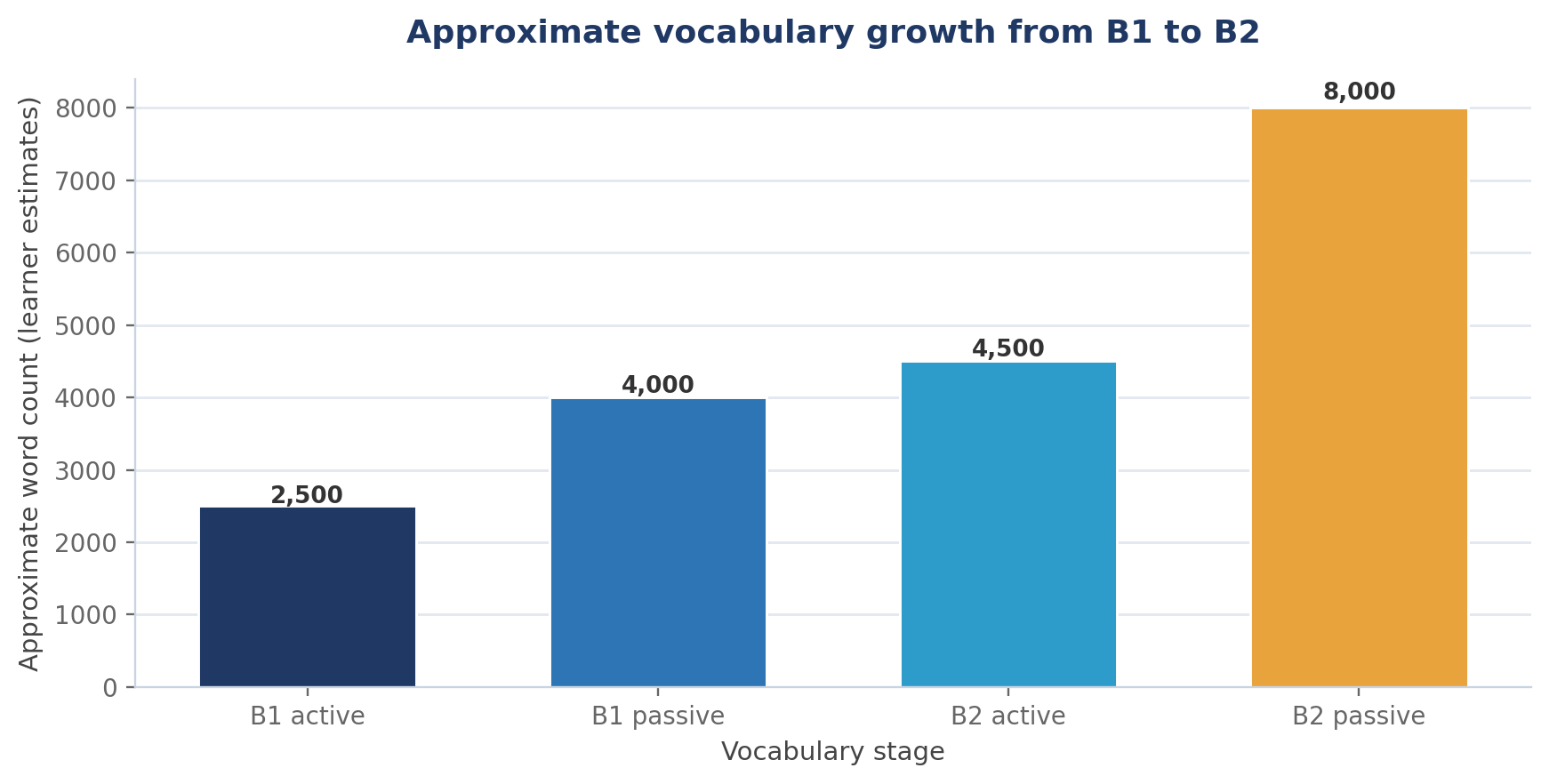
Vocabulary depth is the real differentiator
B2 learners do not know more kinds of words. They know more shades of the same word. This is where collocation becomes the whole game.
Collocations — the word partnerships natives use without thinking — are what make advanced Spanish sound natural rather than translated. Learn phrases, not isolated words.
B2 is built by speaking, not by collecting word lists
A personal AI voice tutor guides structured lessons and gives speaking practice with feedback, so you reach for the natural phrase instead of the safe one and get your register corrected as you practise. That pressure is what closes the B1-to-B2 gap.
Move up to Spanish B2 →Create a free accountWhat DELE B2 tests that B1 never did
DELE B2 keeps the same four-paper structure as B1, but everything is longer, faster and less forgiving.
Candidates usually lose marks in two places: the writing register, and the oral debate, where they must respond to an examiner's counter-argument rather than deliver a prepared speech.
Why learners stall at B1 for years
The pattern is always the same: learners consume content comfortably and avoid production, because production feels bad. But production is the thing being tested.
A realistic route from B1 to B2
Total: roughly six months at 45–60 minutes a day with regular speaking practice. Faster if you speak daily. Slower if you only read.
Twelve weeks of guided speaking beats a year of solo study
An AI voice tutor hears the difference between B1 and B2 in your sentences and pushes you into the next register, lesson by lesson. That is the fastest route through the plateau.
Start Spanish B2 preparation →Create a free accountFrequently Asked Questions
How long does it take to reach Spanish B2? From zero, many guided learners reach B2 in roughly 18 to 24 months. From a solid B1, six to twelve months of consistent study is typical.
Is B2 enough to work in Spanish? For many professional roles, yes. Regulated professions, translation and academia often require levels above B2.
Do I need B2 for Spanish citizenship? Spain's nationality process requires a minimum of A2 via DELE plus the CCSE civics test. Many applicants choose B2 for stronger long-term prospects.
Is DELE B2 harder than SIELE? Both test the same level. DELE gives a pass or fail result; SIELE gives a graded score, which some candidates prefer.
References & Further Reading
- Council of Europe — CEFR B2 level descriptors
- Instituto Cervantes — DELE B2 diploma information
- Instituto Cervantes — Plan curricular: levels and descriptors
- Real Academia Española — Diccionario panhispánico de dudas
- SIELE — International Spanish Language Evaluation Service