Going from A1 to B2 in Spanish is the single most rewarding climb in language learning. A1 is where you say hola and hope for the best. B2 is where you argue about politics, watch a series without subtitles, and get hired in Spanish. In between? A staircase of three levels — A2, B1, B2 — and a whole lot of glorious, noisy practice.
Here's the honest truth nobody tells you: the distance from A1 to B2 is not measured in months on a calendar, it's measured in hours of focused contact with the language. Get the hours in, in the right order, and the levels take care of themselves. This is your roadmap.
What A1 to B2 Actually Means
The CEFR scale describes what you can do, not what you know. That distinction changes everything about how you study.
B2 is the famous "independent user" threshold. It's the level many universities and employers actually mean when they ask for "fluent." It is ambitious, and it is completely reachable.
How Long Does It Really Take?
The Foreign Service Institute (FSI) of the U.S. State Department classifies Spanish as a Category I language — one of the closest to English — and estimates roughly 600–750 hours of classroom instruction for professional working proficiency for learners with strong English aptitude. That's a useful anchor, not a verdict: your mileage depends on your starting point, your method, and how many of those hours are active rather than passive.
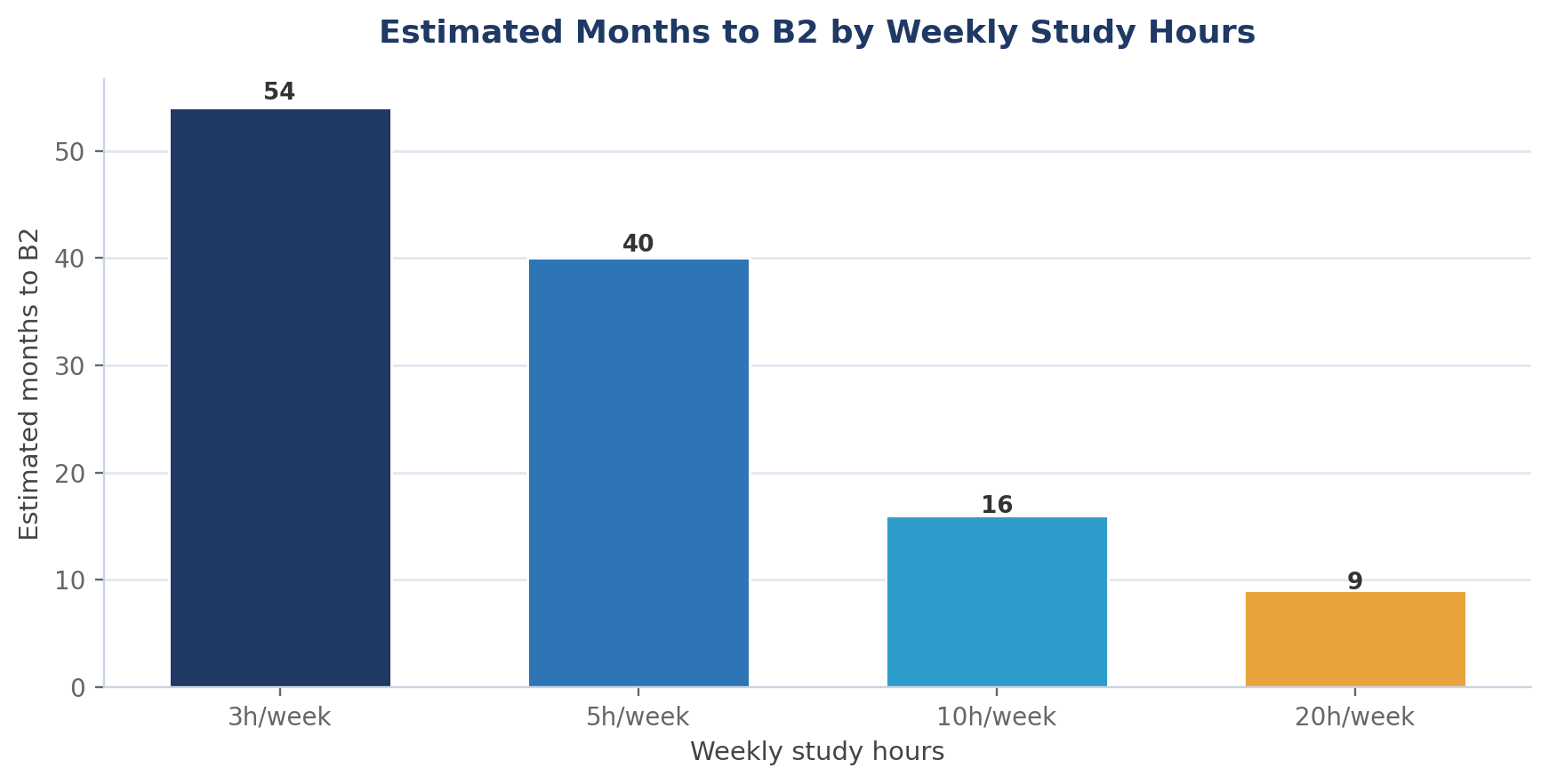
These are extrapolations from the FSI benchmark, not guarantees. The honest summary: most dedicated learners with regular practice land at B2 in about 1.5 to 2.5 years.
Notice the shape of that chart. Doubling your hours doesn't halve your calendar time — but it does compress years into months.
Skip the guesswork, follow the ladder
Our Spanish Course Pass maps every step from A1 greetings to B2 debates, so you always know exactly what to study next.
Get the Spanish Course Pass →Create a free accountThe Four Stages of the Climb
Stage 1 · A1 → A2: Build the Skeleton (0–150 hours)
This is the fastest-moving stage, and the most fun. You're bolting on the frame: present tense, ser vs. estar, basic past tenses, core vocabulary of about 1,000 words. Your goal is fluency of the familiar — saying simple things without freezing.
What to do weekly:
- 3 sessions of new grammar (30–45 min each)
- Daily 10-minute vocabulary drilling
- One short speaking session with the AI voice tutor
- Speed over perfection — errors here are cheap
Stage 2 · A2 → B1: Add the Past and the Opinions (150–400 hours)
This is where Spanish stops being a puzzle and becomes a practice. Past tenses (pretérito and imperfecto) arrive, along with the subjunctive's first stirrings. You start holding real conversations about your life, your plans, and your hot takes.
Stage 3 · B1 → B2: The Subjunctive Wall (400–600 hours)
Welcome to the wall. B2 demands comfort with the subjunctive mood, complex connectors (aunque, siempre que, por lo tanto), and native-speed speech. Many learners stall here for years — not because it's impossible, but because they keep doing A2-style studying for a B2-level goal.
Break through by changing the ratio: less studying, more using. Watch native content with Spanish subtitles, read real news, and force yourself into conversations where you must improvise.
Stage 4 · Consolidation: Prove You're B2 (600–750 hours)
At this point you're not learning structure, you're smoothing edges. Aim for stamina: 30-minute conversations without switching to English, articles read without a dictionary, jokes you actually get.
Your B2 proof, one course at a time
Level up with structured lessons, native-speaker audio, and progress checkpoints that mirror the CEFR descriptors.
Start your Spanish progression →Create a free accountThe Weekly Template That Works
Consistency beats intensity. Copy this rhythm and adjust the volume to your life.
Milestones You Can Actually Measure
Skip vague feelings. Track these instead:
Frequently Asked Questions
Can I reach B2 without living in a Spanish-speaking country? Yes. Immersion helps a great deal, but hundreds of learners hit B2 through structured courses, speaking practice with AI feedback, and daily native-content input. If you can visit for a few weeks, do it — but it's a booster, not a requirement.
Is B2 really "fluent"? Functionally, for most people, yes. B2 means you handle complex, unfamiliar topics with reasonable ease. C1 adds nuance and spontaneity, but B2 is where real independence begins.
What's the biggest reason people stall at B1? Comfort. Learners find a routine that works at B1 and never raise the difficulty. Push your input and output slightly beyond what feels easy every single week.
How many words do I need for B2? Many course designers target roughly 4,000–5,000 word families for B2 reading comfort. Learn words in context and recycle them in your own sentences — that's what makes them stick.
References & Further Reading
- Council of Europe — Common European Framework of Reference for Languages
- FSI Language Difficulty Rankings (U.S. State Department)
- Instituto Cervantes — Plan Curricular del Instituto Cervantes
- Instituto Cervantes — DELE Spanish Diplomas
- Ready to build your plan? Create your free account at LanguageSkills
Keep learning Spanish
- Spanish A1 Guide: What You Learn and How to Reach Beginner Spanish
- Spanish A2 Guide: What You Learn and How to Reach Elementary Spanish
- Spanish B1 Guide: What You Learn and How to Reach Intermediate Spanish
- Spanish B2 Guide: What You Learn and How to Reach Upper-Intermediate Spanish
- Browse all Spanish lessons & guides