You have seen the letters everywhere. A2 on a job advert. B1 on a course page. B2 on a university requirement. C1 on a visa form. They look like a code, and in a sense they are — a shared language for describing what a person can actually do in Spanish.
The CEFR is the framework behind those letters, and understanding it takes about ten minutes that will save you months of studying the wrong thing.
What you will get from this guide
- Where the CEFR comes from and why it exists
- The A1–B2 levels explained in plain language, for Spanish
- How CEFR levels map to DELE and SIELE
- How to work out your own current level
What the CEFR actually is
The Common European Framework of Reference for Languages was published by the Council of Europe in 2001. It is not an exam, a syllabus or a certificate. It is a description scale — a way of saying what a learner can do at each stage, in a form that is comparable across languages and countries.
That is why a Spanish B2 and a German B2 mean roughly the same thing about the learner, even though the languages are entirely different. The CEFR describes competence, not content.
The six levels, in Spanish terms
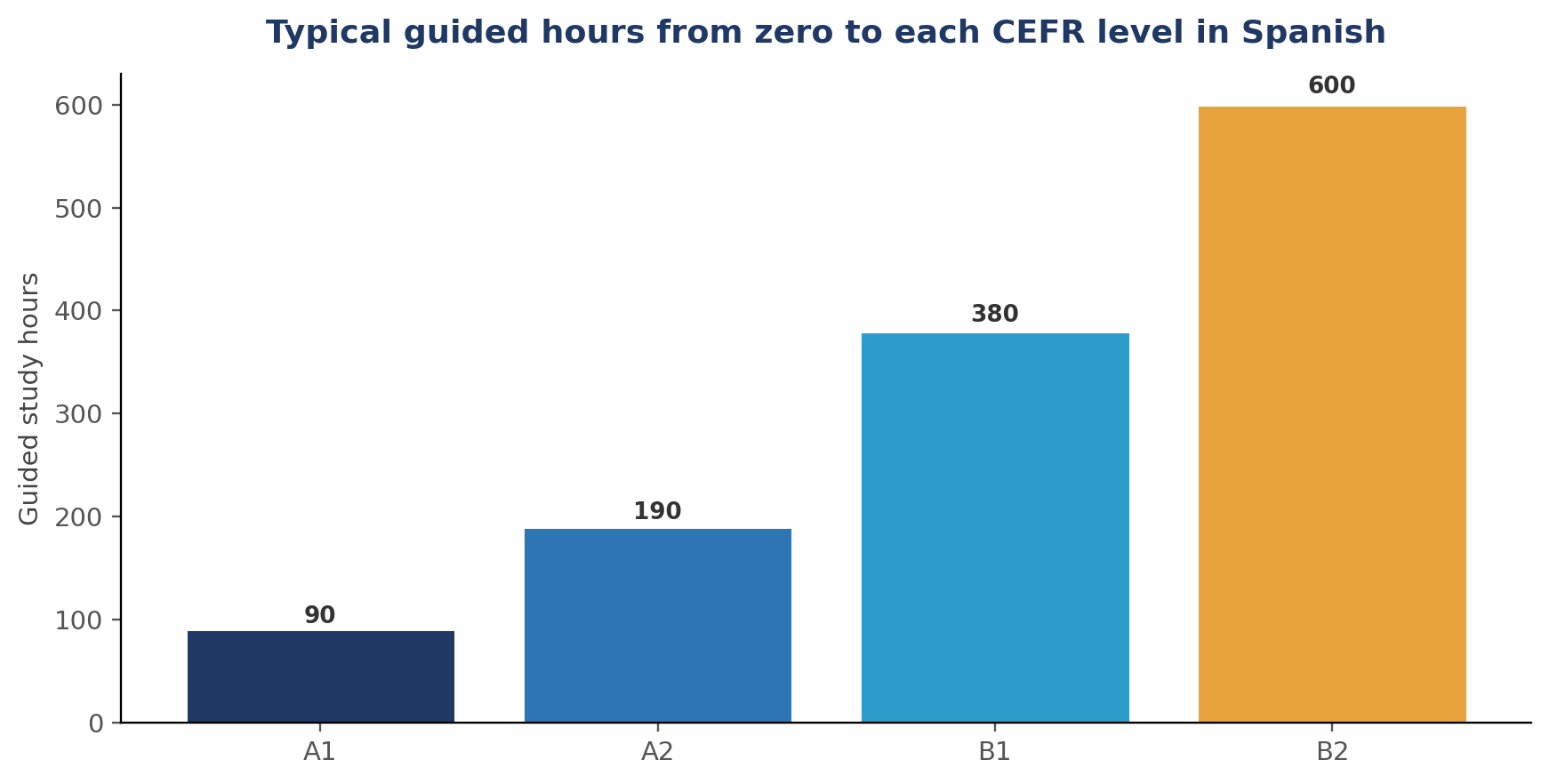
Those hour figures are planning estimates, not promises. They assume guided study with feedback, and they vary dramatically depending on your first language, your practice habits and whether you speak regularly.
A closer look at the awkward jumps
Progress is never linear. Two transitions are noticeably harder than the rest.
A2 to B1 is the famous intermediate wall. The learner can handle predictable situations but freezes when a conversation goes off-script. The fix is uncomfortable but simple: more real conversation, fewer exercises.
B1 to B2 is the gap between coping and controlling. Vocabulary depth, register and automatic grammar are what close it — not new tenses.
Find out which CEFR level you actually are
A short self-paced assessment is the fastest honest answer you will get. Then a Course Pass starts you at the right level, with a plan that targets the jump you are facing.
Take a Spanish level test →Create a free accountHow CEFR maps to Spanish exams
Spanish has two well-known official routes, and both use the CEFR scale.
DELE is pass or fail and never expires. SIELE gives a graded score, is computer-based, and results are typically valid for five years. Both are accepted by employers and institutions, so the choice often comes down to format rather than prestige.
How to work out your own level
Ignore the online quizzes that ask you to translate ten words. Use the can-do statements instead and be honest.
If your reading is two levels above your speaking — which is extremely common — your working level is the speaking one. That is the level you should study at, and the one that needs the most attention.
Why the CEFR is useful, not just bureaucratic
Three practical reasons. It tells you which exam to book. It tells you what a job advert really means. And it stops the vague, corrosive feeling that you are "not getting anywhere", because each level has concrete criteria you can tick off.
Use it as a map, not a judgment. Levels are not a personality test; they are a description of what you can currently do — and what you can currently do is always changeable.
Move to the next level with a plan, not a vague hope
Self-paced Spanish courses with an AI voice tutor target the exact skills that each CEFR jump requires, with feedback on which can-do statements you have not yet earned.
Start your Spanish course pass →Create a free accountFrequently Asked Questions
What does CEFR stand for? Common European Framework of Reference for Languages, published by the Council of Europe. It describes language ability across six levels, from A1 to B2.
Is B2 fluent? B2 is often called upper-intermediate and is widely accepted as professional working ability. Many people reserve "fluent" for C1, where conversation becomes effortless on most topics.
What level do I need for Spanish citizenship in Spain? Spain's nationality process normally requires a minimum of A2 Spanish via DELE, plus the CCSE civics test. Many applicants choose a higher level for practical reasons.
How long does each CEFR level take? Roughly 90 to 220 hours for A1–A2, and 350 to 650 for B1–B2. Consistency affects this more than total time.
References & Further Reading
- Council of Europe — Common European Framework of Reference for Languages
- Council of Europe — CEFR level descriptions
- Instituto Cervantes — DELE diplomas by level
- SIELE — International Spanish Language Evaluation Service
- Instituto Cervantes — Plan curricular: levels and descriptors
Keep learning Spanish
- Spanish A1 Guide: What You Learn and How to Reach Beginner Spanish
- Spanish A2 Guide: What You Learn and How to Reach Elementary Spanish
- Spanish B1 Guide: What You Learn and How to Reach Intermediate Spanish
- Spanish B2 Guide: What You Learn and How to Reach Upper-Intermediate Spanish
- Browse all Spanish lessons & guides