You already suspect the answer. Maybe you can order coffee in Madrid without sweating, but the moment a waiter answers at full speed you blank. Maybe you've studied for years and still freeze on the phone. That gap between "I know Spanish" and "I know exactly what my Spanish level is" is where progress quietly dies — and it is exactly what a free Spanish level test fixes.
Here's the good news: you do not need to pay for a certification exam to find out where you stand. Plenty of solid, free tools exist, and knowing your CEFR band changes everything about what you study next. Let's map it out.
Why Your Level Matters More Than Your Effort
Most learners study blind. They watch a random YouTube video, drill a random deck, and call it a day. The problem is mismatched difficulty: material too easy bores you, material too hard breaks your confidence.
When you test my spanish level properly, you stop guessing and start choosing. That single data point saves months.
The CEFR Scale in Plain English
The Common European Framework of Reference (CEFR) is the standard used across Europe, Latin America, and most language schools worldwide. It has six bands, usually grouped into three stages.
Those hour figures are widely cited estimates from diplomatic-language training research, not guarantees. Your mileage depends on your first language, immersion, and how much you actually speak.
What a Free Spanish Level Test Actually Measures
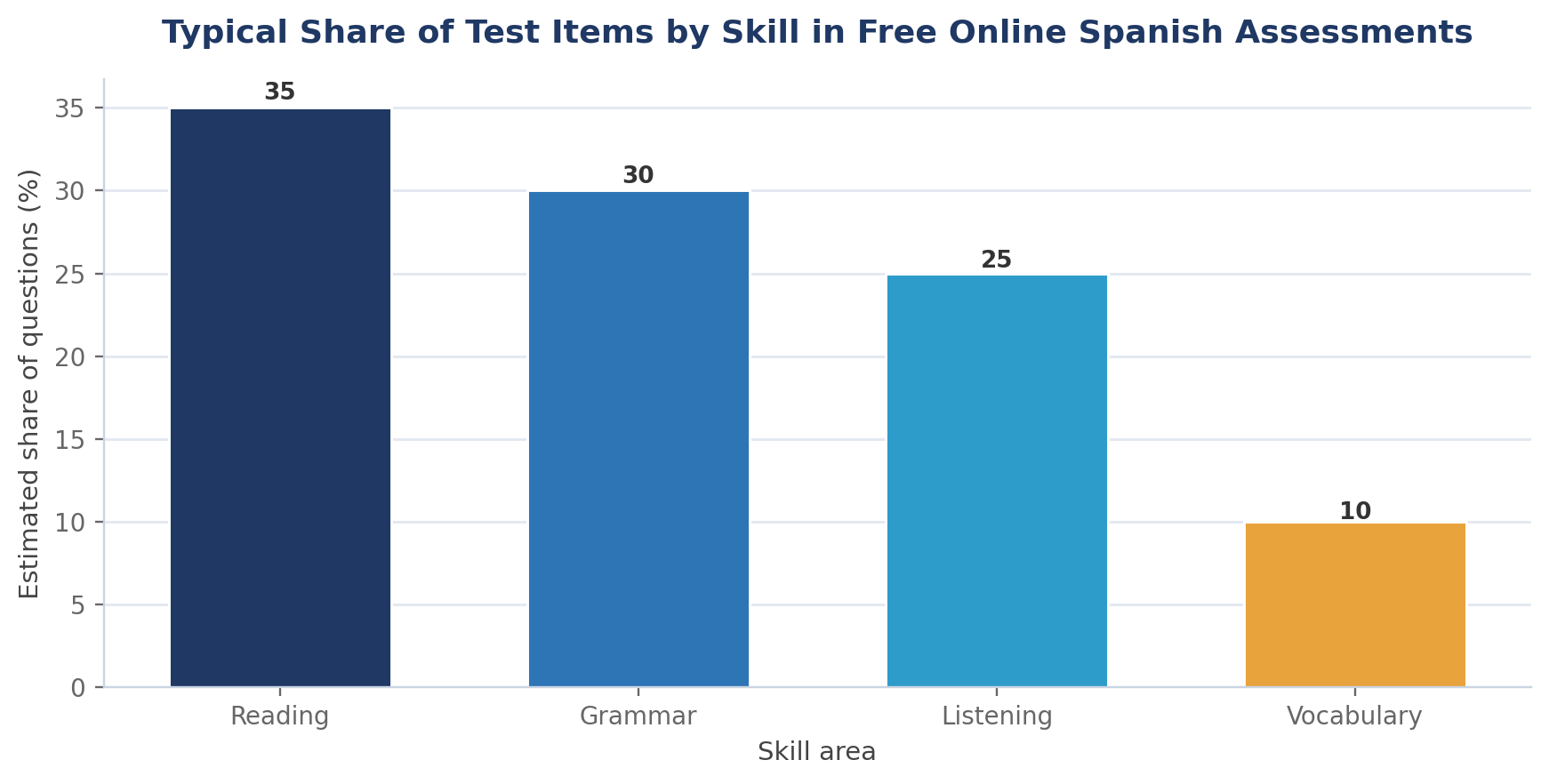
A good free assessment looks at four things, and the honest ones tell you which. Here's the reality check.
Notice what's missing: free tests almost never capture speaking. That's your cue not to over-trust a single score. Treat any online result as a starting hypothesis, then verify it by having one real conversation.
Three Free Ways to Place Yourself This Week
- Take a CEFR-aligned online test. Many platforms offer a free adaptive quiz that ends with an estimated band. Adaptive simply means it gets harder as you get answers right, which is far more accurate than a fixed 20-question quiz.
- Do the "can-do" self-audit. Write one paragraph about your week, in Spanish, with no dictionary. Then read it aloud. If you stumbled on past tense and searched for every third word, you're likely A2–B1.
- Use a placement conversation. A 10-minute chat with a tutor or AI partner tells you more than any quiz. Ask them to rate you against CEFR descriptors and note where you break down.
Get a Free Placement Pass in Minutes
Our adaptive Spanish placement test scores you against every CEFR band and drops you straight into the right course level — no payment, no guesswork. Create your free account and see your real number today.
Take the free Spanish placement test →Create a free accountHow to Read Your Score Without Fooling Yourself
Scores flatter. Reading level is usually your highest skill, and production lags behind. Here's a quick calibration guide.
The fix is simple: assume the lower half of your range until you prove otherwise in conversation. That's not pessimism — it's the fastest route to material that actually stretches you.
What to Do the Moment You Know Your Level
Once you have a band, build a routine around it and nothing else for 90 days.
Retest every 8–12 weeks. Levels move in steps, not slopes, so don't panic during a plateau.
Stop Guessing, Start Levelling Up
A free account unlocks a level-matched Spanish course pass so every lesson lands exactly where you are. Test once, then let the course carry you to the next band.
Create my free account →Create a free accountFrequently Asked Questions
Are free Spanish level tests accurate? The best adaptive ones are reasonably accurate for reading and grammar, typically landing within one CEFR band of a formal assessment. Always confirm with a short speaking session.
Can I test my spanish level without speaking to anyone? Yes — grammar, vocabulary, and reading tests require zero conversation. Just remember they will overestimate your ability to actually speak.
How long does a free Spanish level test take? Most take 10–25 minutes. Adaptive tests finish faster because they stop once your level is statistically clear.
Which CEFR level do I need for work or study? Many universities and employers ask for B2 for general work and professional or academic roles. Always check the exact requirement of your institution.
References & Further Reading
- Council of Europe — Common European Framework of Reference for Languages (CEFR)
- Council of Europe — CEFR Companion Volume and self-assessment grids
- Instituto Cervantes — Diplomas de Español (DELE) levels and descriptors
- U.S. Foreign Service Institute — Language difficulty and training-time estimates
- Language Skills — Spanish courses and placement
Keep learning Spanish
- Spanish A1 Guide: What You Learn and How to Reach Beginner Spanish
- Spanish A2 Guide: What You Learn and How to Reach Elementary Spanish
- Spanish B1 Guide: What You Learn and How to Reach Intermediate Spanish
- Spanish B2 Guide: What You Learn and How to Reach Upper-Intermediate Spanish
- Browse all Spanish lessons & guides