Spanish B1 is the level where the language stops being homework and starts being useful. Below it you are decoding. At B1 you are living: arguing about football, complaining about the landlord, telling a story about last summer without drowning in verbs. It is also the level where the subjunctive finally arrives and refuses to leave.
This guide covers what B1 genuinely demands, what the DELE B1 exam tests, and how to get there without spending three years on the intermediate plateau.
What you will get from this guide
- A plain-language definition of the Spanish B1 level
- The grammar checklist, including the subjunctive triggers
- The DELE B1 exam format, paper by paper
- A twelve-week plan built around the intermediate plateau
What intermediate Spanish actually means
The CEFR describes B1 as the ability to deal with familiar matters, produce simple connected text, and describe experiences, dreams and ambitions. In practice, that means something quite specific.
The honest test is this: can you survive an unexpected phone call in Spanish? At A2, no. At B1, usually — awkwardly, but surviving.
The Spanish B1 grammar checklist
The B1 grammar list is long but finite. It is not a mystery to be discovered; it is a checklist to be drilled.
The subjunctive: the B1 gatekeeper
If the subjunctive is what keeps you awake, you are in excellent company. The key insight is that the subjunctive is not a tense at all — it is a mood, a signal that the speaker is dealing with something unreal: a wish, a doubt, an emotion, a command, an unrealised future.
A shortcut that works surprisingly often: if the sentence has two subjects and the second verb has not happened, is not certain, or carries feeling, reach for the subjunctive first and verify afterwards. Do that for a month and the mood starts to feel native.
The DELE B1 exam, paper by paper
DELE B1 is the official diploma issued by Instituto Cervantes. It is widely accepted for residency, citizenship and university admission in Spain and much of Latin America.
Most candidates lose marks in the oral — not for grammar, but for silence. Fluency is scored, and fluency is built by speaking badly, early and often.
Stop circling the intermediate plateau alone
A Course Pass gives you a personal AI voice tutor that corrects your subjunctive in real time and lets you rehearse speaking tasks at your own pace. Start speaking from week one.
Find your Spanish B1 course →Create a free accountWhy the intermediate plateau happens
The plateau is not a myth and it is not a personal failing. Between A2 and B1 the shape of the learning curve changes. Beginners enjoy fast returns — twenty words a day, instant payoff. Intermediate learners work just as hard for smaller visible gains, because what remains is automation of high-frequency grammar and depth of vocabulary.
A realistic twelve-week route to B1
If you have a certification date, pair structured self-study with regular speaking practice. That is why many serious learners combine a study plan with a Course Pass rather than going it alone — the plan supplies content, and an AI voice tutor supplies the speaking practice that turns knowledge into speech.
Your twelve-week plan works better with a human in the room
Self-paced AI voice-tutor sessions convert passive study into active speaking, with feedback that actually sticks. Start your Course Pass and let your AI tutor keep you honest for twelve weeks.
Start your Spanish Course Pass →Create a free accountFrequently Asked Questions
Is Spanish B1 enough to live in Spain? For daily life, yes — shopping, renting, doctors and socialising are all manageable. For professional or academic settings, B2 is usually the realistic threshold.
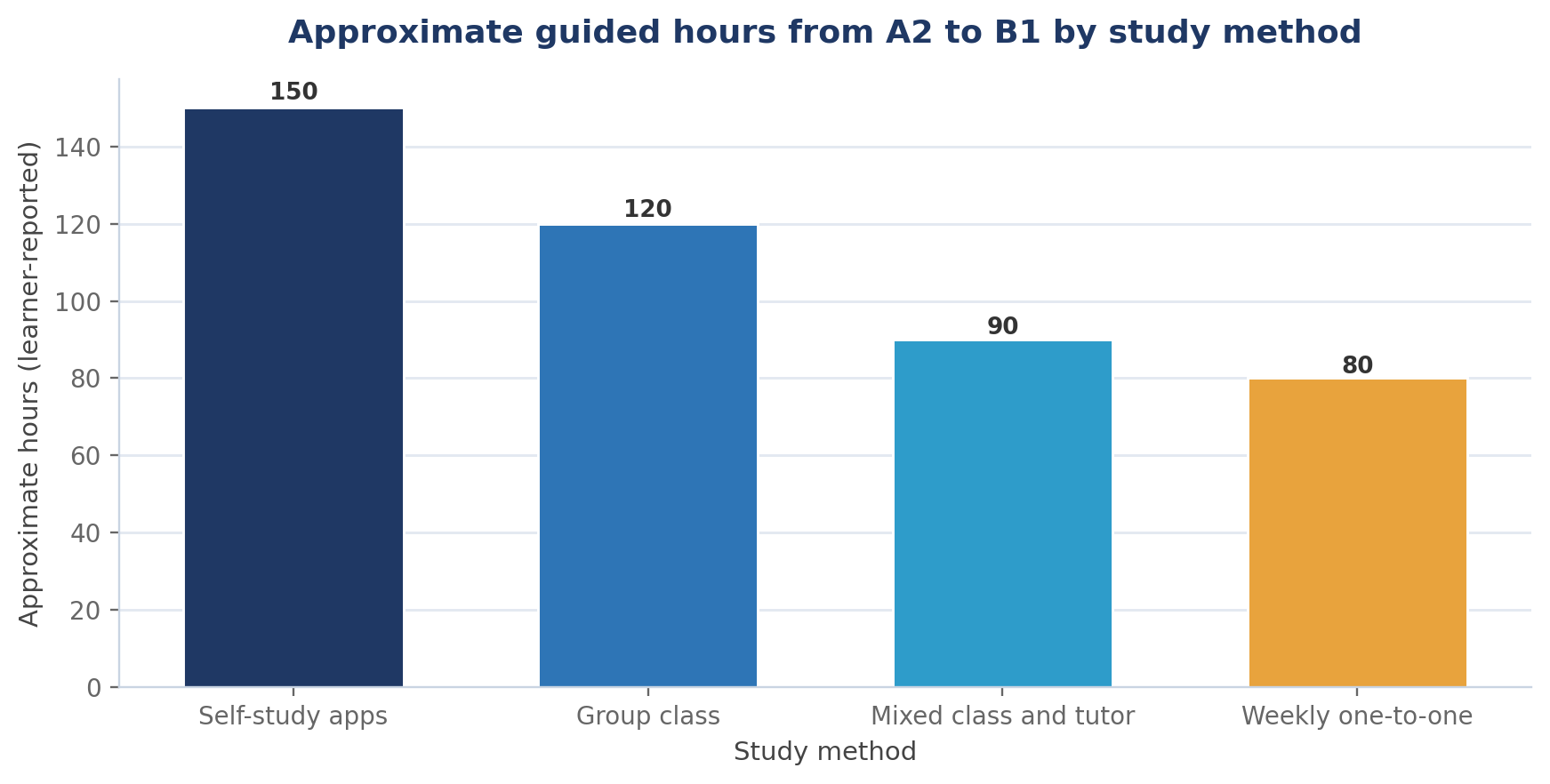
How long does it take to go from A2 to B1? Learners commonly report three to nine months with regular study, but the range depends heavily on guided hours and speaking practice. Treat any single number with suspicion.
Do I need the subjunctive to pass DELE B1? It appears across all four papers and is essential for the written and oral tasks. Skipping it caps your ceiling early.
Is B1 intermediate or advanced? B1 is the first genuinely independent level and is normally called intermediate. B2 is upper-intermediate; C1 is advanced.
References & Further Reading
- Council of Europe — CEFR level descriptions
- Instituto Cervantes — DELE diplomas, including B1
- Instituto Cervantes — Plan curricular: levels and descriptors
- Real Academia Española — Diccionario panhispánico de dudas
- Instituto Cervantes — Spanish learning portal and resources