Your four-year-old says « agua » at the sink. Nobody taught her that. She heard it twice, and now it's hers. That is the entire secret of teaching Spanish to a young child — and it has almost nothing to do with lessons.
Children don't learn languages the way adults do. They learn by wanting something and hearing the word for it. Your job isn't to teach. It's to build a world where Spanish is the word that gets results.
The One Rule That Decides Everything
Whatever you do, do not make Spanish feel like homework. The moment it becomes a subject with a score, a small child's motivation collapses and it is very hard to rebuild.
Make it a game, a song, a secret language between you, a way to get a snack faster. Effort should be invisible.
What you will get from this guide
- What works at each age, from 2 to 12
- A 15-minute daily routine that fits real family life
- Games that teach without anyone noticing
- The five mistakes that make kids refuse the language
What Works at Each Age
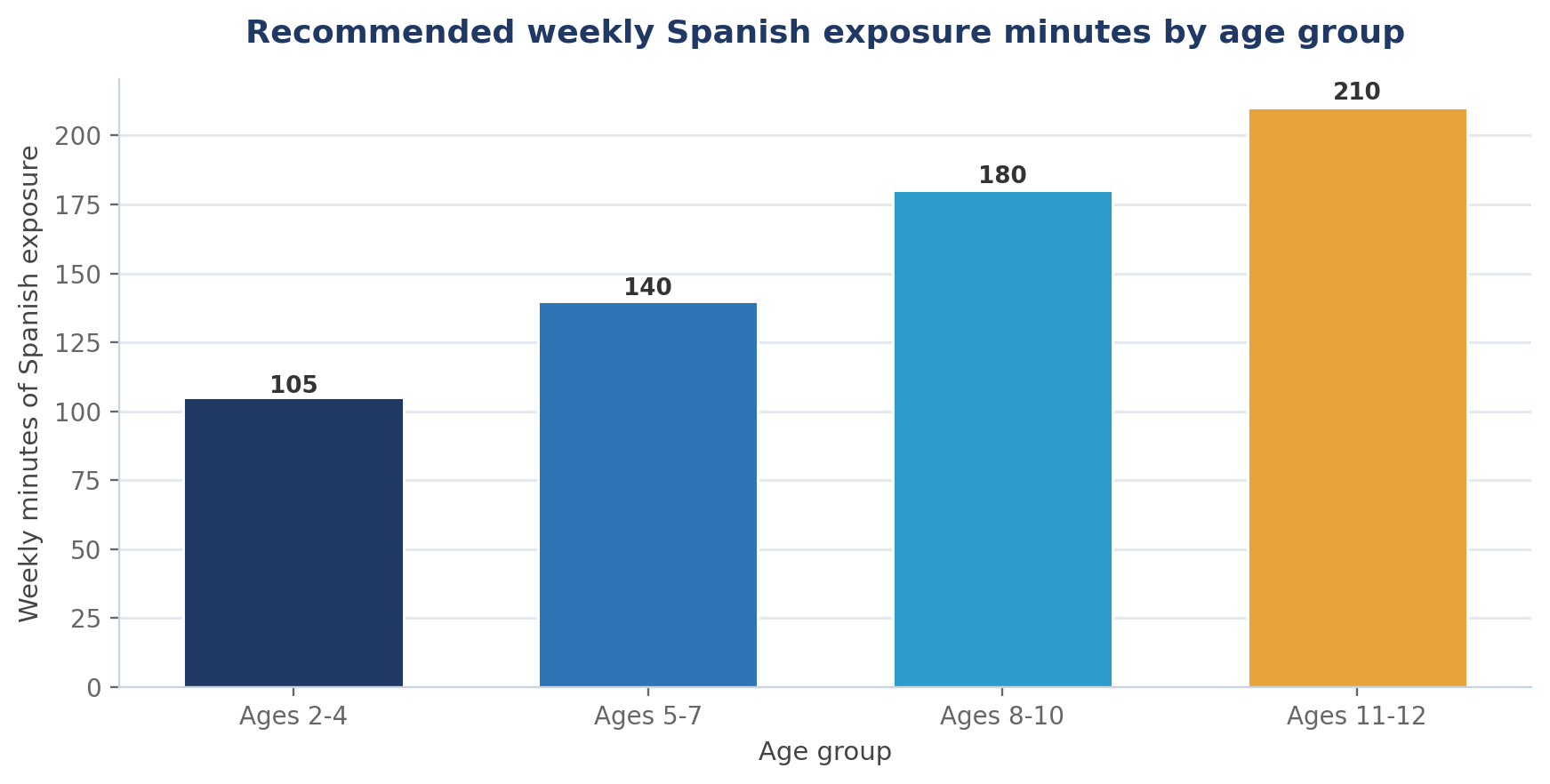
Methods that delight a toddler will insult a ten-year-old. Match the approach to the brain in front of you.
The window widens before it narrows. Under seven, pronunciation comes almost for free. After ten, a child wants to know why they're learning — and "because it's good for you" isn't an answer that lands.
The 15-Minute Daily Routine
Small and daily beats long and weekly, by a wide margin. Fifteen minutes every day is worth more than two hours on Saturday.
Consistency is the whole mechanism. A child who hears Spanish every day internalises rhythm and sound patterns that a weekend learner will fight for years.
Games That Actually Teach
Forget flashcards on the first attempt. Start with games where the Spanish is the mechanism, not the objective.
Veo veo is the star. It has a fixed rhythm — Veo, veo. ¿Qué ves? Una cosita. ¿Y qué cosita es? — that children memorise in a week and then use for years.
The Mistakes That Backfire
Translating constantly. If your child says « dog » and you say « perro », then « dog » again, the Spanish becomes a footnote. Use it in context instead: point, say perro, move on.
Correcting pronunciation too hard. Over-correction kills confidence. Model the right sound by repeating it naturally, not by making them try again.
Testing them. « How do you say…? » turns conversation into an exam. Children learn to avoid the exam.
Stopping for weeks. A two-week gap with a five-year-old erases real ground. Fifteen minutes beats nothing, always.
Making it about performance. The goal is that Spanish feels normal, not impressive.
When a Parent Isn't Fluent
You do not need to be fluent to raise a child with Spanish. You need three things: good audio, a routine, and one real human conversation per week.
Audio exposure gives vocabulary. Humans give speech. Children need both, and the human half is the one you can't fake with an app.
Your child needs a person, not just a screen
Ready to turn reading into real Spanish? Start your self-paced course today.
Start the Spanish course →Create a free accountSongs and videos build vocabulary. Speaking builds fluency. Our self-paced Spanish course for kids uses a personal AI voice tutor — games, stories, and speaking practice at their level, any time. Button: Start a free Spanish account →
Songs and Stories: The Highest-Return Tools
Music is the cheapest fluency hack in existence. A child who knows twelve Spanish songs has several hundred words and perfect rhythm without a single lesson.
Repeat the same five songs for a month rather than rotating twenty. Repetition is not boredom to a child — it is how the words get in.
Reading and Writing: Introduce Late
Reading Spanish is easy. Spanish is highly phonetic — once a child knows the letter sounds, they can decode almost any word. That's a gift, and it's one reason Spanish is a friendly first foreign language for English-speaking kids.
But don't rush it. Reading before age six or seven can crowd out listening. Let the ear lead. Introduce letters when the child is already reading in their first language, and use short, phonetic words: mamá, papá, sol, pan, gato.
Spanish in the Real World
Language dies without a reason to use it. Give your child one.
That last row is where the Instituto Cervantes comes in. For older children and teens, the DELE exams offer a real, internationally recognised goal. The Instituto Cervantes also runs courses and cultural activities, and its materials are a reliable benchmark for what a child at a given age can realistically do. Treat the exam as a destination for later — not a starting line for a six-year-old.
What Success Looks Like
Not a bilingual child by next summer. Success is smaller and better: your child hears Spanish and doesn't flinch. They say « gracias » without thinking. They sing along. They ask what a word means.
That is fluency growing. It compounds quietly for years, and then one day they hold a conversation you can't follow.
Give them a teacher who makes it fun
Ready to turn reading into real Spanish? Start your self-paced course today.
Start the Spanish course →Create a free accountCreate a free account, tell us your child's age and level, and we'll suggest the right starting point. A personal AI voice tutor, games and stories — Spanish that feels like play, at your child's own pace. Button: Create your free account →
Frequently Asked Questions
What age should children start learning Spanish? Any age works, but under seven pronunciation comes almost effortlessly. Starting early is an advantage, not a requirement.
Can I teach my child Spanish if I don't speak it? Yes, with good audio material and a weekly conversation partner or a self-paced AI voice tutor. Your role becomes routine-builder, not grammar teacher.
How much Spanish should a child hear per day? Fifteen to thirty minutes daily for young children, spread across songs, games and stories. Daily beats long sessions.
Should my child take the DELE exam? Only when they're older and want a tangible goal. For under-tens, the DELE is unnecessary — real conversation matters far more.
References & Further Reading
- Instituto Cervantes, Spanish courses and DELE examination information: https://www.cervantes.es/
- Instituto Cervantes Plan Curricular and level reference materials: https://cvc.cervantes.es/
- Instituto Cervantes Mi mundo en palabras, Spanish activities for children aged 7–9: https://cvc.cervantes.es/ensenanza/mimundo/
- CEFR level descriptors, Council of Europe: https://www.coe.int/en/web/common-european-framework-reference-languages
- Radio Nacional de España, audio and children's programming in Spanish: https://www.rtve.es/