A seven-year-old will not sit still for a verb table. But hand her a scarf and ask her to be un gato and she will meow in Spanish for twenty minutes. That is the whole secret. Children learn language the way they learned their first one — by playing, losing, laughing and trying again.
What you will get from this guide
- Ten games that need no special equipment
- What each game secretly teaches
- A simple weekly rhythm you can actually keep
- How to fix the two mistakes parents make most
Why Play Beats Drill for Young Learners
Kids under eleven absorb pronunciation faster than adults. Their ears are still flexible, and their fear of sounding silly is still small. A game removes the pressure of being tested and replaces it with a reason to speak: you need the word rojo because the red card is the one that wins.
The trick is repetition with variety. Play the same game five times in a week with small changes, and new words move from "heard it" to "own it".
Ten Spanish Games for Kids You Can Play Tonight
1. Simón Dice (Simon Says)
Classic for a reason. Simón dice toca la nariz. Commands cover body parts, verbs and directions. It teaches listening comprehension with zero writing.
2. Veo, Veo (I Spy)
Veo, veo. — ¿Qué ves? — Una cosita. — ¿Y qué cosita es? — Empieza con la letra… Perfect for colours, shapes and adjectives. Play it in the car.
3. La Papa Caliente (Hot Potato)
Pass a ball while music plays. When it stops, the holder says a word from the week's list or answers a question. Fast, loud, unforgettable.
4. Bingo de Animales
Draw a 3×3 grid, fill it with animals, and call them out. Listening practice disguised as a race.
5. El Mercado (The Market)
Set up a pretend shop. Your child is the seller, you are the customer with a shopping list. This one teaches numbers, food words and polite phrases.
Activities That Work Without Any Equipment
Not every day is a game day. Some days are kitchen days, car days and bath days.
Cocina en español. Cook something simple and narrate it. Añadimos dos huevos. Ahora mezclamos. Your child hears instructions in context — the way real language arrives.
El abecedario de la casa. One letter, one object, one room. A de armario. Simple, quick, repeatable.
Canciones con gestos. Songs with actions lock words into muscle memory. Ask any teacher: the kids who act out cabeza, hombros, rodillas, pies never forget the body parts.
The Weekly Rhythm That Actually Sticks
Consistency beats intensity. Three short sessions beat one long Sunday lesson, because memory likes small, repeated doses.
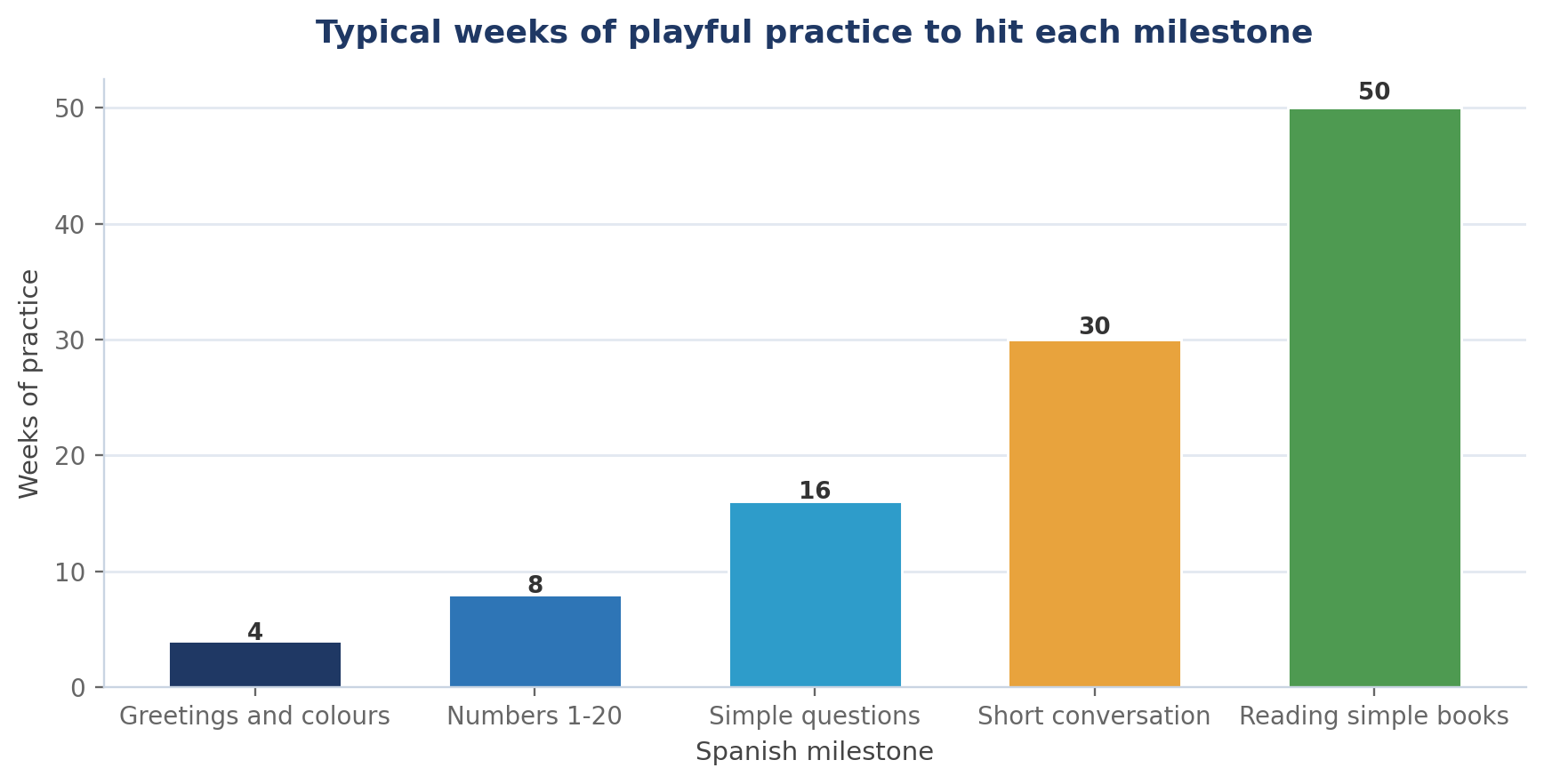
Here is how quickly children typically move through early Spanish milestones when they play regularly with a parent and add guided lessons.
Two Mistakes That Slow Everything Down
Mistake one: correcting too much. If you stop every game to fix pronunciation, the game dies and so does the willingness to speak. Note the error, fix it later, keep playing now.
Mistake two: translating everything. When you translate after every Spanish word, the brain learns to wait for the English. Point, act, draw, mime — let the meaning arrive in Spanish.
Your child already has the best teacher: play. Now add a personal AI voice tutor
Games build momentum. A personal AI voice tutor builds accuracy — proper pronunciation, real questions, and a child who is happy to answer them. Study at your own pace, any time. Try a free account this week.
Start free →Create a free accountHow to Keep It Going When the Novelty Fades
Every family hits week three, when bingo feels old. Rotate, do not quit. Swap the vocabulary, change who calls the game, let your child be the teacher for a day. Kids who get to run the game speak far more than kids who only play it.
Add a small reward that is not food: stickers on a chart, choosing the next song, ten extra minutes before bed.
When to Add Guided Lessons
Play alone gives you vocabulary and confidence. It rarely gives you grammar structure or an accurate accent. That is the point where a personal AI voice tutor helps — it hears your child, gives feedback gently, and knows exactly what comes next. You can find the full course path on the Spanish course page.
Turn bedtime bingo into real Spanish
Self-paced, friendly lessons built for young learners, from first words to short conversations. Play at home, sharpen it with a personal AI voice tutor.
See the Spanish course →Create a free accountFrequently Asked Questions
How many words can a child learn in a month? With playful daily practice, expect roughly 30–50 useful words and phrases in the first month. Comprehension grows before speaking, so do not panic if the output lags.
What if I do not speak Spanish myself? Learn alongside your child. Play the games, use a good audio source, and let a personal AI voice tutor carry the accuracy. Your willingness matters more than your level.
At what age should we start? Any age works. Ages three to ten are especially friendly because children copy sounds easily and are not embarrassed by mistakes.
How long should a session be? Match the age: five to ten minutes for under-sixes, ten to twenty for older children. Stop while it is still fun.
References & Further Reading
- Instituto Cervantes — the official Spanish language institution, with children's resources and DELE exam information.
- Instituto Cervantes — Plan curricular — reference levels for Spanish teaching.
- Centro Virtual Cervantes — free classroom activities and games for young learners.
- UNESCO — Mother tongue and early learning — why early language exposure matters.
- Common European Framework of Reference (CEFR) — the level scale used for Spanish courses.