A three-year-old does not conjugate verbs. She grabs a cookie and says "quiero". And somehow, by five, she will switch between two languages mid-sentence without noticing she is doing something remarkable.
Children do not learn languages the way adults do. They absorb them. Your job is not to teach. Your job is to supply enough contact.
What you will get from this guide
- What bilingualism actually means, and its four common forms
- The two methods that work and one that quietly fails
- Realistic milestones by age
- How many hours a week a child really needs
What Bilingualism Actually Means
"Bilingual" is not one thing. Most children fall into one of four patterns, and knowing which one you are building tells you what to expect.
The pattern you want to avoid is the receptive child: perfectly understands Spanish, never speaks it. It is common, and it is fixable — but only with pressure to produce.
The Two Methods That Work
The method matters less than the consistency. Research on bilingual development consistently shows that what predicts fluency is the amount and variety of exposure, not which strategy you chose.
Milestones: What to Expect and When
Two things reassure parents. First, code-switching is normal and healthy — it is not confusion. Second, bilingual children sometimes hit single-language milestones slightly later and then catch up completely.
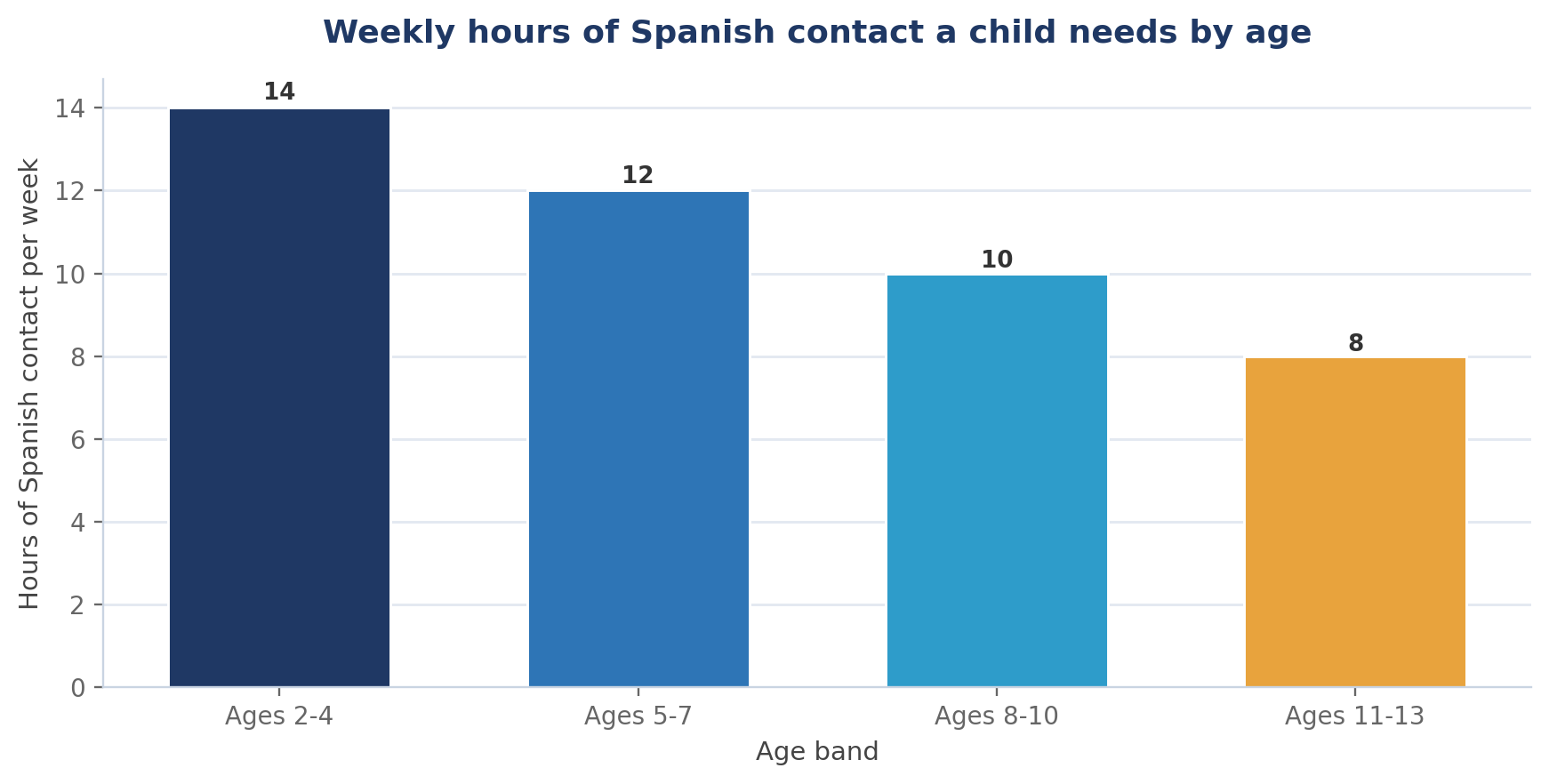
Notice the trend: younger children need more raw contact; older children need less but better-quality input. A twelve-year-old needs conversation and reading, not nursery rhymes.
What Not to Do
- Do not correct every mistake. Constant correction makes children stop talking, and a silent child learns nothing.
- Do not mix languages inside one sentence as a habit ("vamos a la store"). Keep the two systems clean.
- Do not drop Spanish when English takes over at school. School is exactly when the home language starts losing ground.
- Do not treat Spanish as homework. Children protect what is fun and abandon what is graded.
- Do not panic about mixing. Code-switching fades as vocabulary grows.
Give your child a Spanish speaker who is not you
Children often resist the language their parents push. A personal AI voice tutor changes the dynamic entirely: Spanish becomes a game with a friendly voice, not a chore at home. Book a free account and let the AI tutor play, sing and talk with your child.
Empezar gratis →Create a free accountThe Weekly Rhythm That Builds Fluency
Add it up and you are near the contact hours a child needs. The single most valuable line is the fourth: an AI voice tutor gives you correction and structure that family members, however fluent, rarely provide.
The Long Game: Identity, Not Vocabulary
The children who keep their Spanish are not the ones with the biggest word lists. They are the ones who feel Spanish is theirs.
Around age nine or ten, most children decide whether their second language is part of who they are. Everything you do before that is preparation for that decision.
Structure for the years when enthusiasm fades
Habits wobble, especially in the teenage years. A steady weekly AI voice tutor session keeps Spanish moving when motivation alone will not. Our family plans cover children from age four upward.
Ver cursos para niños →Create a free accountFrequently Asked Questions
Will my child be confused by two languages? No. Bilingual children may mix languages early on, but this is a normal stage of development, not confusion. They separate the systems as vocabulary grows.
What if I am not fluent in Spanish myself? You can still raise a bilingual child with songs, books, media and an AI voice tutor. Your role is the routine and the enthusiasm; the AI tutor supplies the accuracy.
Is it too late to start if my child is already eight? No. Older children learn grammar and reading faster than toddlers. They need consistent contact and a reason to speak, not early exposure.
Should we drop Spanish if school is in English? The opposite. School is when the home language loses ground fastest. Keep Spanish at home and make it a source of pleasure rather than a task.
References & Further Reading
- Instituto Cervantes — Spanish language and bilingual education resources: https://www.cervantes.es
- Instituto Cervantes — El español en el mundo (annual yearbook), Spanish in bilingual contexts: https://www.cervantes.es
- Council of Europe — Common European Framework of Reference for Languages, plurilingual education: https://www.coe.int
- UNESCO — resources on mother-tongue and multilingual education: https://www.unesco.org
- LanguageSkills.net — Spanish courses for children and families: https://languageskills.net/spanish
The Last Word
Bilingualism is not a talent some children have and others lack. It is arithmetic: enough hours, enough warmth, enough reasons to speak. Supply the contact, keep it enjoyable, and let the language grow the way the first one did.