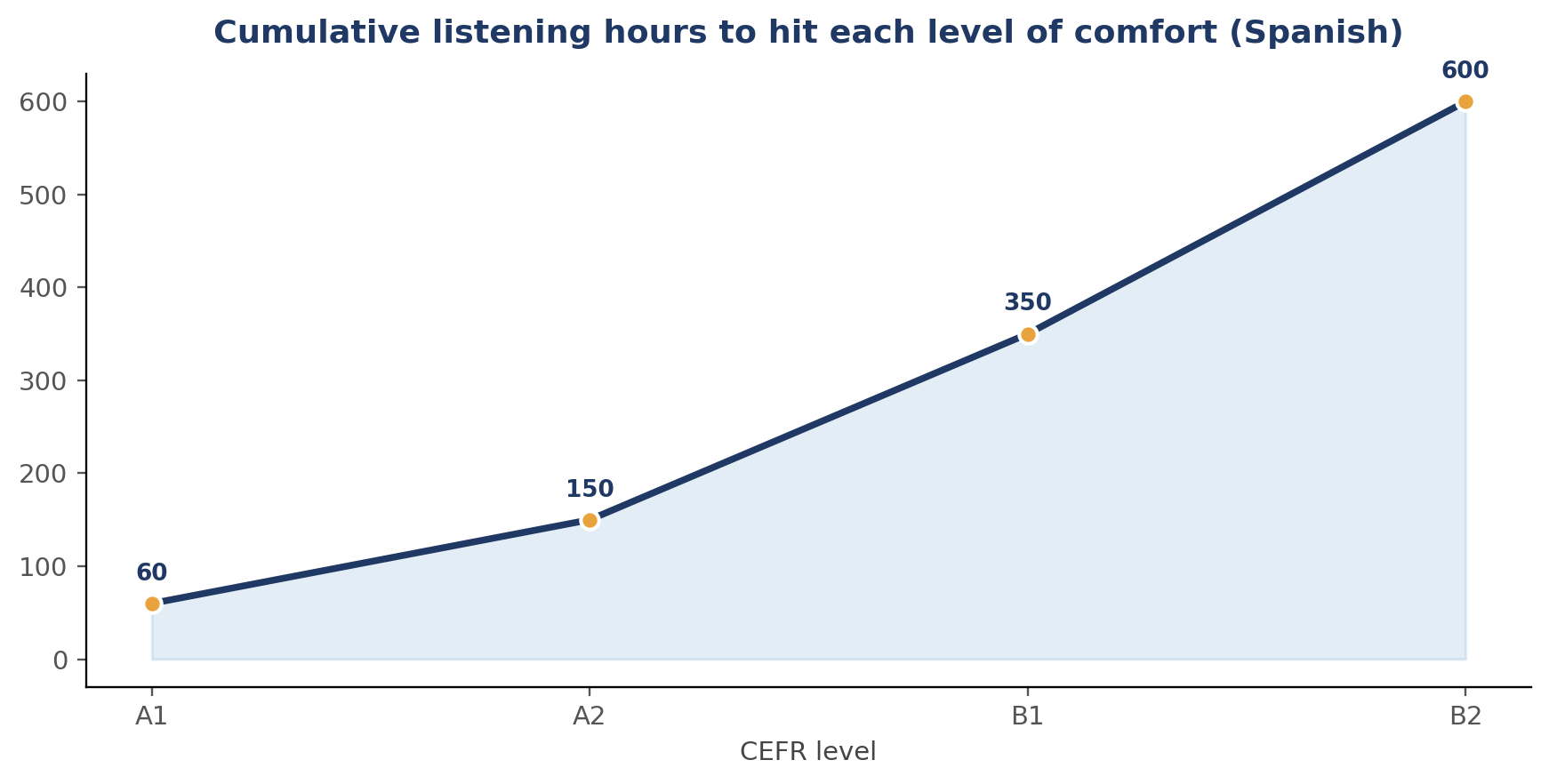
Your ears are the bottleneck. You can read a menu, you can text a friend, and then two Spaniards start talking at normal speed and you understand "eh... hola". One hour of listening a day fixes that faster than any grammar book.
The catch: most learners listen to shows that are either far too hard or far too easy. Here is the honest map.
What you will get from this guide
- Real Spanish podcasts sorted by level, accent and episode length
- A listening routine that fits a commute, not a sabbatical
- Hour targets per CEFR level and how they connect to DELE listening tasks
- How to stop using subtitles as a crutch
Why Podcasts Beat Almost Everything Else
Podcasts give you something no textbook can: volume. Thousands of hours of natural Spanish, free, in your pocket, forever.
There is one hard condition. The audio must be comprehensible input — around 80 to 90 percent understood. Below that, your brain gives up and you learn nothing. Above it, you get bored. That sweet spot moves every few weeks, which is why a single "best podcast" list for all learners is useless.
The Best Spanish Podcasts for Learners, Level by Level
These are real shows with real hosts. Accents noted, because that matters more than most people admit.
Start at the bottom of the level you think you are, not the top. If a show makes you pause every twenty seconds, it is one level above you today.
Choose an Accent On Purpose
Spanish is not one sound. A Mexican host and an Argentine host can be as far apart as a Scot and a Texan.
Pick one as your home accent and visit the others later. Jumping between five accents in month one only overloads you.
Your ears need more than a queue of episodes
Podcasts give you input. A personal AI voice tutor gives you the other half: instant feedback, structured listening tasks and speaking practice where you must answer. Get a listening assessment and a course built around what you actually cannot hear yet.
Start a self-paced Spanish course →Create a free accountThe Routine That Actually Sticks
Motivation dies when listening becomes a chore. Shrink it until it is automatic.
Three rules keep this working. First, never repeat an episode more than three times. Second, note the transcript problem words, not every unknown word. Third, once a week, listen to something with no transcript at all — that is the exam condition.
How to Wean Yourself Off Subtitles
Subtitles feel like progress and often are not. You read, you nod, you remember little.
If the DELE is your goal, this matters directly. The listening paper is audio-only, played once in many tasks, with no transcript. Test formats and level descriptors are published by the Instituto Cervantes on their DELE pages, and practising under those conditions is the only honest rehearsal.
When Podcasts Are Not Enough
Podcasts never ask you a question. That is their weakness.
You can understand 90 percent of an episode and still freeze when someone asks your opinion about it. Listening and speaking are separate skills, trained separately. That is why the strongest learners pair one hour of daily listening with two or three structured speaking sessions a week — self-paced, corrected, and just uncomfortable enough to matter. Check your level first with a free placement-style assessment.
Turn listening hours into real conversation
You have the podcasts. Now get the feedback. Self-paced Spanish lessons with an AI voice tutor mean you speak every session, get corrected on the spot, and hear your own progress gain by gain.
Start a Spanish speaking course →Create a free accountFrequently Asked Questions
How many hours of Spanish listening do I need per day? Thirty minutes daily beats three hours on Sunday. Consistency is what moves comprehension, not volume on a single day.
Should I listen to podcasts while doing something else? Background listening helps only at B2 and above. Before that, give the audio your attention or you are mostly hearing noise.
Do slow podcasts stop me from understanding normal Spanish? No, if you move up regularly. Spend two or three weeks at each speed, then step up to native pace so you do not get stuck at half speed.
Are Latin American and European Spanish podcasts both useful? Yes. Anchor on one accent, then rotate the others so you can handle the range you will meet in the real world.
References & Further Reading
- Instituto Cervantes, official Spanish language institution and DELE exams: https://examenes.cervantes.es
- Radio Ambulante, narrative journalism in Spanish from across Latin America: https://radioambulante.org
- DUOLINGO Spanish Podcast, bilingual true-story episodes: https://podcast.duolingo.com/spanish
- Notes in Spanish, Madrid-based real conversation for learners: https://www.notesinspanish.com
- Hoy Hablamos, daily Spanish podcast with transcripts: https://www.hoyhablamos.com