You can conjugate the subjunctive. You can order dinner in Madrid. Then a native speaker answers you at full speed and your brain goes white. This is not a vocabulary gap — it is a processing gap, and it is the single most fixable skill in language learning.
What you will get from this guide
- Why you freeze at native speed — the real mechanism
- A three-stage listening ladder from A2 to B2
- Accent training for Spain versus Latin America
- DELE listening strategy, task by task
Why You Freeze at Natural Speed
Native Spanish runs at roughly 250 to 300 syllables per minute. A textbook recording runs at about 130. That is not a small gap — it is double.
Worse, Spanish chains words together. ¿Estás en casa? becomes ¿"estás-en-casa"? — one continuous sound. Your ear is looking for word boundaries that do not exist.
Passive listening — playing podcasts in the background — does not fix this. In fact it barely moves the needle. Attention is the active ingredient.
The Three-Stage Listening Ladder
Improvement comes from working at the edge of comprehension: material you understand about 70 to 80 percent of. Easy input bores. Impossible input demoralises. The edge is where the growth is.
Stay at any single stage too long and you plateau. Move up when the "edge" material starts feeling routine — usually within three to five weeks.
The Drill That Beats Passive Listening
Here is the loop. It takes ten minutes and it is worth more than an hour of background playlists.
That third step is the diagnostic. Write down why you missed each word: unknown vocabulary, connected speech, or speed. Three columns. You will see your pattern within a week.
Unknown words mean you need vocabulary work. Connected speech means you need enlace training. Speed alone means you need volume — more hours at the edge.
Spain or Latin America: Train Both
Real Spanish is not one accent, and the differences are audible within seconds.
You do not have to master all of them. You do have to stop being ambushed. Pick one anchor accent, then spend ten percent of your listening hours wandering into the others so nothing sounds alien.
Hearing it once is not enough. Hearing it again and again is everything.
Our AI voice tutor works through listening practice with you at your own pace, any time, and gives you feedback exactly where your ear breaks. That structured, self-paced feedback is the one thing a podcast can never give you.
Practise Spanish listening with the AI voice tutor →Create a free accountDELE Listening: What the Exam Rewards
The DELE comprensión auditiva paper is not a vocabulary test. It is a filtering test. Tasks ask you to catch one specific detail inside a conversation designed to distract you.
Read the questions before the audio starts. Underline the key word in each option. When a speaker says "pues, en realidad no tanto", the answer is rarely the first thing they said.
Build the Habit That Survives a Busy Week
Long sessions collapse under a full calendar. Short daily reps survive.
Sixty minutes a day beats four hours every Sunday. Consistency builds the automatic processing your brain needs, and automatic processing is exactly what fluency sounds like from the inside.
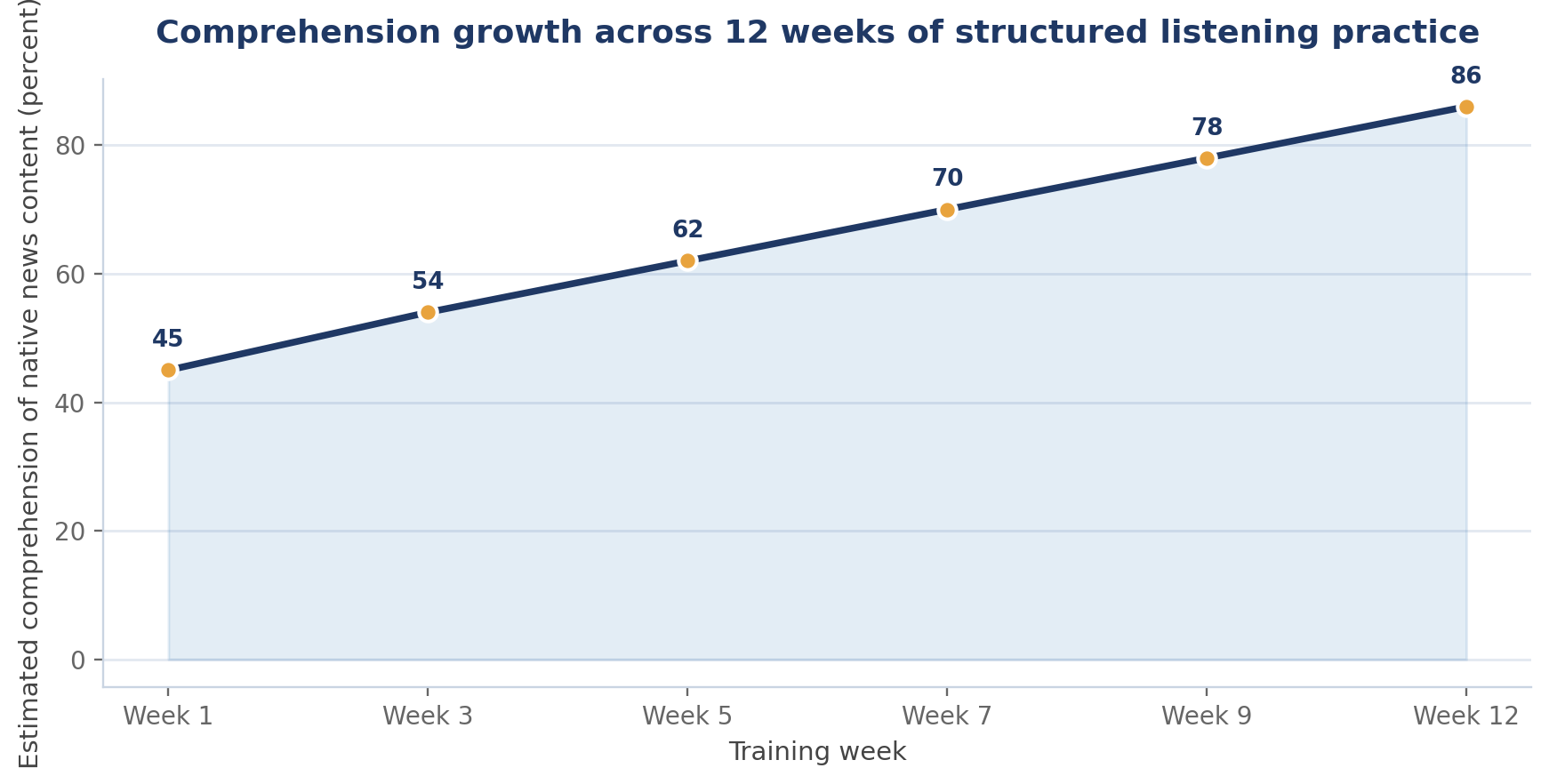
Track comprehension weekly. Ask yourself one question: what percentage of a native news clip did I catch? When that number climbs, your listening is genuinely improving — not just your mood.
Turn "I catch the gist" into "I catch everything"
Bring a clip you cannot understand. The AI voice tutor will break it apart with you, line by line, until the sound finally matches the meaning.
Start self-paced Spanish listening practice →Create a free accountFrequently Asked Questions
How long until my Spanish listening improves? With sixty focused minutes a day, most learners notice a clear jump in three to four weeks. Real comfort with native radio takes three to six months.
Do subtitles help or hurt? Spanish subtitles help — they link sound to spelling. English subtitles hurt, because your eyes do the work and your ears stay lazy.
Should I slow down the audio? Only when diagnosing a specific word. Regular practice belongs at full speed, or you are training for an exam that will never happen.
Is Latin American Spanish harder to understand? Not inherently. Caribbean and Chilean accents drop more sounds and trip learners up more often. Colombian and Mexican broadcast Spanish is a friendly starting point.
References & Further Reading
- Instituto Cervantes — Spanish courses and DELE exam information: https://www.cervantes.es/
- Instituto Cervantes — DELE model papers and preparation materials: https://examenes.cervantes.es/
- RTVE — Spanish public radio and television audio for authentic listening: https://www.rtve.es/
- Radio Ambulante — narrative podcast in Latin American Spanish with transcripts: https://radioambulante.org/
- LanguageSkills.net — self-paced Spanish listening and speaking courses with an AI voice tutor: https://languageskills.net/spanish