One song, looped forty times, will teach you more Spanish than forty flashcards. That is not a motivational poster — it is how the brain stores language: attached to rhythm, emotion and repetition.
What you will get from this guide
- Songs chosen for grammar, not just for taste
- A five-step method that turns a track into a real lesson
- The dialect map hiding inside Latin music
- A weekly listening mix you can actually keep
Why music works when textbooks do not
A chorus is an earworm with grammar inside it. When a phrase arrives attached to a melody, you do not retrieve it — it arrives. Me gustas tú does not need translating after you have heard it thirty times. It simply exists in you.
Music also delivers something textbooks flatten: variety. Within one playlist you travel from Madrid to Buenos Aires to Bogotá, hearing vosotros, vos and ustedes in the space of ten minutes. That is a dialect tour disguised as entertainment.
Use songs for what they are good at, and pair them with a person for the rest.
Spanish songs to learn, sorted by what they teach
Forget "best Spanish songs". Ask instead what each song drills. This table gives you the grammar target for each track.
Two of these — Ojalá que llueva café and Color Esperanza — are worth memorising whole. The subjunctive is the structure learners fear most, and singing it in a chorus is the least painful way to internalise it.
The five-step method
Passive listening is pleasant and almost useless. This is the loop that converts.
Step five is the one that makes words yours. Take me gustas tú and turn it into me gusta el café, me gusta Madrid, no me gusta el lunes. Same structure, your content.
Turn those lyrics into real conversation
Songs load your ear. Speaking them out loud with an AI voice tutor turns them into fluency. Our self-paced Spanish lessons start from the music and culture you already love.
Start learning Spanish →Create a free accountThe dialect map inside your playlist
Latin music is a free accent course, but only if you notice what you are hearing. Spanish changes dramatically across the map.
Pick one accent to imitate for the next three months. Sampling all six at once will leave you with an ear that understands everything and a mouth that does not sound like anywhere.
Lyrics as a grammar laboratory
Songs are full of structures that textbooks introduce late — because songwriters write like people talk.
Copy the frame, swap the words. That is how a chorus becomes a template.
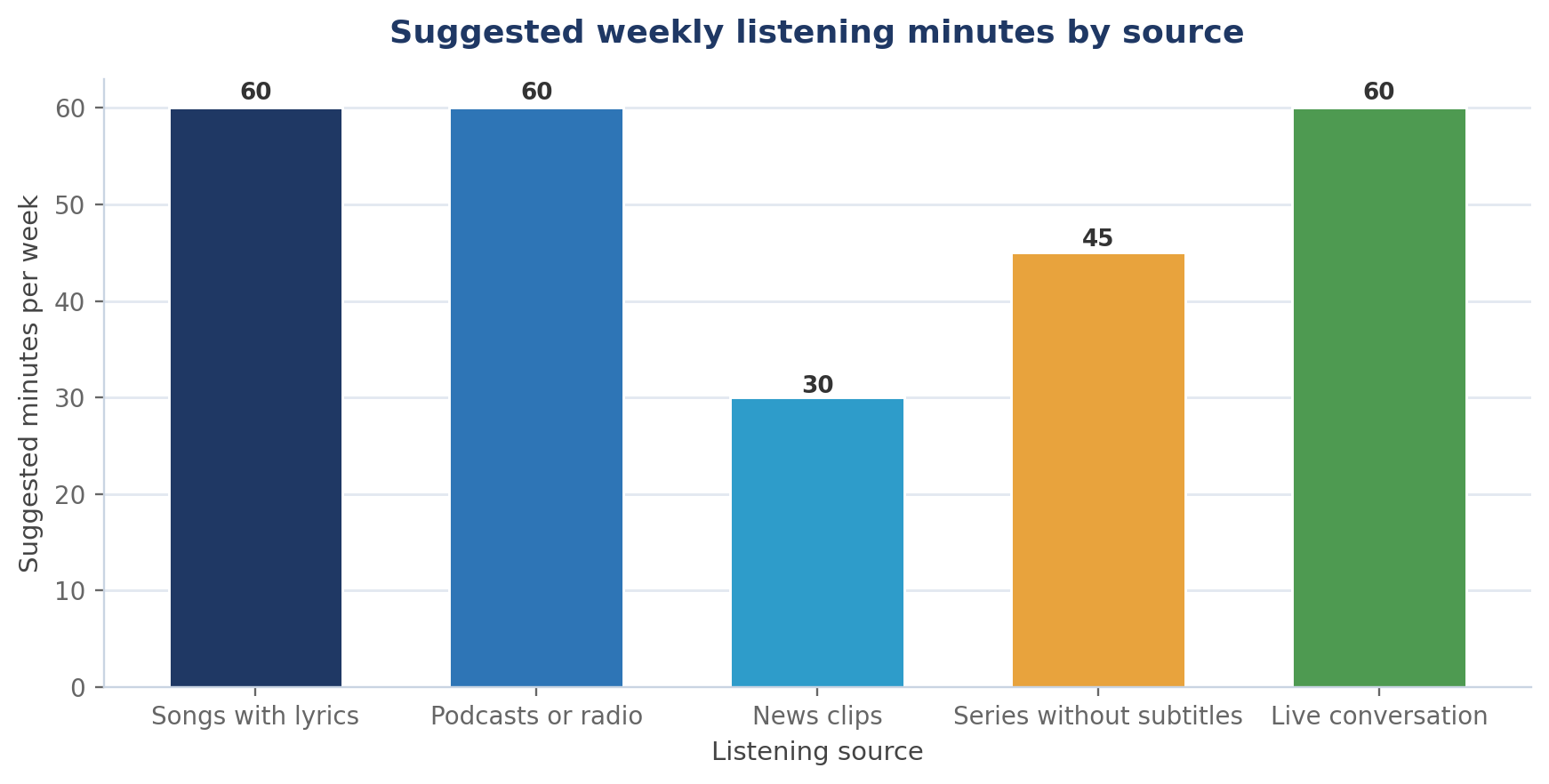
How much listening is enough?
More than you think, and it does not have to be only music. Here is a workable weekly mix.
Songs carry emotion, conversation carries correction. Both belong in the same week.
Songs are not enough on their own
Three limits, stated plainly.
Lyrics are poetry, not speech. They bend word order and drop articles to fit the melody. Sing Todo cambia to sound poetic; say todo ha cambiado to sound correct.
Singers mumble and slide. Spoken Spanish clips consonants in ways studio recordings polish away. Add interviews and podcasts to hear the rough version.
Nobody corrects a recording. You can memorise a misheard lyric for months without a single person telling you it is wrong. A teacher is the only fix.
Frequently Asked Questions
Which Spanish song should a beginner start with? Me Gustas Tú by Manu Chao. Short lines, huge repetition, one clear structure repeated until it sticks.
Does listening to music really improve comprehension? It improves pattern recognition, rhythm and vocabulary. Comprehension in fast conversation still needs dedicated practice with real speech.
What about songs with Spanish and English mixed? Useful, but ration them. Your goal is the Spanish-only channel, and code-switching lets your brain take the easy road for years.
Can I learn a Spanish accent from singing? Partly. Singing trains vowels and rhythm well, but stress and intonation in speech need conversation practice. Use songs to prepare the ear, then talk.
From playlist to fluency
You already have the motivation — you just need the speaking hours. Our self-paced Spanish lessons turn the vocabulary you have absorbed from music into sentences you can use.
Start learning Spanish →Create a free accountReferences & Further Reading
- Instituto Cervantes, El español en el mundo (yearbook) and language resources: cervantes.es
- Instituto Cervantes, DELE exam materials — the official Spanish proficiency certificates.
- Real Academia Española, Diccionario de la lengua española — check the words you hear in lyrics: rae.es
- Spain's national broadcaster RTVE, Radio Nacional de España — free audio in peninsular Spanish: rtve.es
- FundéuRAE, style and usage guidance for contemporary Spanish: fundeu.es