A nine-year-old and a forty-year-old walk into the same Spanish class. Six months later, guess who says rr correctly?
The nine-year-old. Usually. But the forty-year-old finishes the sentence faster and remembers the subjunctive better. That contradiction is the whole answer to the best age to learn Spanish — and it is not one age.
What you will get from this guide
- The real windows for pronunciation, grammar and fluency
- Why "earlier is better" is half true, half marketing
- Hour bands showing what each starting age needs
- Practical plans for toddlers, kids, teens and adults
Two Clocks, Not One
Language acquisition runs on two separate clocks. Pronunciation locks in early and hard. Everything else — vocabulary, grammar, reading, sustained conversation — is wide open for decades.
So the honest answer: start young for the accent, start now for everything else.
The "Critical Period" Without the Hype
The research term is sensitive period, not deadline. The classic study by Johnson and Newport (1989) found that learners who arrived in an English-speaking country before puberty were far likelier to reach native-level grammar than those who arrived later. Later work on hundreds of thousands of test-takers, published in Cognition in 2018, put the decline in learning efficiency starting around age 17 to 18 — notably late.
Read that again. The sharpest drop comes after high school, not after age six. The panic about the "window closing at five" is mostly marketing.
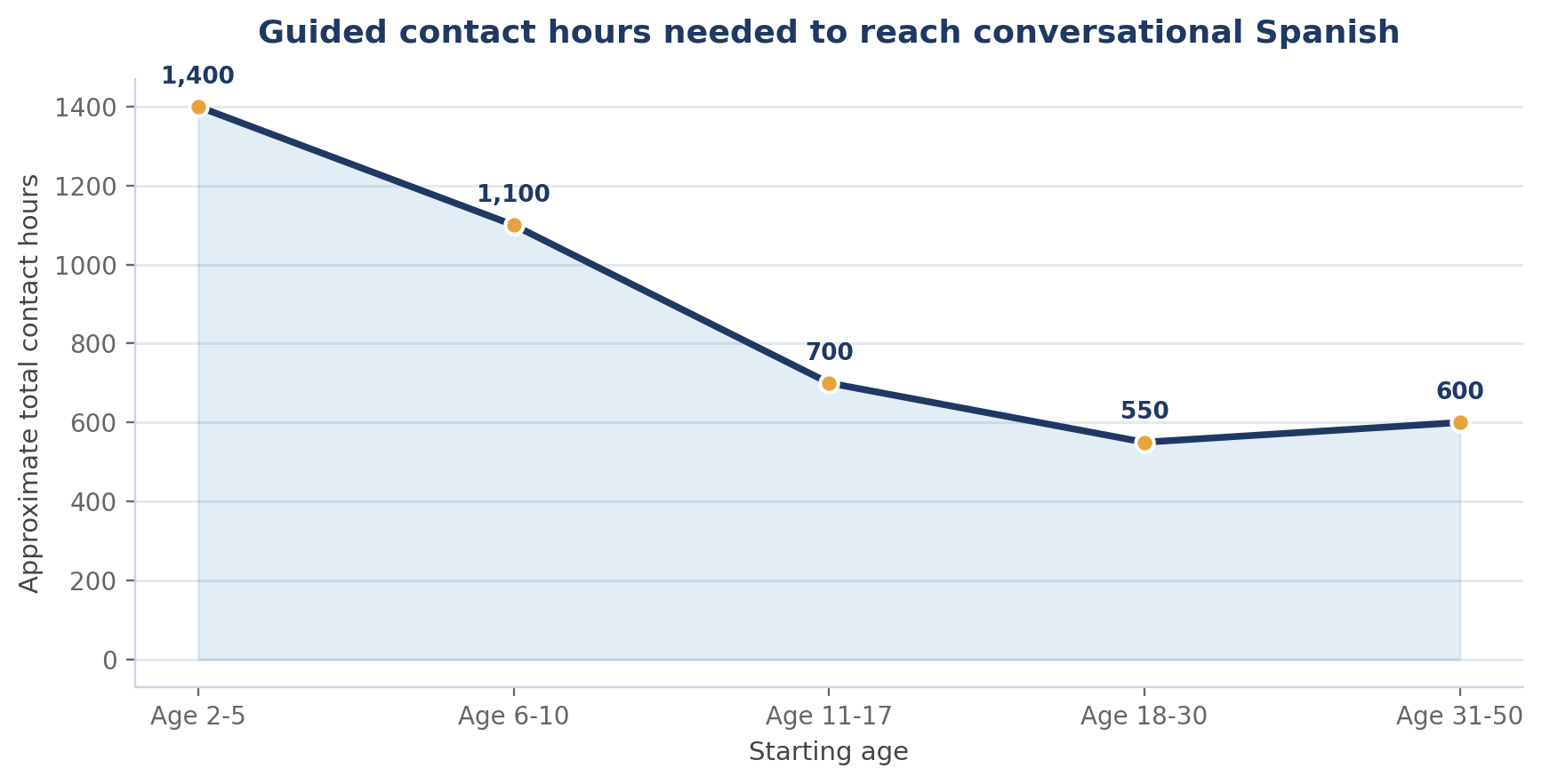
How Many Hours Each Age Really Needs
Young children do not learn faster per hour. They simply accumulate thousands of hours of play, song and repetition without noticing.
Hours fall as you age because adults study efficiently. Hours rise for toddlers because they are not studying at all — they are absorbing.
Ages 0–5: Sound Before Sentences
Ignore flashcards. This stage is ears and mouth.
Plurilingual education guidelines from the Council of Europe back the same idea: input-rich, low-stakes exposure first. A five-year-old who understands "¿Dónde está el osito?" has already won.
Ages 6–12: The Golden Practical Window
This is where the best age to learn Spanish gets genuinely easy to define. Kids at this age still copy sounds accurately, read well enough to learn from text, and have not yet developed the fear of sounding silly.
No magic. Just better mechanics than solo study can offer a seven-year-old alone.
Kids learn fastest when someone talks back
Ready to turn reading into real Spanish? Start your self-paced course today.
Start the Spanish course →Create a free accountOur self-paced Spanish course for children pairs short, playful lessons with an AI voice tutor that actually listens. Ages 6–12, study any time, real speaking practice from lesson one.
Button: Start a kids' Spanish course →
Ages 13–18: The Overlooked Sweet Spot
Teenagers get the worst press and the best results. Their pronunciation is still flexible, their study skills are mature, and Spanish exams like the DELE school-age diplomas give them a real target.
The payoff matters. A DELE A2/B1 diploma is a tangible reward — and useful on CVs and exchange applications.
Adults: Late, Not Lost
Adults start with three swords: they can study grammar deliberately, they can manage their own schedule, and they can use every minute more efficiently than a child.
The accent will carry a trace of your first language. Nobody in Madrid will hold it against you.
A Simple Decision Table
Notice the pattern: every row pairs structured lessons with real speaking practice. Language is social before it is academic.
Five Myths Worth Retiring
Print this table. Stick it on the fridge. It settles most family arguments.
Your child does not need a perfect age. They need a structured, self-paced course.
Ready to turn reading into real Spanish? Start your self-paced course today.
Start the Spanish course →Create a free accountStart with a free account, take a level check, and begin your first AI-tutor lesson this week. One conversation does more than a month of guesswork.
Button: Create your free account →
Frequently Asked Questions
What is the best age to learn Spanish?
For a native-like accent, before roughly age 12. For grammar, vocabulary and fluency, any age works — the research points to a gradual decline in learning efficiency starting around 17, not a cliff at five. Starting now beats waiting for the perfect year.
Is it too late to teach my 11-year-old Spanish?
No. Eleven is an excellent age: pronunciation is still flexible, reading is fluent, and motivation can be aimed at exams like the DELE school diplomas. Expect solid progress within a year of consistent lessons.
Should a bilingual child learn two languages at once?
Yes, and the temporary mixing of languages is a normal stage, not confusion. Consistency matters more than perfection: give each language its own people, times or places.
Can toddlers really learn from videos alone?
Only weakly. Very young children learn language best from responsive humans. Screens work as a supplement for accent exposure, never as the main teacher.
References & Further Reading
- Johnson, J. S., & Newport, E. L. (1989), "Critical period effects in second language learning", Cognitive Psychology — the foundational study on age and grammar attainment.
- Hartshorne, J. K., Tenenbaum, J. B., & Pinker, S. (2018), "A critical period for second language acquisition", Cognition — large-scale evidence on when learning efficiency declines.
- Council of Europe — Common European Framework of Reference for Languages: Companion Volume, including descriptors for young learners.
- Instituto Cervantes — Plan curricular del Instituto Cervantes, the reference syllabus for Spanish levels and the DELE exams.
- UNESCO — reports on multilingual education, on the benefits of early plurilingual schooling.