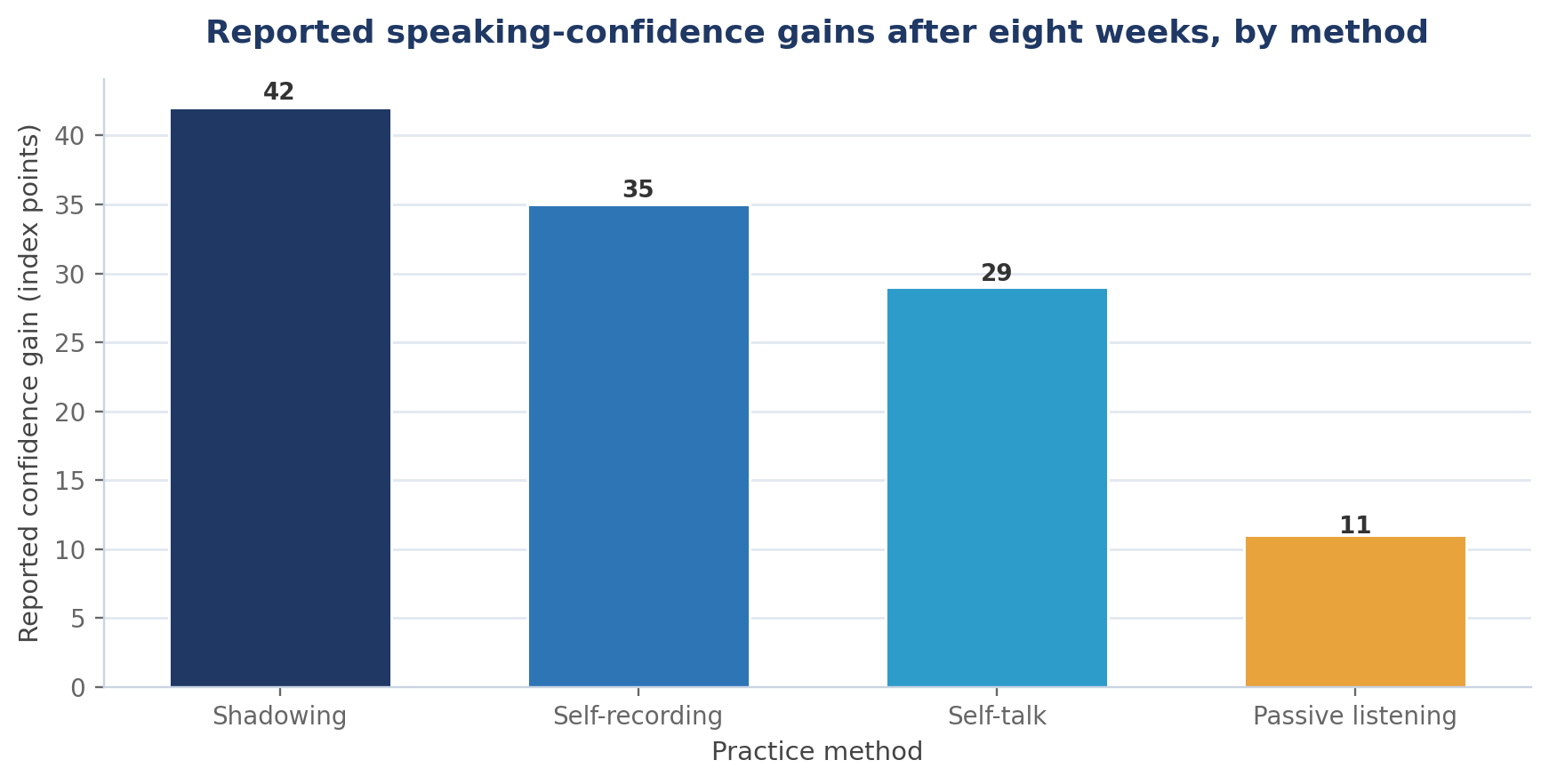
Most learners confess the same thing: I can read it, I just can't say it. That gap is not talent. It is repetitions. Speaking is a motor skill, and motor skills need daily contact — not weekly enthusiasm.
The good news is that you do not need a partner for most of the work. You need four habits: shadowing, pitch-accent awareness, self-recording, and a self-talk routine you can run on a commute.
What you will get from this guide
- Why solo practice works — and where it stops
- A four-week shadowing progression
- The pitch-accent detail almost no course teaches
- A 20-minute daily speaking routine
- The one thing a mirror can never give you
Why solo speaking practice actually works
Nobody is born with a speaking mouth. The muscles that shape ら, つ and ふ learn the same way your fingers learn a chord — by repetition, with no audience.
The Japan Foundation has argued for decades that learner autonomy is one of the strongest predictors of progress in Japanese-language education, and the CEFR framework agrees: spoken production is a named strand at every level from A1 upward. You are not waiting for permission to speak. You are waiting for reps.
Shadowing: the engine of solo fluency
Shadowing means playing native audio and speaking simultaneously, half a second behind — chasing rhythm, speed and melody rather than meaning. You are not translating. You are copying a body moving through sound.
Start with NHK World's Easy Japanese — free, graded and beautifully slow — then graduate to real news clips.
The rule that makes shadowing work: finish every clip out loud. Listening in silence feels like practice and isn't.
Pitch accent: the detail nobody teaches you
Japanese is not tonal like Mandarin, but it is pitch-accented — and the wrong contour makes perfectly correct words sound foreign. The classic proof:
Say each one with the particle が. With 箸, the pitch falls after ha. With 端, it stays level. That particle is your free pitch-accent tutor — it tells you where the contour ends.
Record yourself (yes, even though it hurts)
Your ears lie. Your phone does not. Record sixty seconds daily and score yourself against a fixed checklist.
The first playback is always cringe. That is the price of admission. Within ten days the cringe turns into curiosity — and curiosity is where improvement lives.
Your 20-minute daily self-talk routine
You do not need a partner to narrate your life. You need a skeleton and the nerve to use it out loud.
Add JLPT N5 and N4 vocabulary as fuel — those lists are packed with the high-frequency words self-narration needs. If study abroad is the goal, JASSO's guidance shows exactly what spoken level exchange programmes expect.
Ready to turn reading into real Japanese? Start your self-paced course today.
Start the Japanese course →Create a free accountTurn your solo reps into real conversations
You have built the voice. Now give it someone to talk to. The Course Pass gives you a personal AI voice tutor that teaches structured lessons and gives instant feedback on your speaking, so you can correct your pitch, rhythm and instinct in real time — at your own pace, any time.
Button: Start speaking with your AI voice tutor →
The honest limits of practising alone
Solo practice builds fluency, rhythm and confidence. It cannot build interaction.
You can rehearse forever. But conversation is a dance, and you cannot learn to follow a partner by dancing with a mirror.
That is where a personal AI voice tutor helps. It gives you structured speaking practice with instant feedback on what your phone cannot catch on its own: the pitch slip on 橋, the flattened っ, the polite form that should have been humble. Then you respond — and gradually you are improvising rather than performing. Regular guided speaking practice with feedback routinely outperforms a fortnight of mirror work.
Ready to turn reading into real Japanese? Start your self-paced course today.
Start the Japanese course →Create a free accountFind out exactly where your speaking stands
A free account gives you a spoken-level check and a practice plan built around your gaps — no card, no commitment, nothing to lose but the awkward pause.
Button: Create your free account →
Frequently Asked Questions
Can I really learn to speak Japanese without a partner? Yes — for rhythm, vocabulary and confidence. Expect a plateau on interaction skills until you practise responding to unpredictable prompts, then combine both: solo reps daily, guided speaking practice with your AI voice tutor regularly.
How long should I shadow each day? Fifteen focused minutes beats an hour of distracted listening. Consistency is the variable that matters, not duration.
Does pitch accent matter if people understand me? They will understand you, but you will not sound natural. Pitch errors are the single biggest giveaway of a beginner accent.
What is the fastest fix for a speaking plateau? Focused speaking practice with instant AI feedback that targets your specific errors. Generic advice cannot hear your accent; structured feedback on your own recordings can.
References & Further Reading
- Japan Foundation — Japanese-language education and learner research
- JLPT — Official Japanese-Language Proficiency Test levels
- NHK World — Easy Japanese, free graded audio lessons
- JASSO — Study in Japan and exchange programme guidance
- Council of Europe — CEFR levels and spoken-production descriptors