There is a strange moment every intermediate learner experiences: you say something perfectly grammatical, and a Japanese friend smiles and says 日本語、お上手ですね — and you know, instantly, that you still sound like a textbook.
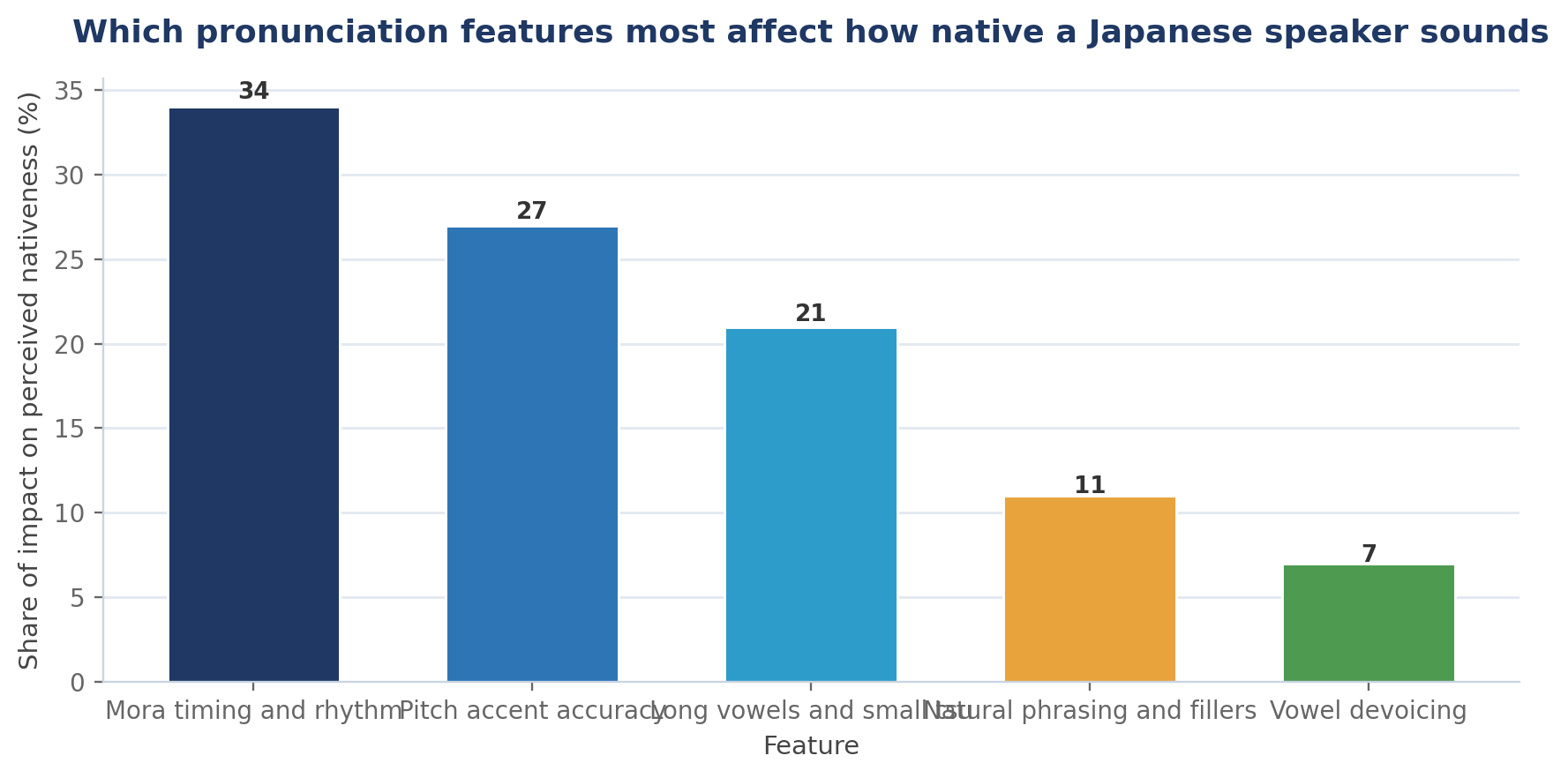
Fluency is not vocabulary. It is rhythm. Japanese listeners decide within seconds whether you sound native, and they decide it based on timing, pitch and phrasing long before they notice your grammar.
Here is what actually creates that impression, and how to build it.
What you will get from this guide
- Why rhythm matters more than vocabulary
- Pitch accent, and which patterns are worth learning
- Mora timing — the single biggest giveaway
- Contractions and fillers natives use constantly
- A daily routine to rebuild your accent
Why rhythm beats vocabulary
Native speech is a stream of beats. Japanese is mora-timed, which means every mora gets roughly equal duration — 東京 is four moras, 日本 is four moras, and both take about the same time to say.
English speakers do the opposite. We stress some syllables and swallow others, so we say TO-kyo with a heavy first beat and a crushed second. It sounds fluent to us and distinctly foreign to everyone else.
The fix is unglamorous and effective: practise clapping or tapping while you speak. One tap per mora. Within a week your mouth starts obeying the beat.
Pitch accent: what to learn and what to skip
Japanese is not tonal like Mandarin — pitch does not change word meaning the way tone does in Chinese. But it changes which word you said, and getting it wrong is the fastest way to sound foreign.
Good news: you do not need to memorise the accent of every word. You need three habits.
- Learn accent with new words only, never retro-fit old ones.
- Track the particle. If が drops after the noun, the accent falls at the end of the noun. If it stays high, the pattern is flat. The particle is a free accent tutor.
- Accept the regional reality. Japanese has several accent systems. Tokyo Japanese is the broadcast standard, but nobody expects perfection.
Mora timing: the biggest giveaway
If you fix only one thing, fix this. The classic four errors:
The long-vowel pair is worth memorising as a warning: おばさん means aunt, おばあさん means grandmother. Same letters, one extra beat, very different family member.
Contractions: the shortcut to sounding casual
Natives compress constantly, and learners rarely learn it. These contractions are normal speech, not slang.
Using ちゃった instead of てしまいました instantly shifts you from polite textbook to person who actually speaks. Just keep the register in mind — these belong in casual conversation, not in a business email.
Ready to turn reading into real Japanese? Start your self-paced course today.
Start the Japanese course →Create a free accountGet your accent corrected by an AI voice tutor that can hear it
Pitch and rhythm are almost impossible to self-diagnose — you cannot hear your own Japanese the way others do. A personal AI voice tutor listens to your speaking and gives feedback on the exact beats you are missing, at your own pace, any time.
Button: Explore the Japanese Course Pass →
Fillers and natural phrasing
Native speakers do not speak in perfectly formed sentences. They pause, hedge and rephrase — and doing the same makes you sound more fluent, not less.
The last one is quietly powerful. Saying なんていうか while you search for a word sounds like a native searching for a word — instead of a learner freezing.
A daily routine to rebuild your accent
Shadowing is the workhorse. Use NHK's graded audio at first, then graduate to real broadcasts. Twenty minutes daily for eight weeks will change how you sound more than a year of vocabulary study.
You have probably already learned enough Japanese. What is missing is the beat underneath it.
Ready to turn reading into real Japanese? Start your self-paced course today.
Start the Japanese course →Create a free accountFind out exactly what your accent is doing
A free account includes a spoken-level check so you can hear your own pitch and rhythm from the outside — the first step to fixing both.
Button: Create your free account →
Frequently Asked Questions
Do I need to learn pitch accent? You do not need every word's accent pattern, but learning accent along with new vocabulary and following the particle will dramatically improve how native you sound.
What is the biggest mistake learners make? Mora timing. English speakers stress and swallow syllables, so their Japanese sounds uneven. Even beats fix more than anything else.
How long until I sound more native? With twenty minutes of daily shadowing, most learners hear a clear difference within four to eight weeks and a substantial one within three months.
Can adults still improve their accent? Yes. Adults rarely achieve native-like pronunciation, but comprehensibility, rhythm and pitch can all be trained at any age.
References & Further Reading
- Japan Foundation — Japanese-language education and teaching resources
- NHK World — Easy Japanese, graded audio and language resources
- JLPT — Official Japanese-Language Proficiency Test levels
- JASSO — Study in Japan and daily-life guidance
- Council of Europe — CEFR levels and spoken-production descriptors