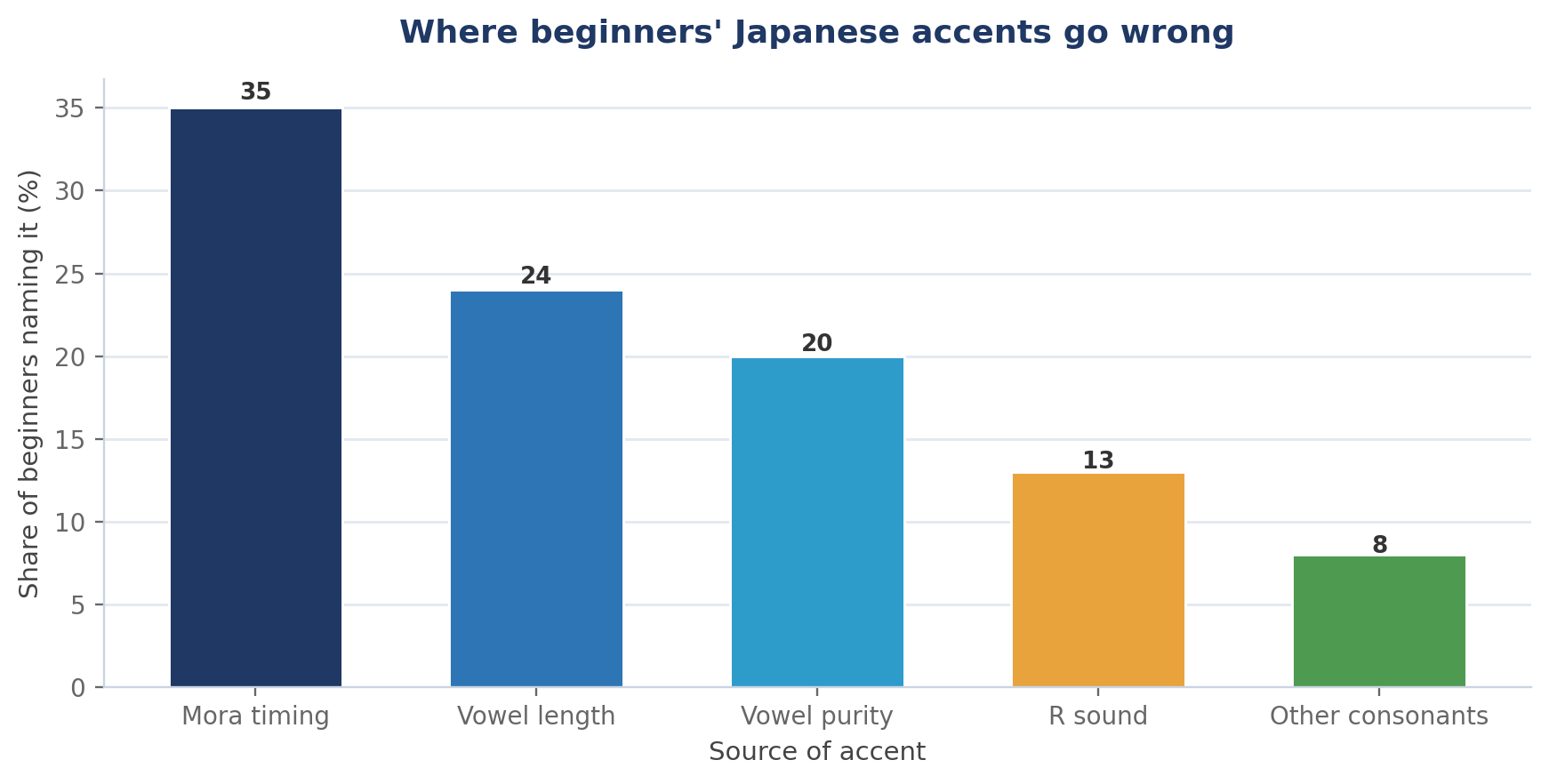
Japanese pronunciation is the friendliest part of learning Japanese. There are five vowels, no tones, no gender and no consonant clusters that will defeat you. Compared with the writing system waiting for you, the sounds are a holiday.
That said, "easy" is not "automatic". A handful of habits from English will make you sound foreign, and they are much easier to prevent in week one than to repair in year two. This guide walks through every sound you need, in order.
What you will get from this guide
- The five vowels, and the one habit that ruins them
- Every consonant worth practising, with English anchors
- Long vowels, small っ and the beats that change meaning
- A short daily routine to lock the sounds in
The five vowels: pure and short
The critical habit: do not glide the vowels. English o is really two sounds, sliding to a w. Japanese o is flat from beginning to end. Say おかね and hold the o steady — if it moves, you are speaking English with Japanese words.
The u is the second trap. English speakers round their lips; Japanese u is produced with relaxed, almost unrounded lips. Try saying "oo" without moving your lips into a circle.
The consonants, with English anchors
The r sound worries beginners more than it should. It is a single flap of the tongue against the ridge behind the upper teeth — the same motion as the tt in American English "butter" or "ladder". You have been making this sound your whole life.
Long vowels: length changes meaning
Japanese distinguishes short and long vowels, both in kana writing and in speech.
Getting these wrong is memorable in the worst way. The good news is that the fix is purely mechanical: hold the long vowel for two beats instead of one, and count them out loud when you practise.
The small っ and mora timing
Japanese counts beats, not syllables. Each beat takes about the same time, and the small っ adds a silent beat — a tiny held pause.
Clap once per beat while you say the word. This is the single fastest correction for the "foreign accent rhythm" problem, and it costs nothing to practise.
Get your sounds checked before they harden
A ten-minute AI voice-tutor assessment tells you which of these five habits is yours — timing, length, purity, or the r sound. Then drill it with your AI voice tutor until it is automatic.
Start your Japanese pronunciation check →Create a free accountPitch accent: a gentle introduction
Japanese uses pitch rather than stress, and pitch can distinguish words: はし can mean chopsticks, bridge or edge depending on the pattern.
Do not build pitch drills into your first month. Copying native audio faithfully absorbs far more correct pitch than memorising abstract patterns, and it is far less discouraging.
A ten-minute daily routine
Recording is the uncomfortable part and the most valuable. Your ear corrects what you intended to say; a recording shows what you actually said. Comparing the two is how you improve without a teacher — and a teacher speeds it up considerably.
Common beginner traps
That last row matters most in the long run. Romaji encourages English pronunciation patterns, and the sooner you read kana, the sooner the sounds come with them.
Learn the sounds with an AI voice tutor listening
A personal AI voice tutor gives you speaking practice with instant feedback on your pronunciation — the one thing self-study cannot do, because you cannot hear your own accent accurately.
Start Japanese with your AI voice tutor →Create a free accountFrequently Asked Questions
Is Japanese pronunciation easy for English speakers? The individual sounds are relatively easy — five vowels and simple consonants. The difficulty lies in rhythm, vowel length and pitch.
**How do I pronounce the Japanese r?** As a single quick tap of the tongue behind the upper teeth, like the tt in American "butter". Do not curl the tongue back as in English r.
What is the small っ in Japanese? It marks a held beat — a tiny pause before the next consonant. It changes meaning: きて is "come", きって is "stamp".
Should I learn pitch accent from the start? Not systematically. Copy native audio faithfully, and let pitch be absorbed. Formal study of accent patterns helps most from intermediate level onwards.
References & Further Reading
- Japan Foundation — Japanese-language learning resources
- NHK — NHK World Japanese lessons with native audio
- Japan Foundation — JF Japanese e-Learning Minato
- Council of Europe — CEFR descriptors for phonological control
- Japan Foundation — Survey on Japanese-language education worldwide