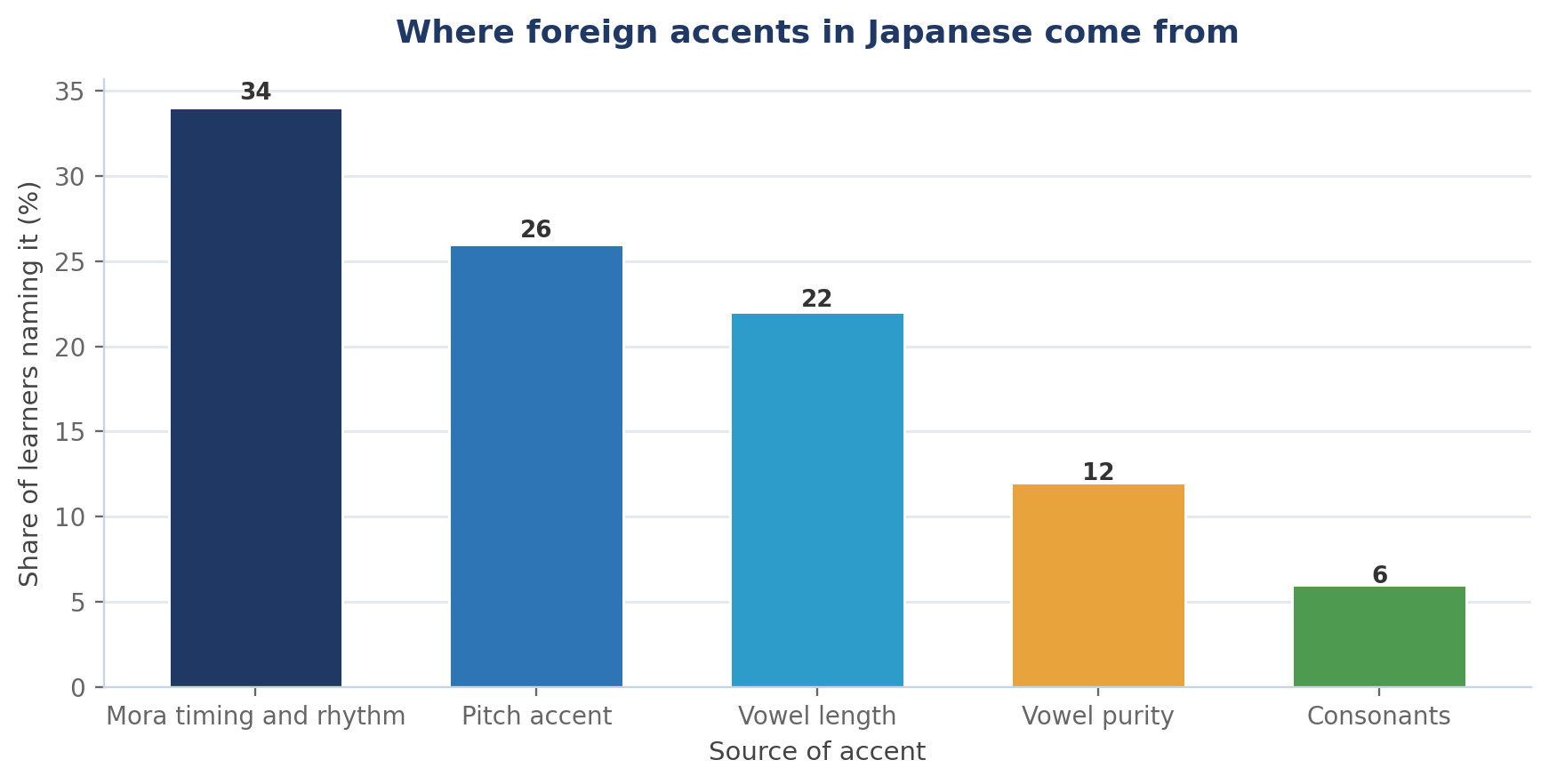
Japanese pronunciation has a reputation for being easy. Compared with Mandarin tones or French nasals, its sound inventory is small: five vowels, a tidy set of consonants, and no tones. That reputation is half true — and dangerously misleading.
The sounds are easy. The rhythm is not. Most foreign accents in Japanese come from timing, pitch and vowel length, not from individual consonants. Fix those three and you stop sounding like a textbook recording that has been stretched.
What you will get from this guide
- Why mora timing matters more than individual sounds
- The vowel habits English speakers must break
- How pitch accent works, and how much to worry about it
- A daily routine that actually changes your accent
The mora: Japan's rhythmic unit
Japanese does not count syllables the way English does. It counts morae — beats. Each one takes roughly the same amount of time, and this consistency is what makes Japanese sound even and machine-gun steady.
Notice gakkō: the small っ adds a silent beat, and the long ō counts as two. English speakers compress these, which is precisely why they sound foreign. The fix is physical: clap or tap the beat while you say the word, one tap per mora.
Vowels: five sounds, held steady
Two habits must go. First, English speakers diphthongise — o becomes "oh-oo". Japanese vowels are pure, start to finish. Second, they round the u, but Japanese u is produced with relaxed, almost unrounded lips. Desu is not "desoo"; it is a short, flat sound often barely voiced at the end.
Long vowels and small っ change meaning
Length is not decoration in Japanese. It is information.
Saying obaasan when you mean obasan is a real, memorable mistake — the kind of error that is funny once and irritating twice.
Find out exactly which habits give you away
A short AI speaking assessment identifies your three biggest pronunciation issues in ten minutes — timing, pitch or vowels. Then you drill them with your AI voice tutor until they stick.
Take a Japanese speaking assessment →Create a free accountPitch accent: how much should you care?
Japanese uses pitch to distinguish words, but in a gentler way than Chinese uses tone. Hashi can mean chopsticks, bridge or edge depending on the pitch pattern.
The practical rule: learn pitch as part of the word, the way you learn stress in English. Do not build separate pitch drills early; just copy audio accurately, phrase by phrase. Learners who shadow faithfully absorb more correct pitch than learners who memorise rules.
The daily routine that works
Recording is uncomfortable and unavoidable. Your ear forgives your accent while you are speaking; the recording does not, and the comparison between you and the native clip is the most honest feedback you will ever get for free.
Consonants: the small remaining list
Do not treat r as an impossible hurdle. It is a single flap of the tongue — the same motion as the tt in the American pronunciation of "butter".
Why real-time feedback beats self-study for pronunciation
You cannot hear your own accent accurately. This is not a motivational claim; it is a perceptual fact. Your brain predicts what you intended to say, which is why your recording surprises you. That prediction gap is exactly what real-time feedback closes.
Pronunciation improves fastest when someone says, in real time, "shorter — that vowel is too long". Five minutes of that beats an hour of guessing.
Practise pronunciation with someone who can hear it
Self-paced AI voice-tutor lessons give you instant feedback on timing, pitch and vowels — the three things self-study cannot diagnose. Short, focused sessions, any time.
Practise Japanese pronunciation with your AI tutor →Create a free accountFrequently Asked Questions
Is Japanese pronunciation easy to learn? The individual sounds are relatively easy for English speakers, but mora timing, vowel length and pitch take deliberate practice. Most learners underestimate the rhythm.
Do I need to learn pitch accent? Not exhaustively. Copying native audio faithfully from the start absorbs much of it naturally. Systematic study helps most at intermediate level and beyond.
How long does it take to improve Japanese pronunciation? Noticeable change comes within four to eight weeks of daily ten-minute practice, with real comfort after three to six months of regular speaking.
Should I learn romaji pronunciation first? Use audio as your primary model and kana as your reference. Romaji encourages English pronunciation habits, especially dipping vowels and compressing long sounds.
References & Further Reading
- Japan Foundation — Japanese-language learning resources
- Japan Foundation — JF Japanese e-Learning Minato
- NHK — NHK World Japanese lessons with audio
- Council of Europe — CEFR descriptors for phonological control
- Japan Foundation — Survey on Japanese-language education worldwide