You studied for months. You built a solid vocabulary, drilled kanji until your eyes blurred, and then ordered coffee in Tokyo — and the barista tilted her head like you had spoken in algebra. Nothing is more deflating. The good news: the Japanese pronunciation mistakes that trip up learners are remarkably predictable, and almost all of them are fixable in weeks, not years. This guide walks through the ten that genuinely affect intelligibility, gives you a repair for each, and shows you why a corrective ear still beats a flashcard deck.
Why These Mistakes Slip Past You
Japanese looks forgiving on paper. Five vowels, tidy syllables, no gnarly consonant clusters. But that surface simplicity hides a language built on timing — and your English-speaking brain is a timing machine wired for stress, not duration. So you say what looks right and hear what you expect, while a native listener hears a different word entirely. That gap between production and perception is exactly why self-study plateaus, and why the fixes below need a mirror you can trust.
The Ten Mistakes That Break Intelligibility
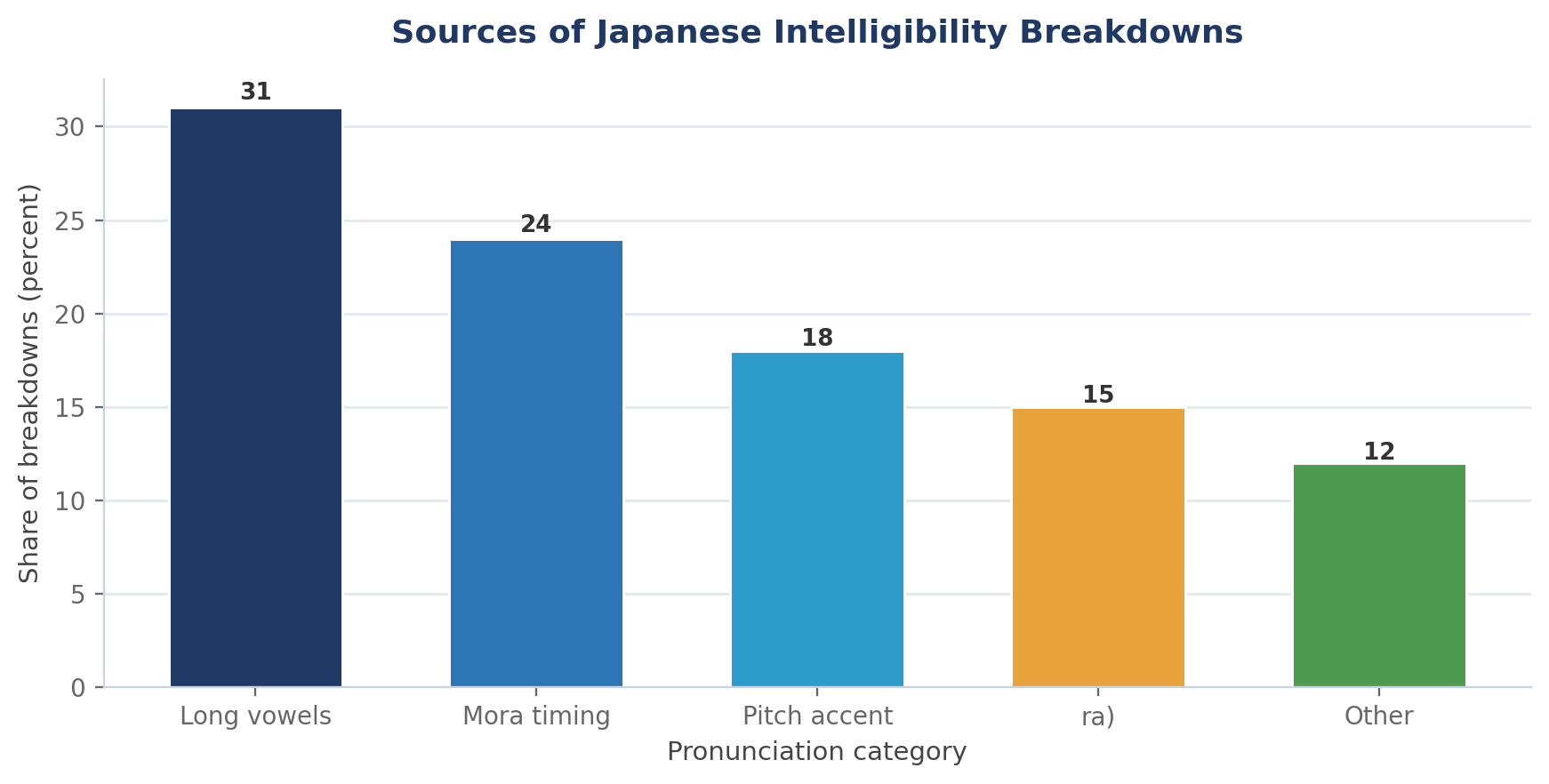
Not every accent quirk matters. These ten do, because each one flips meaning or forces the listener to decode you instead of listen to you. Here is roughly how often each category shows up when intelligibility breaks down:
Rhythm, Length, and Timing
Mora timing is the heartbeat of Japanese. Every mora gets roughly equal time, and getting that wrong causes more confusion than any single consonant.
Consonants That Give You Away
Four segments carry a disproportionate load, and three of them simply do not exist in English.
Pitch Accent and Borrowed Words
Pitch accent is the mistake learners forgive themselves for — and the one that makes fluency sound beginner. Japanese distinguishes words by high-low melody, not volume, and CEFR phonological control descriptors treat this contour work as an advanced skill for good reason.
Learn the sounds your ears keep missing
You can read the fixes, but hearing your own errors is nearly impossible alone. Your AI voice tutor catches your long vowels, your flat pitch, and your runaway っ in real time — then drills them until they stick.
Start your Japanese speaking practice →Create a free accountDrills That Actually Rewire Your Mouth
Pronunciation is a motor skill, so passive listening will not cut it. Ten focused minutes a day beats an hour of background anime. Use the NHK World Easy Japanese audio as your model voice and run this rotation.
Record yourself saying おばあさん and おばさん in a sentence, then play it back against a native clip. If you cannot state exactly which one you produced, that is your proof that self-assessment has limits.
How a Corrective Ear Hears What You Cannot
Here is the humbling truth: your brain filters your own voice to match your intention. You meant a long vowel, so you hear one. A trained ear does not share that filter, and it is calibrated to the exact interference patterns English speakers produce.
This is why the Japan Foundation emphasizes interactional speaking over isolated drills, and why the JLPT listening sections feel brutal to learners who never had a corrective ear. Improvement compounds when something tells you which mora drifted — not just that something feels off.
Start hearing yourself the way natives do
Create a free account to save your drill log, track your accent patterns, and pair your practice with an AI voice tutor that corrects in the moment. Your accent improves fastest when something else is listening.
Create your free account →Create a free accountYour 10-Minute Daily Routine
Clap the morae. Shadow one minimal pair. Read a short passage at half speed. Record one sentence and compare it. Do that daily for three weeks and the big four — long vowels, small っ, mora timing, and devoiced vowels — will feel automatic. Pitch accent takes longer, so attach it to vocabulary from day one rather than bolting it on later. Learners who want structure alongside self-study can lean on JASSO study resources and NHK World Easy Japanese for graded audio.
FAQ
Are Japanese pronunciation mistakes really that important if people understand me? Mostly, yes — because the ten above are the ones that flip meaning. Being understood matters more than sounding native, but a slipped long vowel can turn a family member into a stranger.
How long does it take to fix pitch accent? Expect several months of deliberate practice. Consonants and timing improve in weeks with drills; pitch accent needs vocabulary-by-vocabulary attention and a corrective ear.
Can I fix pronunciation without a tutor? You can fix the mechanical mistakes, like ふ and ら, alone. You cannot reliably fix what you cannot hear, which is why recorded comparison and corrective feedback matter so much.
Should I learn pitch accent from the start? Yes. Unlearning a flat melody later is harder than building the correct contour alongside each new word.