Here is the fact that saves candidates weeks of misdirected effort: the JLPT has no speaking section. Not at N4, not at N5, and not at N1. The exam tests reading, listening, vocabulary and grammar, and nothing else. There is no oral component, no interview, and no recorded speaking task anywhere on the paper.
So why does the phrase "JLPT N4 speaking" turn up everywhere? Because the ability the exam does not test is the ability learners most want, and because several Japanese exams that are not the JLPT do include an oral interview. The result is a confusion that wastes study time in both directions. Candidates who want certified speaking skill prepare for a section that does not exist, and candidates who read that "there is no speaking" conclude that speaking does not matter.
Neither is right. What follows is an honest breakdown of what actually tests Japanese speaking, what an N4-level speaker should be able to do, and the sample answers you should rehearse so that your Japanese works in a room, not just on a multiple-choice answer sheet.
What Actually Tests Japanese Speaking
Once you know the JLPT has no oral section, the sensible next question is which exams do. The short answer is that speaking assessment in Japanese sits largely outside the standard proficiency ladder.
Two conclusions follow. First, if your goal is a certificate, no part of your JLPT preparation time needs to go into an oral drill. Second, if your goal is to actually speak, the certificate will not prove it, and you will have to build and demonstrate that ability separately.
This is exactly why so many learners who pass N4 with a comfortable score still freeze on their first video call with a Japanese colleague. The exam rewarded recognition. Life demands production. The two are related but not identical, and the gap has to be closed deliberately.
What an N4-Level Speaker Can Actually Do
The Japan Foundation publishes a set of can-do descriptors for each level, and they are a far better guide than any exam paper. Stripped of official phrasing, an N4-level speaker can do the following in real time.
Notice how much of that list is transactional. N4-level speaking is not debate or storytelling. It is the ability to conduct ordinary life in Japanese without switching to English, and that is a genuinely useful and achievable target.
The Twelve Situations Worth Rehearsing
Speaking improves fastest when the practice is tied to specific situations rather than to grammar points. These twelve cover the overwhelming majority of an N4 learner's real-world needs.
The last row is the one most learners never practise, and the one that causes the most discomfort. Japanese refusal usually works by trailing off rather than by saying no. ちょっと followed by a pause is a complete and polite refusal, and learning to leave the sentence unfinished is a genuine skill.
Where Speaking Practice Time Should Go
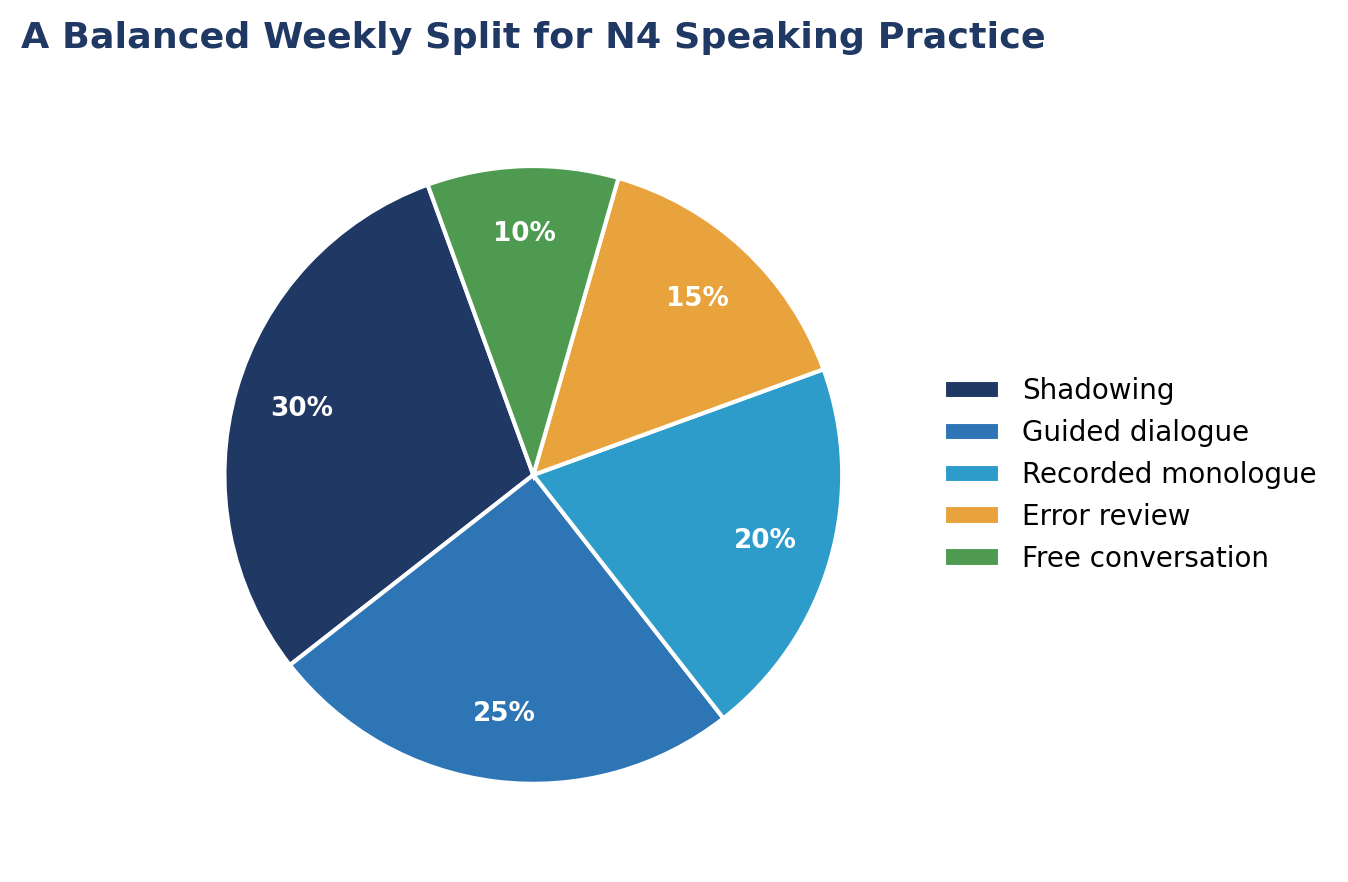
If your goal is functional N4-level speech and not exam credit, the weekly minutes matter more than the method. Here is a distribution that works for most learners at this stage.
Shadowing takes the largest share, and that surprises people. It earns its place because it trains rhythm, not vocabulary. N4 learners rarely fail to be understood because of a missing word. They fail because the pitch and length of their syllables are wrong, and no amount of grammar study fixes that.
The Shadowing Routine That Changes Your Accent
Shadowing means speaking along with a recording, half a beat behind, copying everything including hesitation and intonation. It is uncomfortable for the first week and transformative by the fourth.
The final step is the one people skip and the one that produces the fastest correction. You cannot hear your own accent while you are speaking. You can hear it perfectly ten seconds later on a recording, which is why the review matters more than the repetition.
Sample Answers You Can Rehearse Today
These four answers are written at a genuine N4 level — plain forms, ordinary vocabulary, correct politeness, and nothing that would sound like a textbook recitation.
Tell me about your typical day.
毎朝六時に起きます。まずコーヒーを飲んで、それから七時半に家を出ます。会社まで電車で四十分ぐらいかかります。仕事は九時から六時までです。夜は家で日本語を勉強します。
What did you do last weekend?
土曜日は友だちと映画を見ました。日本の映画で、とてもおもしろかったです。そのあと、駅の近くのレストランで晩ごはんを食べました。日曜日は家でゆっくり休みました。
What are your plans for next year?
来年、日本へ旅行に行くつもりです。三週間ぐらい滞在したいです。京都と東京に行って、それから北海道にも行きたいと思っています。そのために、今、日本語を一生懸命勉強しています。
Why are you studying Japanese?
日本の文化が好きだからです。特にアニメと料理に興味があります。将来、日本で働きたいので、日本語が必要です。まだ上手ではありませんが、毎日少しずつ練習しています。
Read each one aloud three times, then close the page and say it from memory. Then change one detail — a different time, a different city, a different reason — and say it again. Fluency grows from variation, not from repetition alone.
Turn model answers into your own answers
Reciting a script is a rehearsal. Being asked an unexpected follow-up question is the real test. With a personal AI voice tutor, you can practise speaking any time and get instant feedback — which is precisely where fluency is built.
Start learning with your AI voice tutor →Create a free accountAssessing Yourself Without an Examiner
You do not need a rater to know whether you are improving. Score yourself on these four dimensions after every recording, using a simple one to five scale, and keep the numbers in a notebook.
Write the date beside each set of scores. Three weeks of entries will tell you more about your speaking than any single lesson report, because the trend matters far more than the raw number.
Six Mistakes That Slow Speaking Progress
The first two mistakes account for most of the disappointment learners feel after passing N4. The certificate is real and worth having, but it is not evidence of speech, and no exam paper will ever prompt you to open your mouth.
Practice Frames
Answer each prompt aloud in a full sentence within five seconds. Accuracy comes second; the pause is the thing being trained.
Run the whole set twice. The first pass is for correctness, the second for speed. On the second pass, do not stop to repair a mistake — keep going, as you would in a real conversation where the other person is still listening.
Make the second pass your habit
Anyone can produce a correct sentence slowly. The N4 level is the ability to produce it at speed, in a room, with someone waiting. A Course Pass gives you a personal AI voice tutor to practise with any time, until the pause stops arriving.
Get started for free →Create a free accountFrequently Asked Questions
Does the JLPT N4 have a speaking test? No. The JLPT has no speaking section at any level, from N5 to N1. It tests vocabulary, grammar, reading and listening only.
Then what exam should I take if I need a speaking certificate? It depends on your purpose. Institutions frequently run their own oral interviews, and private bodies offer recorded oral proficiency interviews with trained raters. Check the requirement of the school or employer first.
Can I pass N4 without ever speaking Japanese? Yes, and many candidates do. It is also why so many N4 holders cannot hold a basic conversation. If speaking matters to you, build the practice in separately.
How long does it take to speak at an N4 level? With regular speaking practice, many learners reach functional N4 speech after several months of study at the level, on top of the time spent building vocabulary and grammar.