Every year, candidates walk out of the JLPT N4 convinced they have passed, and a meaningful number of them are wrong. Not because they did badly — but because they misunderstood how the score is calculated.
The JLPT does not average your performance, does not convert to a percentage, and does not let a strong section cover for a weak one. It reports your result in two sections with fixed maxima, applies three separate conditions, and requires all three to be met.
Know the structure precisely and you can predict your own result before the scores are published. That is worth a lot of exam-day calm.
What N4 Measures
Like every JLPT level, N4 has no productive component. It tests comprehension.
The Two Scoring Sections
You sit three papers, but your result is reported in two sections.
Papers one and two merge for reporting, which is why a strong vocabulary performance can rescue a weak reading performance within that 120.
The Three Papers and the Clock
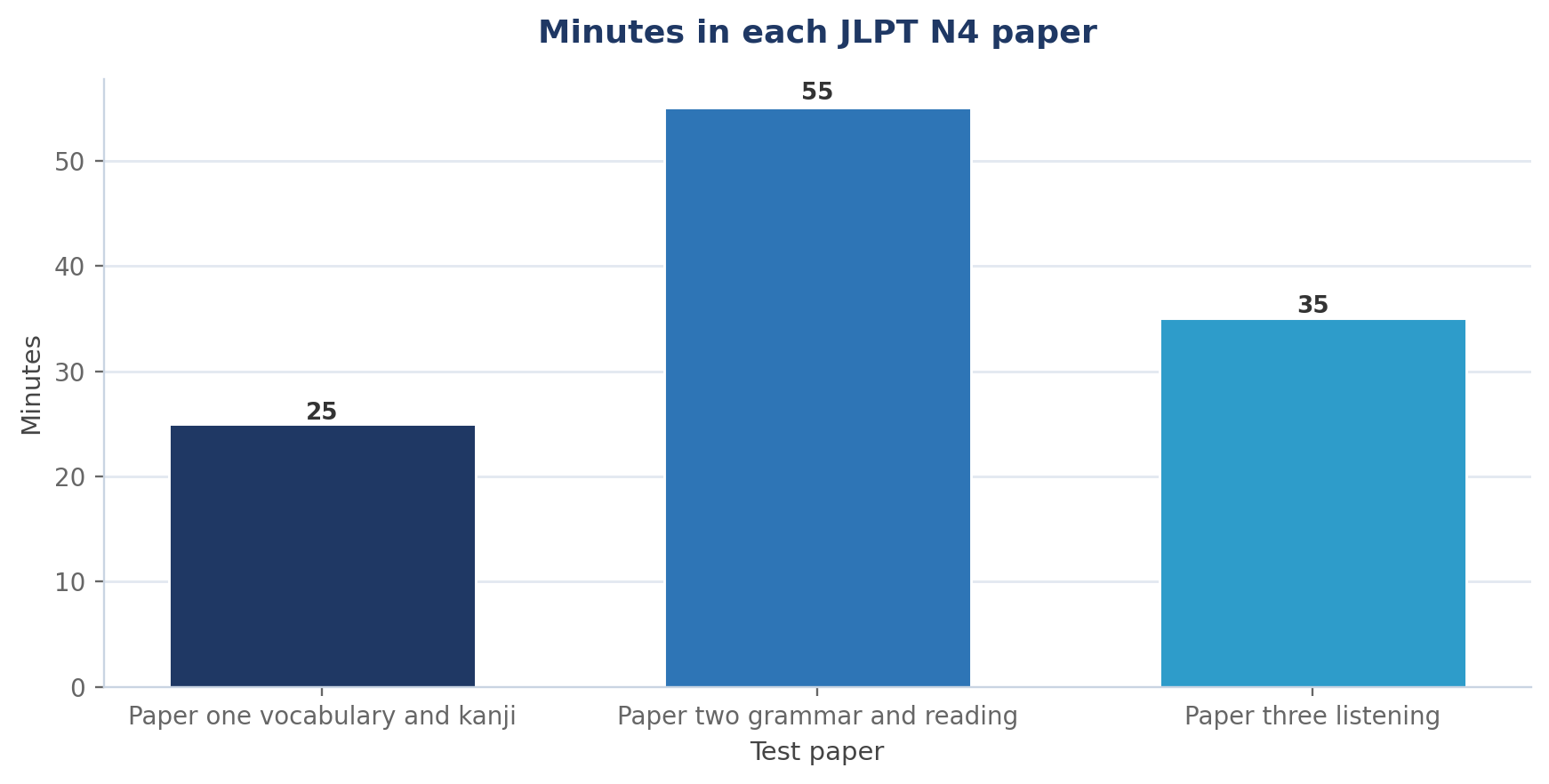
N4 takes 115 minutes, with a break before the listening paper.
Paper two is more than twice the length of paper one, and it is where the majority of time-management failures happen.
The Three Pass Conditions
All three must hold. Two out of three is a fail.
Sectional Minimums in Practice
The rules only make sense once you see them applied. These are realistic combinations.
Look hard at row two. A hundred and five marks out of a hundred and eighty, and still 不合格, because seventeen in listening broke the floor.
Item Types by Paper
Knowing the item types is worth more than knowing the theory, because N4 rewards pattern recognition under time pressure.
How the Score Is Reported
Because there is no expiry, a failed attempt costs time rather than eligibility, and many candidates sit the exam once purely to experience the format.
What N4 Does Not Include
How the Format Should Shape Your Study
The scoring structure tells you where to spend hours. Most candidates over-invest in kanji and under-invest in listening.
Common Misconceptions
Format knowledge protects you from the most expensive mistake
The listening floor fails more N4 candidates than anything else, and it is trained by hearing Japanese at natural speed. A personal AI voice tutor with speaking and listening practice does exactly that, at your own pace, any time. Prepare with self-paced Japanese lessons →
Start the Japanese course →Create a free accountPractice Frames
Predict your own N4 result
Study structured A1 to B2 lessons with a personal AI voice tutor, at your own pace, any time. Start your self-paced Japanese course →
Start the Japanese course →Create a free accountFrequently Asked Questions
What is the total score for JLPT N4? 180 marks, split into 120 for language knowledge and reading and 60 for listening.
What is the JLPT N4 passing score? 90 of 180 overall, plus at least 38 of 120 in language knowledge and reading, plus at least 19 of 60 in listening.
How long is the JLPT N4 test? 115 minutes across three papers: 25 minutes for vocabulary and kanji, 55 minutes for grammar and reading, and 35 minutes for listening.
Does the JLPT N4 have a speaking section? No. The JLPT tests reading and listening comprehension only, at every level.